
How many sentences in a paragraph? There is no fixed rule, but most well-built paragraphs have 3 to 8 sentences, which usually works out to about 100 to 150 words. A paragraph ends when its idea ends, so one sentence can be enough and ten can be fine.
The five-sentence rule you learned in school was a training tool, not a law. Below you'll find what writing centers and style guides actually say, typical lengths for essays, web pages, news and fiction, a table of how many paragraphs you need for 300 to 3,000 words, and simple ways to tell when a paragraph is too long or too thin.
How many sentences in a paragraph is normal?
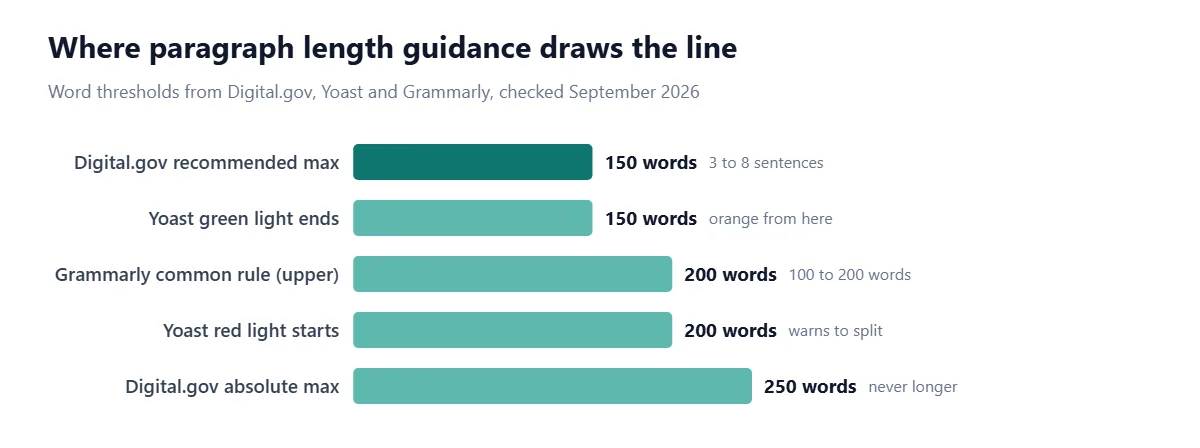
Most published guidance lands in the same place. The U.S. government's plain language guide says writing experts recommend paragraphs of "no more than 150 words in three to eight sentences," and adds that paragraphs should never be longer than 250 words (Digital.gov).
Writing centers add a point that matters just as much: length is not what makes a paragraph. The UNC Writing Center says that "length and appearance do not determine whether a section in a paper is a paragraph" and defines a paragraph as a sentence or group of sentences that support one main idea (UNC Writing Center). Purdue OWL's version is shorter: keep one idea to one paragraph (Purdue OWL).
So the useful answer has two parts. Use 3 to 8 sentences as a sanity check, and let the idea decide where each paragraph actually stops.
Where the five-sentence rule came from
Many students are taught that a paragraph needs five sentences: a topic sentence, three supporting sentences and a closing sentence. UNC lists "a group of at least five sentences" as a common student definition, then explains why it doesn't hold up.
The rule exists for a good reason. It forces beginners to support a claim instead of just stating it. Grammarly makes the same point, describing sentence counts as a way teachers push students to develop their ideas rather than a hard limit (Grammarly).
Ask a room of teachers how many sentences in a paragraph is right and you'll hear several answers. Texas A&M's writing center notes that, depending on who taught you, a paragraph should be at least three sentences, or five, or three to seven, or eight (Texas A&M Writing Center). None of those numbers is wrong. They are all rough ranges for the same goal: one idea, fully explained.
How many sentences in a paragraph by type of writing
There's no single answer to how many sentences in a paragraph you need, because the right length depends on where the text will be read. A research paper and a news story have different jobs, and their paragraphs look different. The first two columns are typical ranges; the last column is what the cited guides say.
Type of writing | Typical sentences | Typical words | What the guidance says |
|---|---|---|---|
Academic essay | 4 to 8 | 100 to 200 | Purdue: be wary of 2 to 3 sentences |
Web page | 3 to 8 | under 150 | Digital.gov: 150 max, never over 250 |
Blog post | 2 to 6 | under 150 | Yoast: warns above 150 words |
News story | 1 to 3 | 25 to 75 | No more than 3 sentences |
Fiction | 1 to 10+ | varies | New paragraph for each speaker |
Business email | 1 to 4 | under 80 | Rule of thumb: one point each |
Academic essays and research papers
In an essay, each body paragraph carries part of the argument: a claim, evidence, your explanation of that evidence, and a link back to the thesis. That rarely fits in fewer than four sentences. Purdue OWL warns that a paragraph of only two or three sentences is probably not fully developed, and suggests ways to build it out, such as examples, data, quotations, definitions and comparison.
If you're planning a whole paper, our guide to how long an essay is shows typical word counts by essay type.
Web pages and blog posts
People scan screens, and a 150-word paragraph that looks fine on a laptop can fill a phone screen. Digital.gov's 150-word ceiling is a good target. The Yoast SEO plugin uses a traffic light: green below 150 words, orange from 150 to 200, red above 200, and it also says a paragraph should generally be more than two sentences (Yoast).
For more on structuring long online articles, see how long a blog post should be.
News writing
Newspapers use the shortest paragraphs. A University of Arkansas journalism textbook tells reporters to write paragraphs of "typically no more than three sentences," to keep sentences to about 25 words, and to give each direct quote its own paragraph (University of Arkansas). Narrow columns are part of the reason: three lines on a laptop can be ten lines in a newspaper column.
Fiction and creative writing
Fiction follows rhythm more than rules. A long descriptive paragraph slows the pace, and a short one speeds it up. That's why action scenes often use quick, short paragraphs, while reflective passages can stretch out. The one firm convention is dialogue: start a new paragraph every time the speaker changes, even if a character says a single word (University of Hull).
How many words is a paragraph?
Most paragraphs run about 100 to 150 words, and Grammarly cites 100 to 200 words as one common rule. Words are actually a better gauge than sentences, because sentence length varies so much. Five sentences of 30 words make a 150-word paragraph. Five sentences of 12 words make only 60.
Sentences | Short (12 words each) | Medium (20 words each) | Long (28 words each) |
|---|---|---|---|
3 | 36 words | 60 words | 84 words |
5 | 60 words | 100 words | 140 words |
8 | 96 words | 160 words | 224 words |
10 | 120 words | 200 words | 280 words |
The pattern is easy to see. If your sentences are long, fewer of them fit before a paragraph feels heavy. Eight long sentences already pass Yoast's red line at 200 words. The Sentence Counter shows your average sentence length and flags any sentence over 25 words, which is often the real cause of a bloated paragraph.
How much is a paragraph on a page?
UNC notes that many students think of a paragraph as "half a page long." That is a fair picture for academic writing. At about 250 words per double-spaced page, a 150-word paragraph fills a little over half a page. Single-spaced, at roughly 500 words per page, the same paragraph takes up under a third.
If a single paragraph fills a whole double-spaced page, it almost always holds more than one idea. The Words Per Page Calculator shows how your font, spacing and margins change these numbers.
How many paragraphs is 300, 500 or 1,000 words?
Divide your word count by 100 to 150 to get a range. Introductions and conclusions are often shorter than body paragraphs, so the lower count fits essays with long, developed paragraphs and the higher count fits web copy.
Total words | Paragraphs at 150 words | Paragraphs at 100 words | Typical use |
|---|---|---|---|
300 | 2 | 3 | Short answer, cover letter body |
500 | 3 to 4 | 5 | Short essay, blog intro post |
750 | 5 | 7 to 8 | Op-ed, personal statement |
1,000 | 7 | 10 | Standard essay or article |
1,500 | 10 | 15 | Long essay, feature |
2,000 | 13 to 14 | 20 | Long blog post |
3,000 | 20 | 30 | Report or term paper |
A classic five-paragraph essay of 500 words has paragraphs of about 100 words each, which sits right inside the normal range. A 650-word college application essay works out to roughly 4 to 7 paragraphs, depending on how much each one develops.
Is a one-sentence paragraph okay?
Yes, when it's a choice. Digital.gov says there is nothing wrong with an occasional one-sentence paragraph, and UNC points out that in journalistic writing a paragraph can be just one sentence long. Texas A&M adds that a single-sentence paragraph surrounded by longer ones draws extra attention, which makes it a good tool for emphasis. For example, after two long paragraphs describing a product launch that went badly, a single line such as "Then the reviews came in." works as a turn. Buried at the end of a long paragraph, the same line would lose most of its force.
The trouble starts when one-sentence paragraphs happen by accident. In an academic essay, a lone sentence usually means one of two things: the point needs evidence, or it belongs with the paragraph before or after it. Several one-line paragraphs in a row on the same topic should normally be merged.
When to start a new paragraph
Purdue OWL lists four moments to break: when you start a new idea, when you contrast information or ideas, when readers need a pause, and when you end an introduction or start a conclusion. For dialogue, add a fifth: each new speaker.
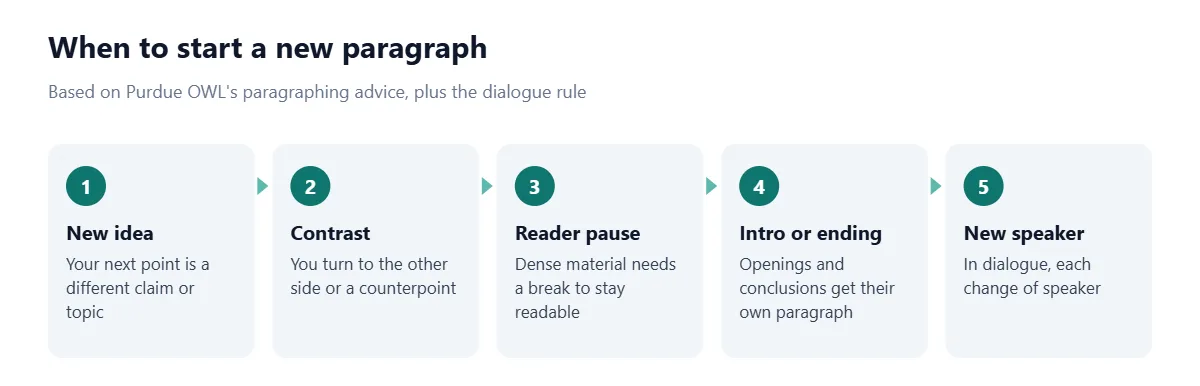
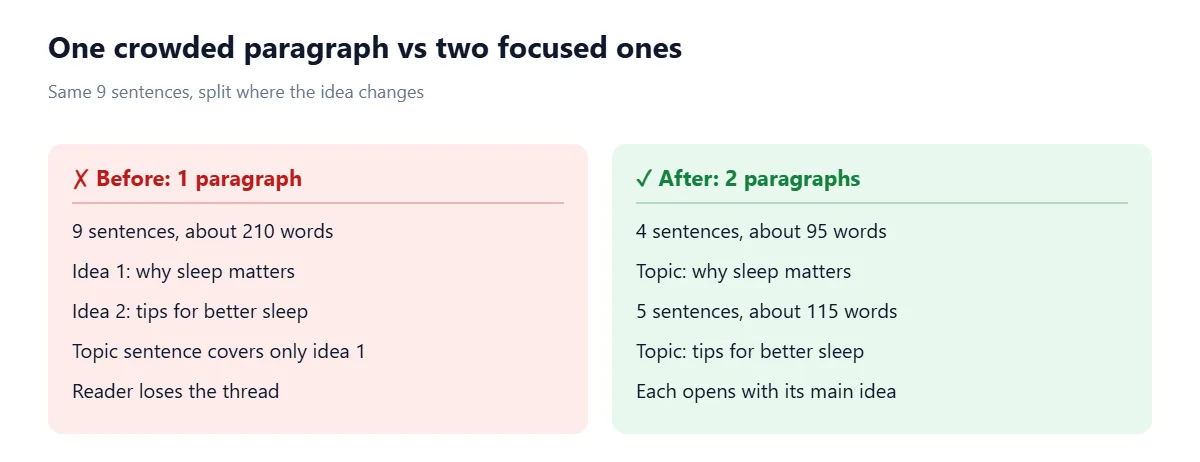
Notice that none of these signals is a number. A count only helps you spot paragraphs worth a second look. If you've written nine sentences and they all serve one idea, the paragraph may be fine. If you've written four and they cover two ideas, split it, as UNC advises.
Signs a paragraph is too long or too short
Use these quick checks when you revise. They catch more problems than counting sentences alone.
Too long: the topic sentence no longer describes the last few sentences; the paragraph passes 200 words; it fills most of a phone screen; or you can find a natural spot where a new point begins.
Too short: a claim appears with no evidence or explanation; three or more short paragraphs in a row discuss the same idea; or the paragraph reads like a list squeezed into prose.
Uneven: one paragraph is three times longer than its neighbors. That usually means it's doing two jobs.
Very long sentences make paragraphs feel heavier than their sentence count suggests. If a sentence keeps adding clauses with commas, it may also be a run-on sentence.
How to check paragraph length in your own writing
Paste your draft into the Word Counter. It shows words, sentences and paragraphs together.
Divide total words by the number of paragraphs to get your average. Between 60 and 150 is a healthy range for most writing.
Scan for outliers: any paragraph over 200 words or any lone sentence you didn't intend.
Run long paragraphs through the Sentence Counter to see whether a few very long sentences are the cause.
Split at the point where the idea changes, then give each new paragraph a clear first sentence.
Here's a worked example. A 1,200-word essay with 6 paragraphs averages 200 words each, which is long for most readers. If two of those paragraphs each hold two ideas, splitting them gives 8 paragraphs averaging 150 words, right at Digital.gov's suggested ceiling. You haven't cut a word, but the essay is easier to follow because each paragraph now makes one point.
Asking how many sentences in a paragraph is a good starting question, but the better question is how many ideas. One idea per paragraph, explained well, will usually land you in the 3-to-8 range without counting.
Frequently asked questions
How many sentences in a paragraph is standard?
Most paragraphs have 3 to 8 sentences. Plain language guidance from Digital.gov recommends no more than 150 words in three to eight sentences.
How many sentences in a paragraph for an essay?
Body paragraphs in an essay usually have 4 to 8 sentences: a topic sentence, evidence, explanation and a link to the thesis. Purdue OWL warns that two or three sentences is often too few to develop an idea.
How many words is a paragraph?
A typical paragraph is about 100 to 150 words. Some guides allow up to 200, and Digital.gov says a paragraph should never exceed 250 words.
Can a paragraph be one sentence?
Yes. One-sentence paragraphs are common in news writing and fine for emphasis elsewhere, but in academic essays they usually mean an idea needs more support or belongs with a neighboring paragraph.
How many sentences in a paragraph is too many?
There is no hard maximum, but once a paragraph passes about 8 sentences or 200 words, check whether a second idea has crept in. Ten sentences can work if they all support one point.
How many paragraphs is 500 words?
About 3 to 5 paragraphs, at 100 to 150 words each. A five-paragraph essay of 500 words has paragraphs of roughly 100 words.
How many paragraphs is 1,000 words?
About 7 to 10 paragraphs if each one is 100 to 150 words. Web articles tend toward the higher number because their paragraphs are shorter.
What is the minimum number of sentences in a paragraph?
One. There is no grammatical minimum, though most developed paragraphs in essays and reports need at least three sentences.
Sources
Digital.gov. Clear and short. U.S. General Services Administration.
The Writing Center, UNC Chapel Hill. Paragraphs.
Purdue Online Writing Lab. On paragraphs. Purdue University.
Texas A&M University Writing Center. In a Word: Paragraph length.
Grammarly. How long is a paragraph?.
Yoast. Paragraph length check: why and how to write shorter paragraphs.
King, W. Paragraph length and story starts. University of Arkansas Pressbooks.
University of Hull Library. Formatting dialogue: basic rules.

Comments