
A run-on sentence is two or more independent clauses (complete sentences) joined without the punctuation or conjunction they need. "I love this song it reminds me of summer" is a run-on, because two full sentences crash into each other with nothing between them.
Run-ons are a common error in essays and emails, and they're easy to fix once you can see them. This guide shows both types, a table of examples with corrections, five fixes, the "however" trap that catches careful writers, and why a long sentence is not automatically a run-on.
What is a run-on sentence?
Merriam-Webster defines a run-on sentence as "a sentence containing two or more clauses not connected by the correct conjunction or punctuation" (Merriam-Webster). The term has been in use since 1914.
The key idea is the independent clause: a group of words with its own subject and verb that could stand alone as a sentence. "The bus was late" is one. "I missed the exam" is another. Put them side by side with nothing to tell the reader how they relate, and you have a run-on. UNC's writing center describes it as joining two complete sentences together "without separating them properly" (UNC Writing Center).
A dependent clause such as "because the bus was late" can't stand alone, so it can never cause a run-on on its own. The problem only arises when two clauses that could each be full sentences are glued together badly.
The two types of run-on sentence
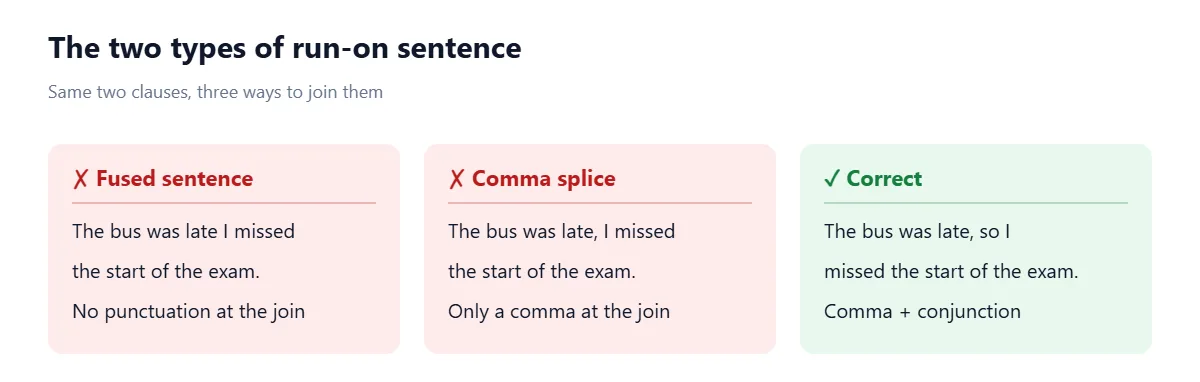
Fused sentence
A fused sentence joins two independent clauses with no punctuation or linking word at all. It's the classic run-on, and UNC notes that run-ons are "also called fused sentences" (UNC).
"My phone died I couldn't call you."
"The museum is free on Sundays we should go then."
Comma splice
A comma splice joins two independent clauses with only a comma. Merriam-Webster defines it as "the use of a comma between coordinate main clauses not connected by a conjunction," with the example "nobody goes there anymore, it's boring" (Merriam-Webster).
"My phone died, I couldn't call you."
"The museum is free on Sundays, we should go then."
Grammar guides don't all use the terms the same way. Some use "run-on" only for fused sentences and treat comma splices as a separate error, while most treat the comma splice as a special type of run-on (Wikipedia, Comma splice). The fix is the same either way.
Run-on sentence examples (and how to fix them)
Run-on | Type | Corrected |
|---|---|---|
I studied all night I still failed. | Fused | I studied all night, but I still failed. |
The café was full, we went home. | Comma splice | The café was full, so we went home. |
She loves hiking she goes every weekend. | Fused | She loves hiking; she goes every weekend. |
It's raining, take an umbrella. | Comma splice | It's raining. Take an umbrella. |
The report is due Friday, however, nobody has started. | Comma splice | The report is due Friday; however, nobody has started. |
Dogs need exercise they get restless without it. | Fused | Dogs need exercise because they get restless without it. |
I called the office, they said to email instead. | Comma splice | When I called the office, they said to email instead. |
This is my favorite book I've read it five times. | Fused | This is my favorite book. I've read it five times. |
Look at where the second clause starts in each run-on. Very often it begins with a pronoun such as "it", "they", "she", "this" or "I". That's a useful tell: when a pronoun starts a fresh subject in the middle of a sentence, check what's in front of it.
How to fix a run-on sentence: 5 ways
Writing center guides list the same core fixes (UNC; George Mason University; Walden University). Which one you choose depends on how closely the two ideas are linked.
Use a period. Split it into two sentences. "My phone died. I couldn't call you." Best when the ideas are separate enough to stand alone, and often the clearest choice.
Use a semicolon. "My phone died; I couldn't call you." A semicolon joins two closely related independent clauses without a conjunction. Use it sparingly, or your writing starts to feel stiff.
Use a comma plus a coordinating conjunction. The seven are "for, and, nor, but, or, yet, so" (often remembered as FANBOYS). "My phone died, so I couldn't call you." This shows the relationship: cause, contrast or addition.
Make one clause dependent. Add a subordinating word such as "because, although, when, since" or "after". "Because my phone died, I couldn't call you." This puts the more important idea in the main clause.
Rewrite the sentence. Sometimes the cleanest fix is a new structure. "With my phone dead, I had no way to call you."
UNC also lists a dash as an option when you want emphasis. It works, but it's informal; in academic writing, a period or semicolon is safer.
Run-on sentences with however, therefore and then
This is the run-on that catches good writers, and most quick guides skip it. Words like "however", "therefore", "moreover", "otherwise" and "consequently" are adverbs, not conjunctions. They can't join two sentences with just a comma.
Wrong: "The results were unclear, therefore more testing is needed."
Right: "The results were unclear; therefore, more testing is needed."
Also right: "The results were unclear. Therefore, more testing is needed."
Walden University's writing center gives the rule plainly: put a semicolon before the transitional word and a comma after it (Walden University). A quick test: if you can move the word to another spot in the second clause ("more testing, therefore, is needed"), it's an adverb, so you need a semicolon or period before the second clause.
"Then" causes the same problem in everyday writing. "We ate dinner, then we watched a movie" is a comma splice in formal writing. Add "and" ("and then we watched") or drop the second subject ("We ate dinner, then watched a movie").
Is a long sentence a run-on sentence?
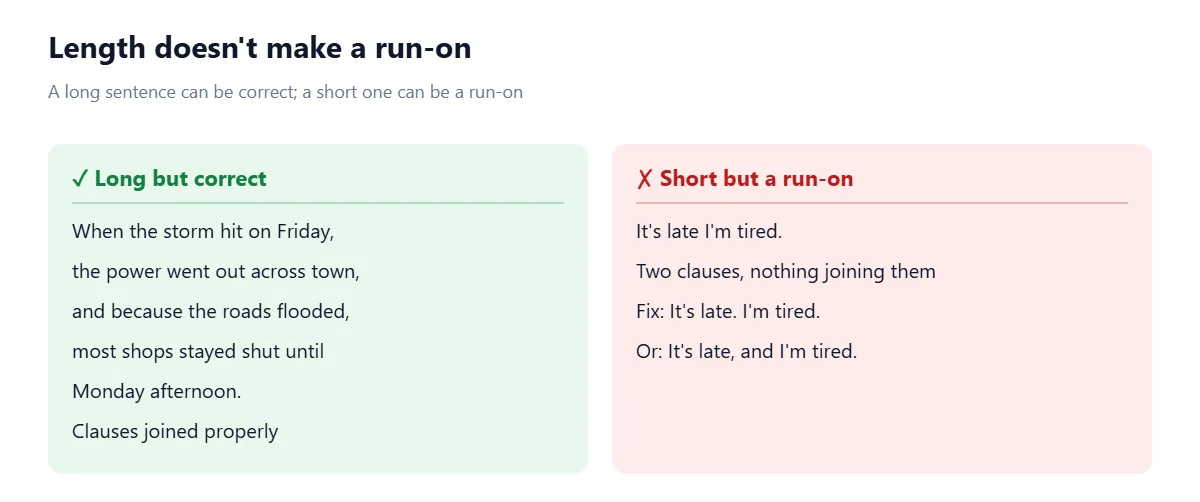
No. This is the biggest myth about run-ons. A run-on is defined by how its clauses are joined, not by how many words it has. UNC puts it simply: really long sentences can be tiring "but not necessarily wrong," and George Mason's writing center makes the same point (UNC; GMU).
That said, long sentences are where run-ons hide, and they're harder to read even when correct. The Sentence Counter shows your average sentence length and flags any sentence over 25 words, so you can check those first. Our post on the Flesch reading ease score explains how sentence length affects readability.
How to find run-ons in your own writing
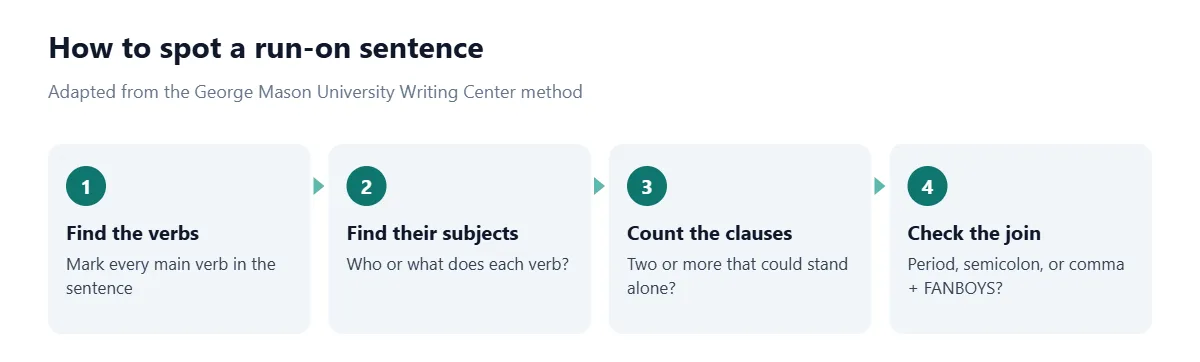
Read it out loud. Where you naturally pause or drop your voice between two complete thoughts, check the punctuation.
Look for a pronoun mid-sentence. A new "it", "they" or "this" after a comma often marks the start of a second clause.
Check every "however" and "therefore". If a comma comes before it and a full clause follows, you need a semicolon or period.
Start with your longest sentences. Paste your text into the Word Counter to see your sentence count, then review the longest ones first.
Test with a period. Put a period where you suspect the join. If both halves stand alone as sentences, the original was a run-on unless a conjunction or semicolon links them.
Are comma splices ever acceptable?
Sometimes, in a narrow set of cases. "Garner's Modern English Usage" says most usage authorities accept a comma splice when the clauses are short and closely related, there's no risk of misreading, and the context is informal; "The Elements of Style" also allows commas between very short clauses that are alike in form (Wikipedia, Comma splice).
The textbook example is "I came, I saw, I conquered." Mignon Fogarty (Grammar Girl) notes that joining very short, exactly parallel sentences with commas is accepted, but adds that such sentences don't come up in real life very often (Quick and Dirty Tips). Novelists also use comma splices on purpose for rhythm or voice. In essays, reports and job applications, avoid them: a reader who spots one will usually assume it's a mistake.
Practice: fix these run-ons
Try each one before reading the suggested fix. There's often more than one right answer.
Run-on | One good fix |
|---|---|
The meeting ran long we missed lunch. | The meeting ran long, so we missed lunch. |
I'd love to come, I have to work. | I'd love to come, but I have to work. |
He's never late, today he was. | He's never late. Today he was. |
Prices rose, as a result sales fell. | Prices rose; as a result, sales fell. |
The app crashed I lost my notes. | When the app crashed, I lost my notes. |
If you got these, you can fix any run-on you'll meet. The skill is in noticing them, which gets easier once you start checking where each clause begins and ends. Cutting padding helps too: our list of filler words to cut makes long sentences shorter and the joins easier to see.
Frequently asked questions
What is a run-on sentence?
A run-on joins two or more independent clauses without the correct punctuation or conjunction. "I'm hungry let's eat" is an example.
What are the two types of run-on sentences?
The fused sentence, which joins two independent clauses with no punctuation, and the comma splice, which joins them with only a comma.
Is a comma splice a run-on sentence?
Yes, most grammar guides treat a comma splice as a type of run-on. Some textbooks list it as a separate error, but the fixes are the same.
Can a short sentence be a run-on?
Yes. "It's late I'm tired" is only four words but is a run-on, because it joins two complete sentences with nothing between them.
Is a long sentence always a run-on?
No. A long sentence is correct if its clauses are properly joined. Length affects readability, not grammar.
How do you fix a run-on sentence?
Use a period, a semicolon, a comma with a coordinating conjunction (and, but, so), a subordinating word (because, although), or rewrite the sentence.
Do you need a semicolon before however?
Yes, when "however" joins two independent clauses: "It was cheap; however, it broke." A comma alone before "however" creates a comma splice.
What is the difference between a run-on and a fragment?
A run-on has too much: two or more complete sentences joined incorrectly. A fragment has too little: it's missing a subject, a verb or a complete thought.
Sources
Merriam-Webster. Run-on sentence. Merriam-Webster.
Merriam-Webster. Comma splice. Merriam-Webster.
The Writing Center, University of North Carolina at Chapel Hill. Fragments and Run-ons. UNC.
George Mason University Writing Center. Run-on Sentences. GMU.
Walden University Writing Center. Run-On Sentences and Sentence Fragments. Walden University.
Comma splice. Wikipedia (citing Garner's Modern English Usage and The Elements of Style).
Fogarty, M. What Is a Comma Splice?. Quick and Dirty Tips, 2017.

Comments