
Flesch Reading Ease rates text on a scale of roughly 0 to 100, where higher scores are easier to read. For most everyday writing, aim for 60 to 70, which is about the level of plain English that an eighth or ninth grader can follow.
The score comes from just two things: how long your sentences are and how many syllables your words have. That makes it quick to calculate and easy to game, so it's worth knowing exactly what it measures before you start rewriting to please it.
What is the Flesch Reading Ease score?
It's a readability formula created by Rudolf Flesch and published in 1948 in the Journal of Applied Psychology under the title "A new readability yardstick" (ReadabilityFormulas.com). It predicts how hard a piece of text is to read, based only on its surface: sentence length and word length.
Longer sentences and longer words both push the score down. The formula doesn't look at meaning, grammar, word order or layout, which is both why it's fast and why it has limits (more on those below).
The Flesch Reading Ease formula
Here is the formula as Microsoft documents it for Word's readability statistics:
To calculate it by hand, count three things: words, sentences and syllables. Then work out the two averages and plug them in. The next section shows every step with a real example.
Readability score chart
Scores are usually read against bands like these. The descriptions follow the commonly published interpretation of Flesch's scale (Wikipedia summary):
Score | Difficulty | Rough school level |
|---|---|---|
90–100 | Very easy | 5th grade |
80–90 | Easy | 6th grade |
70–80 | Fairly easy | 7th grade |
60–70 | Plain English | 8th–9th grade |
50–60 | Fairly difficult | 10th–12th grade |
30–50 | Difficult | College |
10–30 | Very difficult | College graduate |
Below 10 | Extremely difficult | Professional |
The scale isn't actually capped at 0 and 100. Very short words in very short sentences can score above 100, and dense legal or academic prose can fall below zero. You'll see a negative score in the worked example below.
Worked example: calculating the score step by step
Let's score three versions of the same building notice. We counted syllables with a dictionary, word by word, and ran the published formula in a script, so the numbers below are exact to one decimal place.
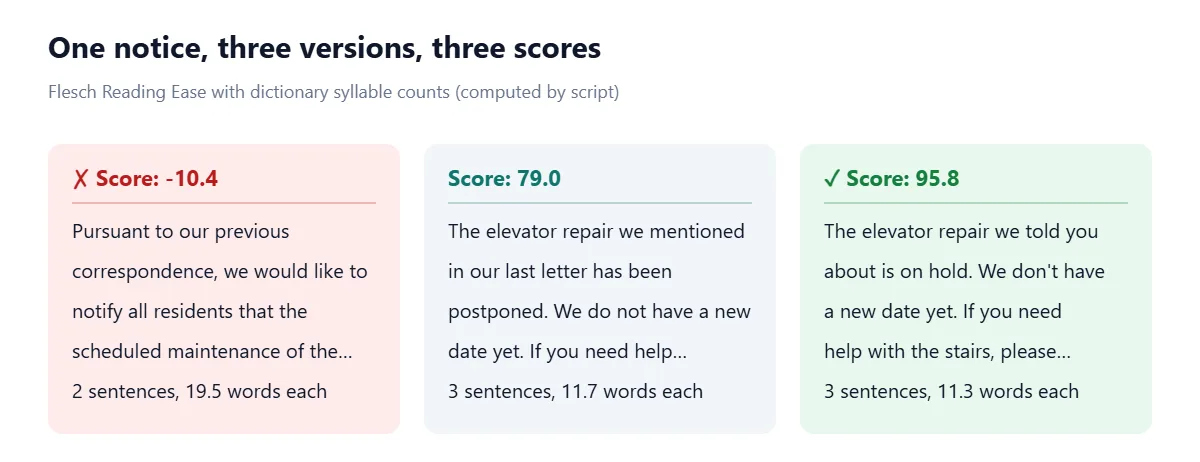
Version 1: the formal notice
"Pursuant to our previous correspondence, we would like to notify all residents that the scheduled maintenance of the building's elevator infrastructure has been postponed indefinitely. Consequently, individuals requiring accessibility accommodations should contact the management office at their earliest convenience."
Count: 39 words, 2 sentences, 91 syllables.
Average sentence length: 39 ÷ 2 = 19.5 words.
Average syllables per word: 91 ÷ 39 = 2.333.
Score: 206.835 − (1.015 × 19.5) − (84.6 × 2.333) = 206.835 − 19.79 − 197.40 = −10.4.
Version 2: a neutral rewrite
"The elevator repair we mentioned in our last letter has been postponed. We do not have a new date yet. If you need help using the stairs in the meantime, please contact the management office." That's 35 words, 3 sentences and 48 syllables: 11.67 words per sentence and 1.371 syllables per word, for a score of 79.0.
Version 3: plain and direct
"The elevator repair we told you about is on hold. We don't have a new date yet. If you need help with the stairs, please call the office and we will sort it out." That's 34 words, 3 sentences and 40 syllables: 11.33 words per sentence and 1.176 syllables per word, for a score of 95.8.
Look at what changed between versions 2 and 3. The sentence length barely moved, yet the score jumped almost 17 points, because "postponed", "meantime", "contact" and "management" became "on hold", "call" and "office".
Why syllables matter more than sentence length
The two weights in the formula tell the story. Each extra word per sentence costs 1.015 points. Each extra syllable per word, on average, costs 84.6 points. In practice, averages move in small steps, so here's the comparison that matters: cutting your average sentence from 20 words to 10 gains about 10 points, while dropping from 1.6 to 1.4 syllables per word gains about 17.
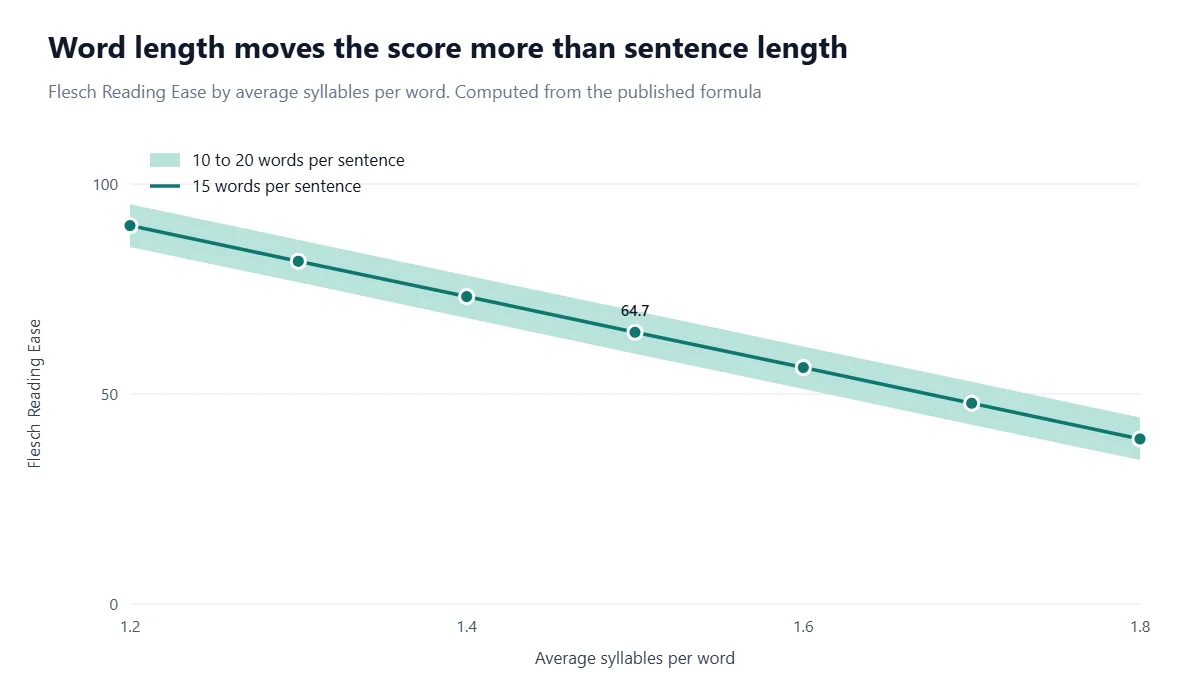
That's also why splitting long sentences alone rarely rescues a stiff draft. Cut version 1 above into four sentences instead of two and its score only rises from −10.4 to −0.5. The long, Latin-derived words are the real problem.
Why different tools give different Flesch scores
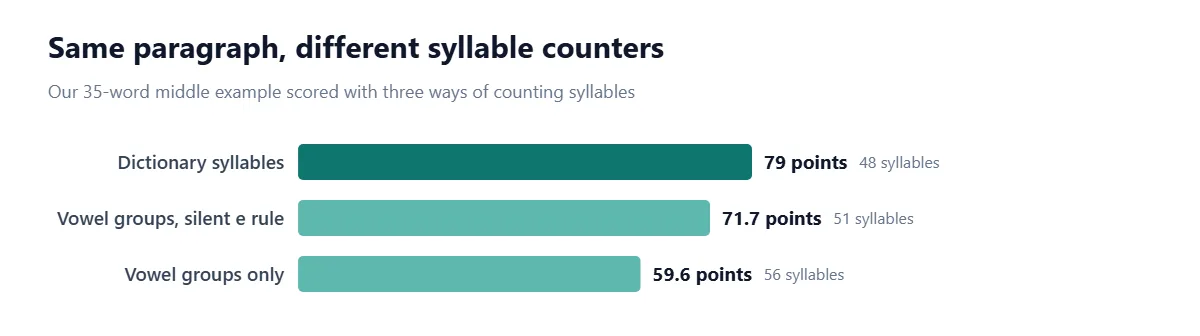
Paste the same text into three readability checkers and you may get three different numbers. The formula is identical everywhere; the counting isn't. Software usually estimates syllables with spelling rules rather than a full dictionary, and every rule set handles silent e, "-ed" endings and vowel pairs a little differently. Our example below shows how much that matters.
Sentence counting varies too. Florida's insurance law, which requires certain policies to score at least 45, even spells out its own counting rules: a unit ending in a period, semicolon or colon counts as a sentence, and contractions and hyphenated words count as one word (Fla. Stat. § 627.4145).
What is a good Flesch Reading Ease score?
For most writing aimed at the general public, 60 or higher is a good target, and 60–70 is the range Microsoft suggests for standard documents. Here's how that plays out by type of writing:
Type of writing | Sensible target | Why |
|---|---|---|
Public information, instructions | 70+ | Readers skim, often on a phone |
Blog posts and web pages | 60–70 | Plain English for a broad audience |
Business documents | 60–70 | Microsoft's guidance for standard documents |
Insurance policies (Florida) | 45 minimum | Required by state law for covered policies |
Academic and technical writing | 30–50 | Specialist terms are unavoidable |
UK government teams set an even gentler bar. The Home Office design manual recommends writing for a maximum reading age of 9, even for specialist audiences, and GOV.UK's guidance asks writers to split sentences over 25 words and notes that 1 in 6 adults in England have very poor literacy skills.
Readability and length are separate questions. A 2,000-word guide can score 70 and a 50-word disclaimer can score 20. If you're also deciding how long a piece should be, see our guides on blog post length and essay length.
Flesch Reading Ease vs Flesch-Kincaid Grade Level
The Flesch-Kincaid Grade Level uses the same two inputs but outputs a US school grade instead of a 0–100 score. It was developed by J. Peter Kincaid and colleagues in 1975 for the US Navy, in a study of 531 enlisted personnel (ERIC record).
The two move in opposite directions: a higher Reading Ease means a lower grade. Our three versions score grade 19.5, 5.1 and 2.7. Microsoft suggests aiming for a grade of about 7 to 8 for most documents. There's no upper limit on the grade, and the lowest possible score is −3.40.
How to check Flesch Reading Ease in Microsoft Word
Word calculates both Flesch scores for you. In current Microsoft 365 versions, the steps from Microsoft Support are:
Open your document and go to the Home tab.
Select Editor, then Document stats.
Select OK in the dialog box that appears.
Read the Flesch Reading Ease and Flesch-Kincaid Grade Level at the bottom of the statistics window.
Microsoft notes that Word shows readability for the last language it checked, and for some European languages it shows only counts and averages. If you're not in Word, you can paste your text into the Word Counter to see its word, sentence and readability figures in the browser. For a finished Word or PDF file, the Document Word Counter reads the file directly.
How to improve your readability score
Swap long words for short ones. "Use" for "utilize", "help" for "assist", "about" for "approximately". This is the biggest lever, as the chart above shows.
Turn nouns back into verbs. "We will make a decision" becomes "We will decide". Fewer words, fewer syllables.
Split sentences over 25 words. One idea per sentence is easier to follow, even if it moves the score less.
Cut filler. Phrases like "in order to" and "at this point in time" add length with no meaning. Our guide to filler words to cut has a full list.
Keep the technical terms your readers need. Replacing a precise word with a vague one raises the score and lowers clarity.
Limitations of the score
A high score doesn't prove text is clear. Shuffle the words in any paragraph into nonsense and the score won't change, because the formula never checks meaning or order. It also can't see headings, lists or white space, which help readers far more than a few syllables.
Plain-language experts have said this for decades. Editors Canada's Gael Spivak summarizes research showing that rewriting to lower a grade-level score doesn't by itself increase comprehension, and notes that the 2023 ISO plain language standard focuses on how well readers can use a document rather than on mechanical measures such as readability formulas. Even Yoast SEO stopped using the Flesch score in its readability analysis from version 19.3, replacing it with word complexity and sentence length checks.
Use the score as a smoke alarm: a low number tells you to look for long words and tangled sentences. Then judge the fix by reading it aloud, or better, by asking a real reader.
Frequently asked questions
What is a good Flesch Reading Ease score?
A score of 60 to 70 is good for most writing and matches Microsoft's recommendation for standard documents. Aim for 70 or higher for public information and instructions.
What does a Flesch Reading Ease score of 50 mean?
A score of 50 is fairly difficult, roughly 10th to 12th grade level. It's normal for technical or academic writing but hard going for a general audience.
How is Flesch Reading Ease calculated?
Flesch Reading Ease = 206.835 − (1.015 × average words per sentence) − (84.6 × average syllables per word). Higher results mean easier text.
Is a higher readability score better?
Higher means easier to read, which is usually better for general readers. Very high scores can also mean choppy, childlike text, so match the score to your audience.
Can a Flesch Reading Ease score be negative?
Yes. Very long sentences full of long words can score below zero, and very simple text can score above 100. The 0–100 range is typical, not a hard limit.
What is the difference between Flesch Reading Ease and Flesch-Kincaid?
Both use sentence length and syllables per word. Reading Ease gives a 0–100 score where higher is easier; Flesch-Kincaid Grade Level gives a US school grade where lower is easier.
Why do readability tools give different scores?
They count syllables and sentences differently. In our test the same paragraph scored anywhere from about 60 to 79, so compare drafts in one tool only.
Sources
Microsoft. Get your document's readability and level statistics. Microsoft Support.
Flesch, R. A new readability yardstick. Journal of Applied Psychology, 32(3), 221–233, 1948 (via ReadabilityFormulas.com).
Flesch–Kincaid readability tests. Wikipedia.
Kincaid, J. P., Fishburne, R. P., Rogers, R. L. and Chissom, B. S. Derivation of new readability formulas for Navy enlisted personnel. ERIC, 1975.
The Florida Senate. Florida Statutes § 627.4145: Readable language in insurance policies. 2022.
Home Office. Readability. Home Office User-Centred Design Manual.
GOV.UK. Use clear language. GOV.UK content and publishing guidance.
Spivak, G. Readability formulas, programs and tools: Do they work for plain language? Our Languages blog, Government of Canada, 2023.
Yoast. The Flesch reading ease score: Why and how to use it.

Comments