
When to spell out numbers depends on your style guide. Spell out numbers from one to nine and use numerals for 10 and above if you follow AP or APA style, which covers most news, business and science writing. Chicago style spells out numbers up to one hundred, MLA spells out any number you can write in one or two words, and every major guide spells out a number that starts a sentence.
The rules look fussy, but they exist for one reason: readability. A reader scans "9" and "nine" at about the same speed, while "one thousand two hundred forty-seven" is a chore and "1,247" is not. Each style guide just draws the line in a different place. Below you'll find where each one draws it, the exceptions that apply almost everywhere, and a quick way to decide when the rules seem to clash.
When to spell out numbers: the two main rules
There are two general rules in circulation, and nearly every guide uses one of them:
The one-to-nine rule. Spell out zero through nine and use numerals from 10 up. This is the rule in AP style, used by most newsrooms, PR teams and websites, and in APA style, used across psychology and the social sciences.
The zero-to-one-hundred rule. Spell out whole numbers up to one hundred, and round multiples of them such as "five thousand". This is the general rule in The Chicago Manual of Style, the standard for book publishing and much of the humanities.
MLA sits close to Chicago. Its guidance is to spell out numbers "that can be written in a word or two" and to use numerals for the rest, so "forty-two" and "three thousand" are words, while 125 is a numeral (MLA Style Center).
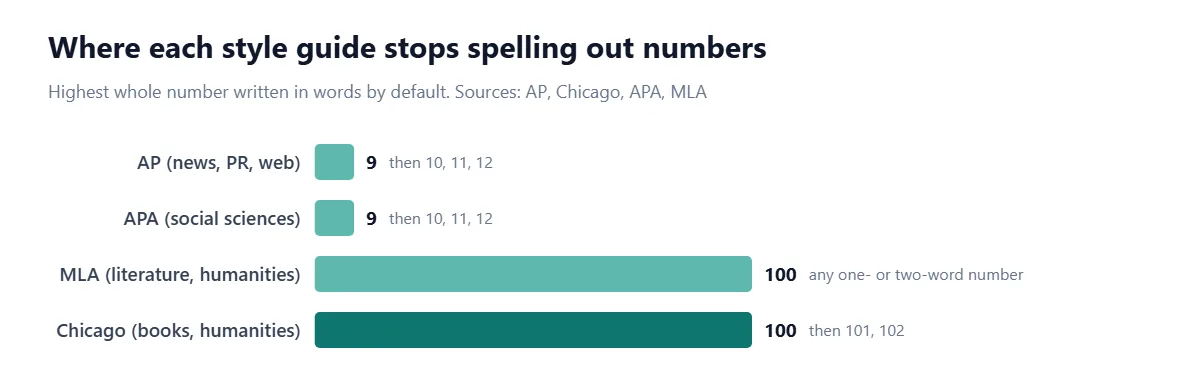
If nobody has told you which guide to follow, the one-to-nine rule is the safer default for anything published online or at work. It keeps statistics easy to scan and matches what readers see in the news every day.
Number rules by style guide: AP vs Chicago vs APA
Here's how the three most common guides compare on the questions people ask most often. MLA is covered in its own section below.
Rule | AP | Chicago | APA |
|---|---|---|---|
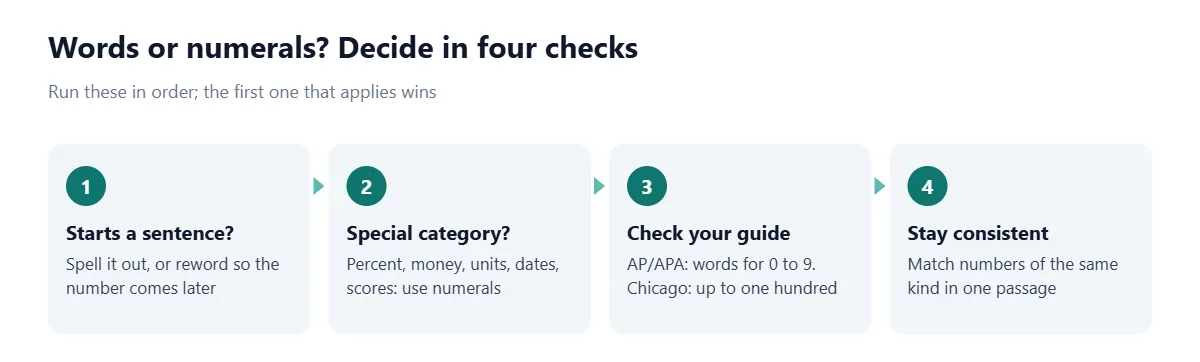
Spell out | One through nine | Zero through one hundred | Numbers below 10 |
Numerals start at | 10 | 101 (but "five thousand") | 10 |
Start of a sentence | Spell out (years excepted) | Spell out | Spell out |
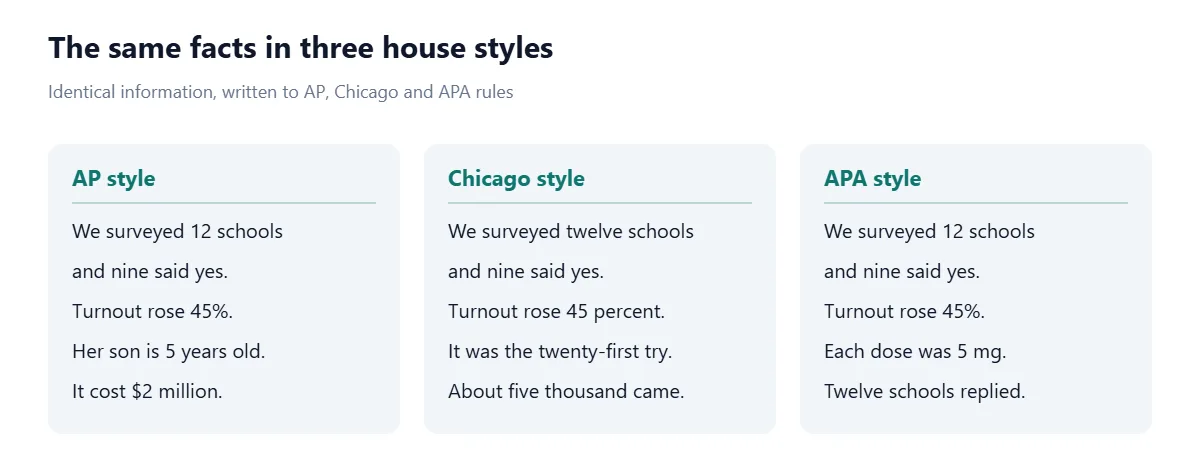
Percentages | 45% | 45 percent (45% in science) | 45% |
Always numerals for | Ages, money, dimensions | Pages, rooms, scores | Units, times, dates, statistics |
Sources for the table: AP rules as summarized by the NMU Writing Center and Writing Explained, Chicago's Numbers Q&A, and APA 7 rules as summarized by Monmouth University. The AP Stylebook and the APA site sit behind paywalls or bot checks, so we've relied on university writing centers that quote them.
MLA rules for numbers
MLA writers mostly discuss texts, not data, so the MLA Handbook leans toward words. The main points from the MLA Style Center:
Spell out numbers that take one or two words: "thirty-six", "two hundred", "a number one hit".
Use numerals when it would take more than two words, so an age of 101 is written as a numeral.
In passages full of numbers, switch to numerals for all of them, ages included, so the figures are easy to compare.
Pair numerals with the % sign and spelled-out numbers with the word "percent" (MLA on percentages).
Spelling out numbers at the start of a sentence
This is the one rule nearly everyone shares. A sentence should not open with a numeral, because the capital letter that normally signals a new sentence is missing and the reader can stumble. Chicago spells the number out (CMOS Shop Talk), and so does APA.
AP makes one exception: a year can open a sentence as a numeral, as in "1995 was a very good year" (Writing Explained).
Spelling out a big number at the front of a sentence gets ugly fast. "Two thousand four hundred sixteen people signed" is correct but hard to read. The better fix, and the one most editors reach for, is to rewrite the sentence so the number moves:
Awkward: Two thousand four hundred sixteen people signed the petition.
Better: The petition drew 2,416 signatures.
Also fine: In total, 2,416 people signed the petition.
Ages, percentages and money
Ages
AP always uses numerals for ages, even under 10: "a 6-year-old boy" and "the boy is 5 years old" (Writing Explained). Note the hyphens when the age comes before a noun, and none when it comes after. MLA spells out ages that take a word or two, such as "forty-three years old", unless the text is full of numbers.
Percentages
AP changed its rule in 2019. It now uses the % sign with a numeral and no space, as in "about 60% of Americans agreed", and puts a zero before decimals below one, as in "0.6%" (Poynter). Older guides that tell you to write "60 percent" in AP style are out of date.
Chicago uses numerals for every percentage but prefers the word in general writing: "10 percent" in humanities work and "10%" in scientific or statistical work (Chicago Q&A). APA uses numerals for percentages, ratios and other statistical values.
Money
AP writes dollar amounts as numerals with the $ sign, such as $5 and $15.5 billion, and cents as "5 cents". On a check, of course, you write the amount in words as well, and there are separate conventions for that; see our guide on how to write a check amount in words.
Large numbers: million, billion and round numbers
For very large numbers, most guides combine a numeral with a word. AP writes "1 million people" and "$2 billion", with no hyphen between the figure and the word (Writing Explained). That's far easier to read than 1,000,000 or 2,000,000,000.
Chicago goes further with round numbers. It spells out whole multiples of one through one hundred when they're followed by hundred, thousand or hundred thousand, so "five thousand" and "one hundred thousand" are words, while 150,000 stays a numeral (Chicago Q&A). For millions and above, Chicago suggests the mixed form too, and admits that perfect consistency isn't always realistic.
APA adds a useful twist: write out a number when it's only an approximation, as in "about three years ago". An exact figure is data; a rough one is just part of the sentence.
Ordinal numbers: first, 10th, twenty-first
Ordinals follow the same line as the guide's cardinal numbers. In AP style that means "first" through "ninth", then "10th", "25th" and so on, as in "fourth grade" but "10th grade". AP also drops the ordinal ending from dates: write "Oct. 15", not "Oct. 15th".
Chicago spells out ordinals through one hundredth, so centuries become "the seventeenth century" and "the twenty-first century". Under its alternative rule, used by publishers who prefer numerals above nine, the same phrases become "17th century" and "21st century". Pick one and hold it: Chicago recommends local consistency when single- and double-digit ordinals appear close together.
Mixing words and numerals in the same sentence
The rules above sometimes collide. A sentence might contain "eight" and "14" side by side, which looks odd if both count the same thing. Chicago's advice is to aim for consistency in the local context: if one number in a category needs a numeral, you can set the related ones as numerals too.
Inconsistent: The class had eight boys and 14 girls.
Consistent (numerals): The class had 8 boys and 14 girls.
Different categories, both correct: Nine students each wrote a 15-page essay.
The last example is fine as it stands. The students and the pages are different kinds of count, so each follows its own rule. APA also keeps numerals before units of measurement no matter how small, as in a "5-mg dose", because the number is a measurement, not a casual count.
How to write spelled-out numbers correctly
Once you've decided to use words, a few mechanics trip people up:
Hyphenate twenty-one to ninety-nine. Compound numbers take a hyphen: "forty-five", "ninety-nine", "twenty-first".
Hyphenate fractions used as words. APA's example is "three-fourths", and it writes common fractions out in words.
Keep proper nouns as they are. The Ten Commandments and the Big Ten stay in words, whatever the general rule.
Watch your word count. "One hundred twenty-five" counts as three or four words depending on how your tool treats hyphens, while "125" is one. On a tight word limit, Chicago-style prose runs a little longer than AP-style prose. Paste both versions into the Word Counter to see the difference, and see our guide to checking word count for how different tools count.
If you need to turn a long figure into words for a formal document, an invitation or a check, the Number to Words Converter writes it out for you, including ordinals and currency.
Which number rule should you follow?
Use the guide your teacher, publisher or employer names. If there isn't one, match the kind of writing:
Websites, blogs, business writing, press releases: AP, so one to nine in words.
Psychology, education, nursing and most social science papers: APA, so words below 10.
Literature and language essays: MLA, so words for one- or two-word numbers.
Books, fiction and history: Chicago, so words up to one hundred. In creative writing, Chicago's own editors say readability matters more than rigid consistency.
Common mistakes with numbers in writing
Starting a sentence with a numeral. "12 people came" should be "Twelve people came", or better, a sentence that doesn't lead with the number.
Using AP's old percent rule. Since 2019 AP writes "45%", not "45 percent".
Spelling out measurements. "Five kilograms" in a lab report should be "5 kg" in APA.
Adding "th" to dates. AP writes "Oct. 15", not "Oct. 15th".
Switching styles mid-document. Pick one rule and apply it everywhere. A quick search for each digit, 1 to 9, catches most slips.
Frequently asked questions
Should you spell out numbers under 10?
Yes, in AP and APA style you spell out zero through nine and use numerals from 10 up. Chicago and MLA spell out even more numbers, up to one hundred.
Do you spell out numbers at the beginning of a sentence?
Yes. AP, Chicago and APA all spell out a number that starts a sentence; AP's only exception is a year. If the number is long, reword the sentence so it doesn't come first.
Is it 10 or ten in Chicago style?
Ten. Chicago's general rule spells out whole numbers from zero through one hundred and uses numerals from 101.
Does AP style use percent or the % sign?
AP uses the % sign with a numeral and no space, such as 45%. The change came in the 2019 AP Stylebook; before that AP wrote "45 percent".
How do you write ages in AP style?
Always as numerals, even under 10: "a 6-year-old girl" and "she is 6 years old". Use hyphens only when the age comes before a noun.
Do you spell out million and billion?
Most guides combine a numeral with the word, such as 3 million or $2 billion. It is easier to read than a long run of zeros.
How does APA handle numbers below 10?
APA writes them as words, except when they come before a unit of measurement, show a statistic or percentage, or give a time or date, as in 5 mg or 3%.
Sources
MLA Style Center. How do I style numbers referring to charts of record sales?. Modern Language Association.
MLA Style Center. When referring to a person's age, do I use numerals or words?. Modern Language Association.
MLA Style Center. How do I style percentages?. Modern Language Association.
The Chicago Manual of Style Online. Chicago Style Q&A: Numbers. University of Chicago Press.
The Chicago Manual of Style Online. Chicago Style Q&A: Percentages. University of Chicago Press.
CMOS Shop Talk. Numbers in Creative Writing. University of Chicago Press, 2020.
Monmouth University. APA 7 Numbers and Tables. Resources for Writers.
Northern Michigan University Writing Center. AP Style.
Writing Explained. AP Style Numbers.
Poynter. AP says the percentage sign now OK when used with a numeral. Poynter, 2019.

Comments