
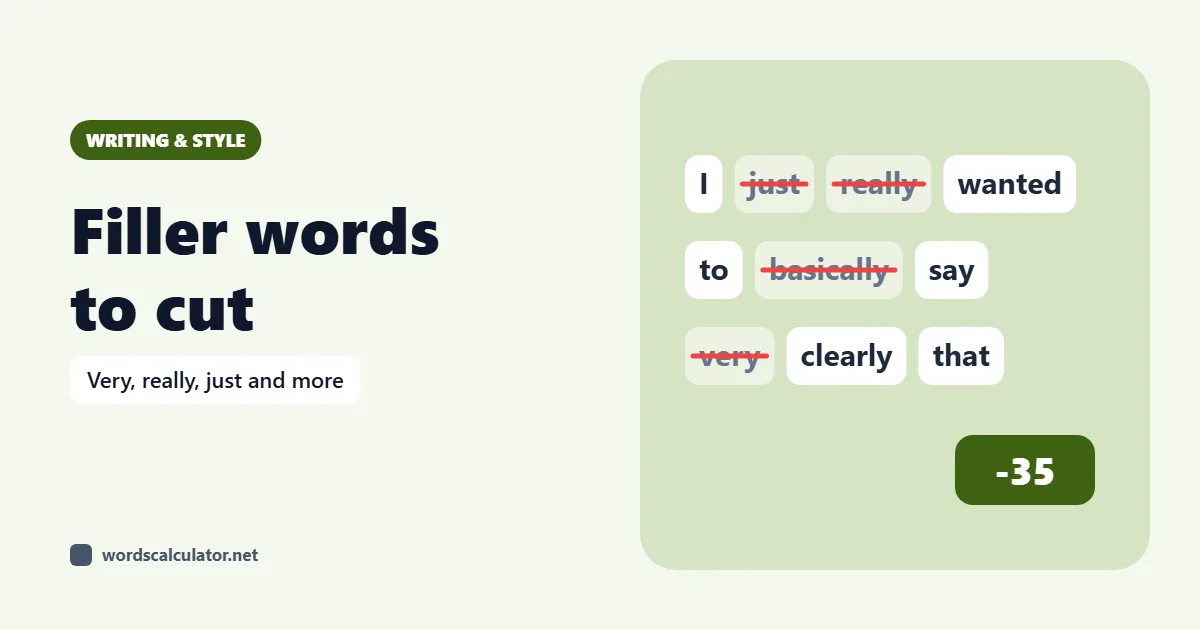
Filler words are words that make a sentence longer without adding meaning. The usual suspects are very, really, just, actually, basically, quite and totally, plus padded phrases such as "in order to" (use "to") and "due to the fact that" (use "because").
Cutting them is the fastest edit you can make. In the example later in this article, removing filler takes a 52-word message down to 17 words without losing a single fact.
What are filler words in writing?
In speech, fillers are the sounds and words people use to signal that they're pausing to think: "um", "uh", and increasingly words like "like", "you know", "actually" and "basically" (Wikipedia)). In speech they do a job. They hold your turn in the conversation.
On the page they have no job to do. The reader can't hear you thinking, so "basically" and "actually" become extra words to wade through. In writing, "filler" covers a wider family: empty intensifiers, reflexive hedges, long phrases that could be one word, and redundant pairs that say the same thing twice.
The principle is old. William Strunk's 1918 The Elements of Style put it in three words, "Omit needless words", and explained: "A sentence should contain no unnecessary words, a paragraph no unnecessary sentences, for the same reason that a drawing should have no unnecessary lines and a machine no unnecessary parts" (Strunk, 1918).
Filler words list
Here are the usual suspects, grouped by the way they pad a sentence. Not every use is filler (see the section on when to keep them), but every one is worth a second look.
Intensifiers and empty modifiers
Very, really, quite, totally, completely, absolutely, actually, extremely, truly, definitely, highly, incredibly. The Federal Plain Language Guidelines single out "absolutely, actually, completely, really, quite, totally, and very" as modifiers you can usually drop.
Hedges and softeners
Just, basically, simply, kind of, sort of, somewhat, rather, a bit, I think, I feel, I believe, it seems that, perhaps. These make a statement sound less sure. Sometimes that's right; often it's a habit.
Throat-clearing openers
"I just wanted to reach out…", "I'm writing to let you know that…", "It is important to note that…", "It goes without saying that…", "As you may know…", "Needless to say…". The real sentence starts after them.
Redundant pairs and doubled phrases
Each and every, first and foremost, any and all, cease and desist, begin and commence, due and payable, advance planning, end result, past history, free gift, completely finished. Pick one word. The UNC Writing Center gives "For each and every book you purchase" as its example; "For every book" says the same.
Wordy phrases and shorter alternatives
These swaps come from Strunk, the US Federal Plain Language Guidelines and the UNC Writing Center. The last two columns show what each swap saves, which matters when you're writing to a character limit.
Instead of | Write | Words saved | Characters saved |
|---|---|---|---|
in order to | to | 2 | 9 |
due to the fact that | because | 4 | 13 |
at this point in time | now | 4 | 18 |
is able to | can | 2 | 7 |
on a monthly basis | monthly | 3 | 11 |
a sufficient number of | enough | 3 | 16 |
in the event that | if | 3 | 15 |
in spite of the fact that | although | 5 | 17 |
the question as to whether | whether | 4 | 19 |
in a hasty manner | hastily | 3 | 10 |
each and every | every | 2 | 9 |
begin and commence | start | 2 | 13 |
Strunk was blunt about one phrase in particular: "the fact that" should be revised out of every sentence in which it occurs. "Owing to the fact that" becomes "since", and "the fact that he had not succeeded" becomes "his failure".
Before and after: filler words examples
Here's a customer message written the way many of us write on autopilot, and the same message with the filler cut:
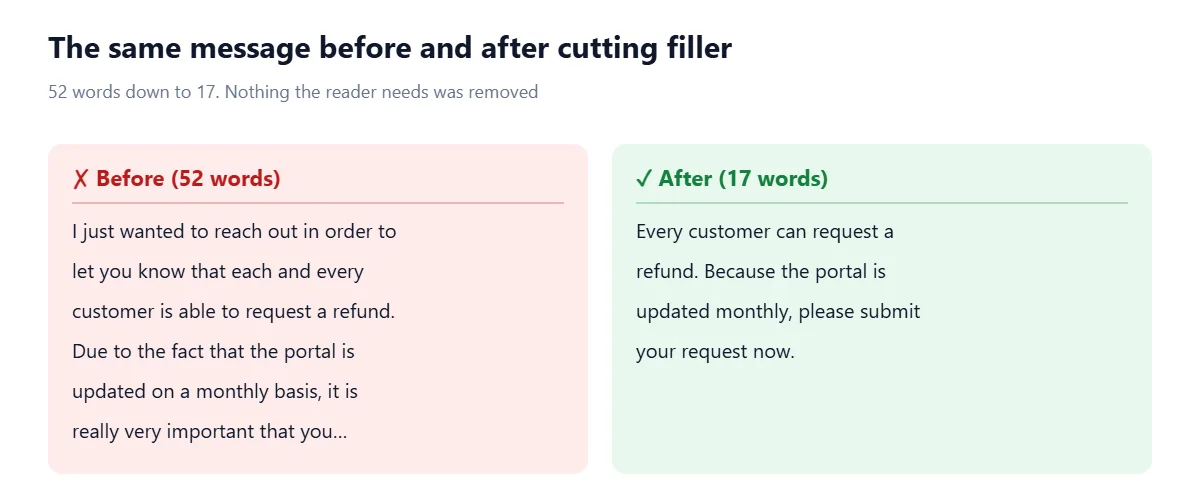
The full original reads: "I just wanted to reach out in order to let you know that each and every customer is able to request a refund. Due to the fact that the portal is updated on a monthly basis, it is really very important that you basically submit your request at this point in time." That's 52 words and 262 characters. The edit is 17 words and 107 characters.
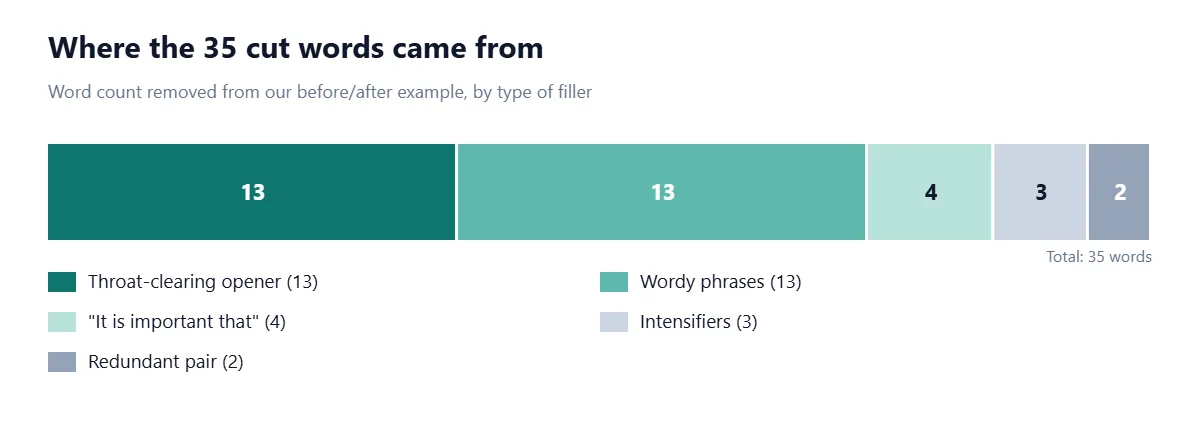
Notice where the words went. Deleting "really", "very" and "basically" saved only three words. The big wins were the 13-word opening that said nothing, and four stock phrases that each collapse to a single word. When you're over a limit, hunt phrases first and single words second.
A few more quick edits:
"There are many students who find that the library is actually quite useful." → "Many students find the library useful."
"It is important to note that the deadline has been extended." → "The deadline has been extended."
"The reason why the project failed was because of the fact that funding ran out." → "The project failed because funding ran out."
"We will make a decision on a weekly basis." → "We will decide weekly."
Why filler words weaken your writing
They bury the point. Readers skim. Every extra word pushes the useful ones further from the start of the sentence.
They cost you space. On platforms with hard limits, such as a 280-character post on X or a meta description that Google cuts short, filler takes room from content. See our guides to the X character limit and meta description length.
They weaken claims. "This is a very important change" sounds less certain than "This change matters". Intensifiers often signal that the plain word wasn't strong enough, and readers notice.
They make text harder to read. Long phrases add syllables and sentence length, the two things readability formulas measure. Our guide to Flesch Reading Ease shows how much that moves the score.
The US government treats this as a real problem: its plain language guidelines call wordy, dense construction "one of the biggest problems in government writing".
Buzzwords that pad business writing
Some words aren't filler exactly, but they take the place of a plainer, more specific word. GOV.UK's style guide bans a list of them because plain English is mandatory on the site. A selection, with GOV.UK's suggested replacements:
Avoid | Use instead |
|---|---|
facilitate | say what you're actually doing to help |
leverage (unless financial) | influence or use |
utilise | use |
initiate | start or begin |
collaborate | work with |
going forward | from now on or in the future |
deliver | make, create or provide |
key (unless literal) | important or significant |
GOV.UK's clear language guidance adds everyday swaps in the same spirit: "buy" instead of "purchase", "help" instead of "assist", "about" instead of "approximately".
When filler words are worth keeping
Blind deletion makes writing curt, and sometimes changes what it means. Keep the word when it's doing one of these jobs:
Honest hedging. In academic writing, "may", "suggests" and "appears to" stop you claiming more than your evidence shows. Inger Mewburn, writing as the Thesis Whisperer, makes the point that hedging should be kept strategically, not stripped out.
Tone. "Could you just check this?" is softer than "Check this." In a message to a colleague, the softer version may be the right one.
Meaning. "Only" and "just" can change a sentence: "I just finished" (a moment ago) is not "I finished".
Clarity. "That" often looks cuttable, but "She said that Tuesday was fine" is clearer than "She said Tuesday was fine" when readers might stumble. Keep it where it prevents a double take.
How to find filler words in your draft
You won't spot every filler word by rereading, because your brain fills in what you meant to say. A few mechanical passes work better:
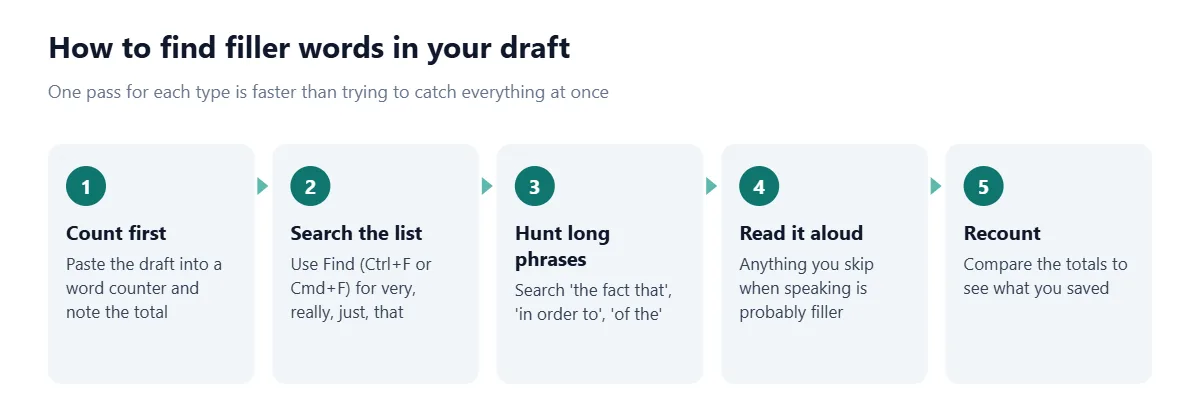
Paste your draft into the Word Counter and note the word count. Its list of repeated words and phrases shows which of your habits ("really", "just", "in order to") appear most often.
Use Find in your editor to jump to each word from the list above. In Word and Google Docs, Find highlights every match at once.
Search for the phrases "the fact that", "in order to", "of the" and "there is" / "there are". These usually mark a sentence that can be rebuilt shorter.
Read the draft out loud. Anything you naturally skip or stumble over is a candidate for cutting.
Recount and compare the totals. If you're trimming to a hard limit, the Character Counter shows exactly how many characters are left.
Common mistakes when cutting filler words
Swapping filler for jargon. "Utilize" is shorter than "make use of", but "use" is shorter still.
Cutting single words while leaving long phrases. Deleting every "very" saves less than rewriting two "due to the fact that" clauses.
Stripping all hedges from research writing. Overclaiming is a bigger problem than a few cautious words.
Making messages cold. A little warmth in an email isn't filler. Cut the padding, keep the please and thank you.
The simplest check is before-and-after: paste the original and the edit into a counter, and you'll see exactly how much you've saved.
Frequently asked questions
What are filler words in writing?
Filler words are words and phrases that make a sentence longer without adding meaning, such as very, really, just, basically, actually and "in order to".
What are the most common filler words?
Common examples are very, really, just, actually, basically, quite, totally, that and so, plus phrases like "in order to", "due to the fact that" and "at this point in time".
Is "very" a filler word?
Usually. "Very" rarely adds meaning, and a stronger single word often works better: "exhausted" instead of "very tired", or "tiny" instead of "very small".
Is "that" a filler word?
Sometimes. "She said that it was fine" works without "that", but keep it when removing it makes the sentence harder to read at first glance.
What can I say instead of "in order to"?
Just write "to". "We met in order to plan the launch" means exactly the same as "We met to plan the launch".
Are filler words always bad?
No. Hedges like "may" and "suggests" are needed in academic writing, and softeners like "just" can set a friendly tone. Cut them only when they add nothing.
How do I stop using filler words?
Write your draft freely, then edit in separate passes: search for a list of filler words, rewrite long phrases, and read aloud. Over time you'll catch your habits as you type.
Sources
Strunk, W. The Elements of Style. 1918 (Project Gutenberg edition).
Plain Language Action and Information Network. Federal Plain Language Guidelines. March 2011, rev. May 2011.
Plain Language Action and Information Network. Omit unnecessary words. plainlanguage.gov (archived).
UNC Writing Center. Conciseness. University of North Carolina at Chapel Hill.
Digital.gov. Writing for understanding. US General Services Administration.
GOV.UK. A to Z style guide: words to avoid.
GOV.UK. Use clear language.
Mewburn, I. De-stuffing your writing. The Thesis Whisperer, 2018.
Filler (linguistics)). Wikipedia.

Comments