
How long should a blog post be? Most should be 1,000 to 2,000 words, and the average post today is about 1,300 words. Google has no preferred word count, though, so the best length is the one that fully answers the reader's question, which might be 500 words for a simple answer or 3,000 for a complete guide.
Word count advice online ranges from "at least 300 words" to "always write 2,500". Both come from somewhere real, and both are misleading if you apply them to every post. Here's what the data actually shows, what Google has said about length, and a practical way to pick a target for any keyword.
How long is the average blog post?
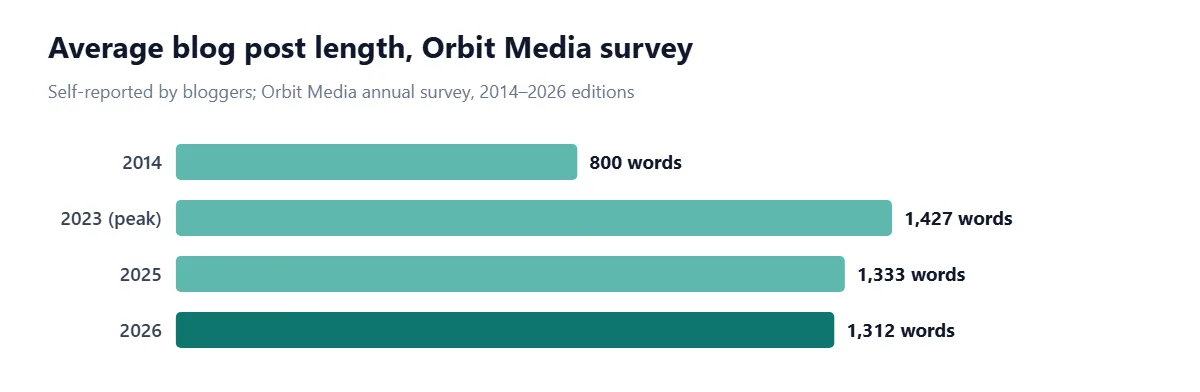
Orbit Media has surveyed bloggers every year since 2014, and length is one of the questions it tracks. In the 2026 edition, based on 1,042 content marketers, the average post was 1,312 words, taking about 3 hours 20 minutes to write (Orbit Media, 2026). That's up from about 800 words in 2014, though slightly down from the 2023 peak of 1,427 words.
Long posts are still the minority. In the 2025 survey only 9% of respondents said they publish posts longer than 2,000 words, yet 39% of that group reported strong results from blogging, against 21% of bloggers overall (MarketingProfs, 2025).
Before you take that as a reason to write 2,000 words every time, notice what the survey measures. Bloggers who write long posts also tend to spend more time on research, editing and promotion. Length travels with effort, and Orbit's own 2026 report says the link between effort and results has weakened considerably.
Is word count a Google ranking factor?
No. Google's guidance on helpful content asks site owners directly: "Are you writing to a particular word count because you've heard or read that Google has a preferred word count? (No, we don't.)" (Google Search Central).
What Google does ask is whether your page gives "a substantial, complete, or comprehensive description of the topic", and whether readers leave "feeling like they need to search again to get better information from other sources". Those two questions are the real reason length and rankings tend to move together. A thorough answer to a broad question simply needs more words than a thin one.
Even Yoast, whose WordPress plugin flags short posts, says plainly that "word count is not a ranking factor in itself" (Yoast, 2025). Its minimums exist to make sure a page has enough context for search engines and readers to understand it.
Do longer blog posts get more backlinks and shares?
On average, yes. A 2019 analysis of 912 million blog posts by Backlinko and BuzzSumo found that long-form content (over 3,000 words) earned an average of 77.2% more links than articles under 1,000 words, and that posts of 1,000 to 2,000 words got 56.1% more social shares than shorter ones (Backlinko). Beyond 2,000 words, the extra shares tailed off.
The same study found that 94% of all blog posts had zero external links. That's the detail most summaries skip. Averages are pulled up by a small number of posts that attract huge numbers of links, so the typical long post may still get none. Writer Josh Bernoff made this point in a critique of the study, arguing that length is correlated with thoughtful, well-promoted work rather than being the cause of success (Bernoff).
How long should a blog post be for SEO?
Long enough to satisfy the search intent, and no longer. The intent behind a keyword tells you a lot about the length that will work:
Quick-answer searches ("how many ounces in a cup") want the answer in the first line. A focused post of 300 to 800 words, with the answer up top and useful context below, is often enough.
How-to searches want steps, examples and fixes for common problems. These usually land between 1,000 and 2,000 words.
Broad or comparison searches ("best project management software") need many options covered fairly, so 2,000 words or more is common.
Definitive guides to a whole topic can pass 3,000 words, but split them into clear sections so readers can jump to their part.
The pages already ranking are your best clue. If the top five results for your keyword are all 800-word answers, a 4,000-word guide will probably not suit the searcher. If they're all 2,500-word guides, a 600-word post is unlikely to compete.
How to find the right length for your keyword
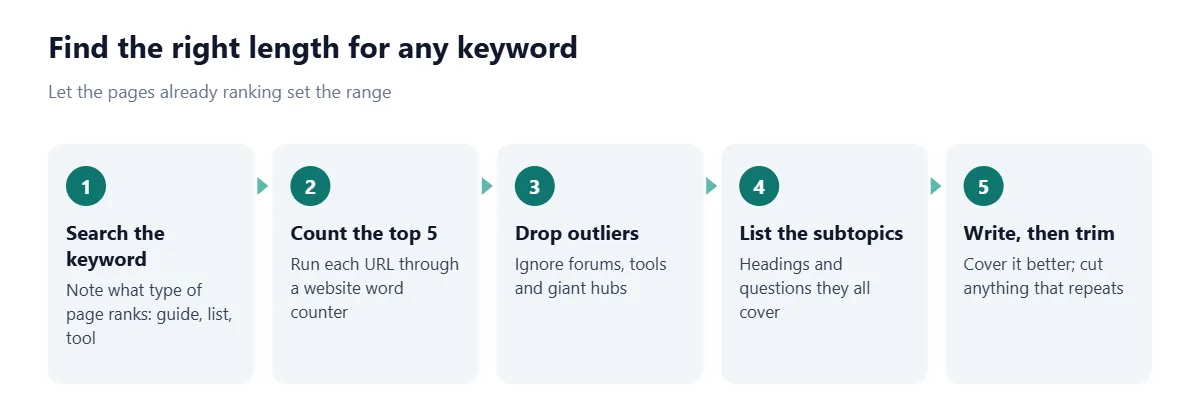
The Website Word Counter is handy for step two: paste a URL and it counts the words on that page. Treat the result as a range, not a target to beat by 10%. The goal is to cover the same ground more clearly, and then add at least one thing the other pages miss.
Ideal blog post length by type
These ranges are rules of thumb based on the research above and common practice. Use them as a starting point, then adjust to what ranks for your keyword.
Post type | Typical length | Reading time at 238 wpm |
|---|---|---|
News or quick update | 300–600 words | 1–3 minutes |
Quick answer / definition | 500–900 words | 2–4 minutes |
How-to or tutorial | 1,000–2,000 words | 4–8 minutes |
List post | 1,200–2,500 words | 5–11 minutes |
Product review or comparison | 1,500–2,500 words | 6–11 minutes |
Opinion or thought leadership | 800–1,500 words | 3–6 minutes |
Pillar page or complete guide | 2,500–4,000+ words | 11–17+ minutes |
Reading times use the average adult silent reading speed for non-fiction of 238 words per minute (Brysbaert, 2019). For a deeper look at reading speed, see how long it takes to read 1,000 words.
What is the minimum word count for a blog post?
There isn't an official one. The most widely used benchmark comes from Yoast SEO, which recommends at least 300 words for regular posts and pages and at least 900 words for cornerstone content, the key articles you most want to rank (Yoast).
Very short pages can still rank when the question is simple and the answer is complete. The risk with them is thin coverage, not the number itself. If a 250-word post leaves obvious follow-up questions unanswered, add those answers; if it doesn't, leave it alone.
What about reading time?
Some writers plan by minutes rather than words. A well-known 2013 analysis by Medium found that posts taking about 7 minutes to read captured the most total reading time on average (Medium Data Lab). Medium calculates read time at roughly 265 words per minute (Medium Help Center), which puts that sweet spot at about 1,850 words.
That's a neat match for the 1,000 to 2,000 word range, but it describes one platform more than a decade ago. Use it as a sanity check, not a rule.
How to make a long post easy to read
Length only works if readers can find what they need. The most common problem with long posts isn't the word count. It's an introduction that makes people scroll for the answer.
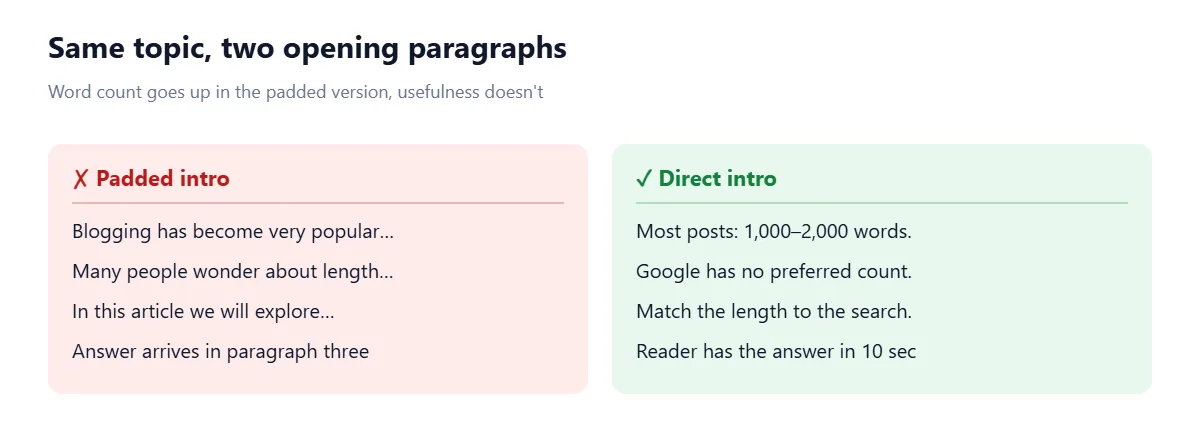
Answer in the first two sentences. It helps readers and gives search engines a clean passage to show as a snippet.
Use descriptive headings. Phrase them the way people search, so a skimmer can jump straight to their question.
Break up long stretches. Tables, numbered steps and short paragraphs carry more information per scroll than walls of text.
Write a meta description that sells the page. Keep it within the space Google shows; our guide to meta title and description length has the numbers.
Common mistakes with blog post length
Writing to a number. Yoast calls this out directly: writing only to hit a count leads to repetition and filler that reduce clarity and trust.
Copying the longest competitor. One 6,000-word hub page in the results doesn't mean searchers want 6,000 words. Look at the typical result, not the outlier.
Splitting one topic across thin posts. Five 300-word posts on closely related questions usually serve readers worse than one well-organized article.
Never updating old posts. Adding a missing section to a post that already ranks is often worth more than a new post.
To see where a draft stands, paste it into the Word Counter. It shows the word count and reading time as you type, and you can check word count the same way in Google Docs or Word.
Frequently asked questions
How long should a blog post be in 2026?
Most blog posts should be 1,000 to 2,000 words. The average post in Orbit Media's 2026 survey was 1,312 words, but the right length depends on what the searcher needs.
Is 500 words enough for a blog post?
Yes, if the topic is simple and the post answers it completely. Quick answers and news updates often work at 300 to 800 words.
Does Google prefer longer content?
No. Google says it has no preferred word count; it looks for content that covers the topic completely so readers don't need to search again.
What is the minimum word count for SEO?
There is no official minimum. Yoast SEO recommends at least 300 words for regular posts and 900 words for cornerstone content.
Are 2,000-word blog posts better?
Not automatically. In surveys, bloggers who write 2,000+ word posts report stronger results more often, but they also tend to invest more effort in research and promotion.
How many words is a 5-minute read?
About 1,190 words at an average silent reading speed of 238 words per minute, or about 1,325 words at Medium's 265 words per minute.
How long does it take to write a blog post?
About 3 hours 20 minutes on average, according to Orbit Media's 2026 survey of more than 1,000 content marketers.
Sources
Orbit Media. Blogging Statistics. 2026.
MarketingProfs. Blogging Benchmarks for 2025: Word Count and Frequency Trends. 2025.
Google Search Central. Creating helpful, reliable, people-first content.
Yoast. Word count and SEO: how long should an article or page be?. 2025.
Backlinko. We Analyzed 912 Million Blog Posts. Here's What We Learned About Content Marketing. 2019.
Bernoff, J. Correlation, causation, and confusion: the Backlinko study of 912 million blog posts.
Sall, M. The Optimal Post is 7 Minutes. Medium Data Lab, 2013.
Medium Help Center. Read time.
Brysbaert, M. How many words do we read per minute? A review and meta-analysis of reading rate. Journal of Memory and Language, 2019.

Comments