
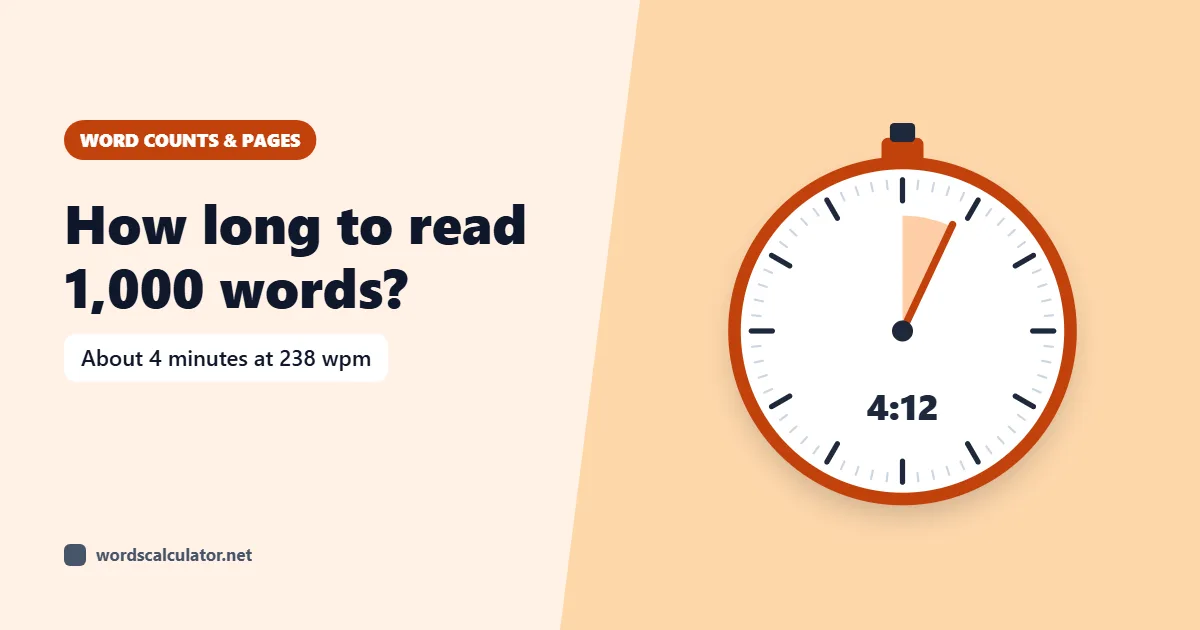
How long to read 1,000 words? It takes the average adult about 4 minutes to read 1,000 words silently, based on an average reading speed of 238 words per minute. Reading the same 1,000 words out loud takes about 5½ minutes, and skimming can cut it to 1 or 2 minutes.
You'll often see a faster figure quoted: 300 words per minute, which would make it 3 minutes 20 seconds. The research says that's too quick for most people. Below are the measured reading speeds, a reading time chart for 100 to 10,000 words, and a simple way to find your own speed.
How long does it take to read 1,000 words?
The best current estimate of adult reading speed comes from a 2019 review by psychologist Marc Brysbaert, who pooled 190 studies with 18,573 participants. He found that adults reading English silently average 238 words per minute for non-fiction and 260 words per minute for fiction (Brysbaert, 2019).
At those speeds, 1,000 words takes:
Non-fiction (238 wpm): 4 minutes 12 seconds. This covers articles, reports, essays and most things you read for work or study.
Fiction (260 wpm): 3 minutes 51 seconds. Stories use shorter words on average, so they go faster.
A slower reader (175 wpm): 5 minutes 43 seconds.
A faster reader (300 wpm): 3 minutes 20 seconds.
Brysbaert found that most adults fall between 175 and 300 wpm for non-fiction and between 200 and 320 wpm for fiction. So if 1,000 words takes you 5 minutes, you're not slow. You're well inside the normal range.
How long to read 1,000 words at different speeds
How you're reading changes the answer far more than who's reading. Silent reading, reading aloud, listening and skimming all run at different speeds:
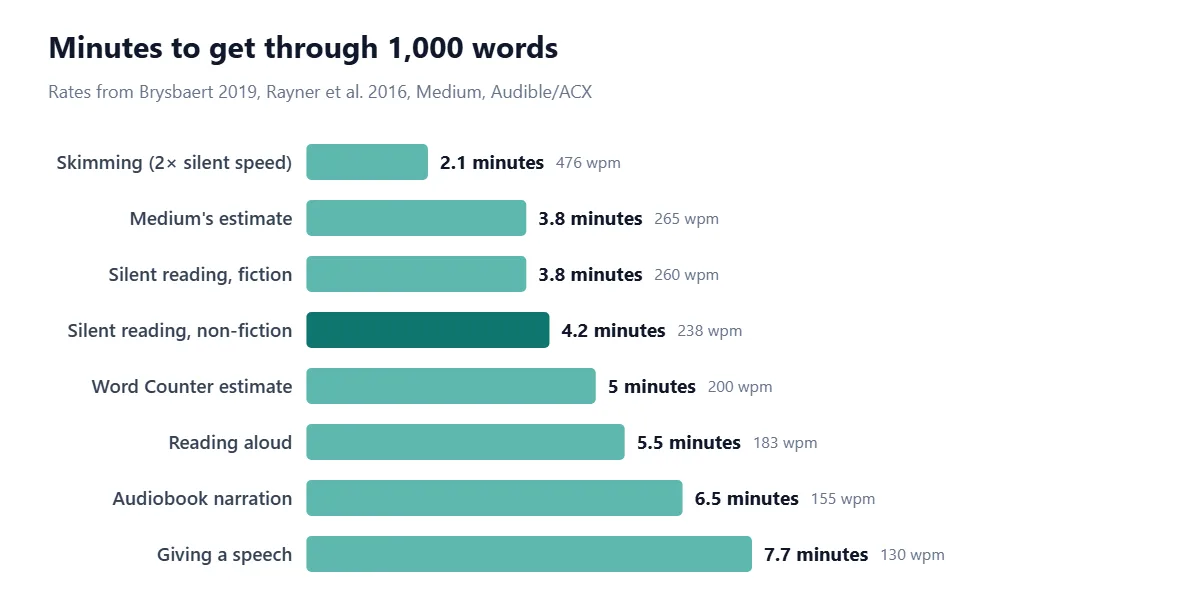
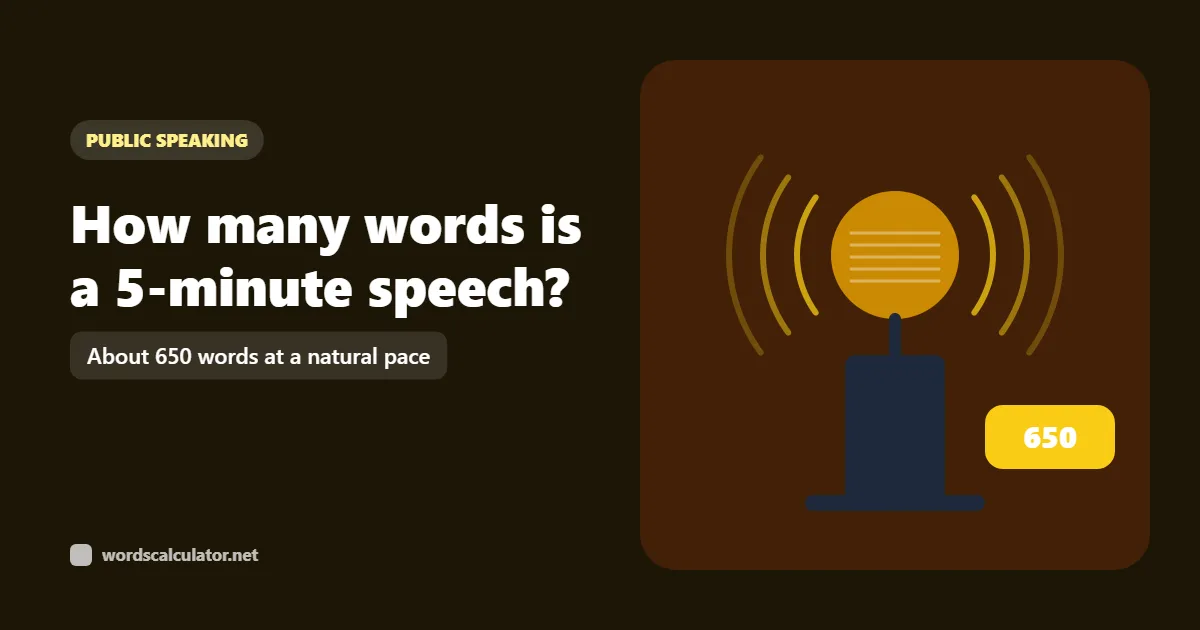
The gap between silent reading and speaking is the one that catches people out. A 1,000-word text you can read to yourself in about 4 minutes takes nearly 8 minutes to deliver as a talk. If you're timing a speech, see how many words fit in a 5-minute speech instead.
Reading time chart: 100 to 10,000 words
Times under 10 minutes are shown as minutes:seconds. The first column is the research average for silent reading of non-fiction; the others show a relaxed reader, a fast reader and reading out loud.
Word count | Silent, 238 wpm | Relaxed, 200 wpm | Fast, 300 wpm | Aloud, 183 wpm |
|---|---|---|---|---|
100 words | 0:25 | 0:30 | 0:20 | 0:33 |
250 words | 1:03 | 1:15 | 0:50 | 1:22 |
500 words | 2:06 | 2:30 | 1:40 | 2:44 |
750 words | 3:09 | 3:45 | 2:30 | 4:06 |
1,000 words | 4:12 | 5:00 | 3:20 | 5:28 |
1,500 words | 6:18 | 7:30 | 5:00 | 8:12 |
2,000 words | 8:24 | 10 min | 6:40 | 11 min |
2,500 words | 11 min | 12 min | 8:20 | 14 min |
3,000 words | 13 min | 15 min | 10 min | 16 min |
5,000 words | 21 min | 25 min | 17 min | 27 min |
7,500 words | 32 min | 38 min | 25 min | 41 min |
10,000 words | 42 min | 50 min | 33 min | 55 min |
For any other length, divide the word count by the reading speed. 3,600 words ÷ 238 wpm ≈ 15 minutes. It scales up to books too: an 80,000-word novel read at the fiction average of 260 wpm takes about 5 hours 8 minutes of reading time. For typical book lengths, see how many words are in a novel.
What is the average reading speed for adults?
About 238 words per minute for non-fiction and 260 for fiction, according to Brysbaert's review. That's lower than the numbers often repeated online, and the paper says so directly: its estimates are "lower than the numbers often cited in scientific and popular writings."
A separate 2016 review led by Keith Rayner describes good college-educated readers as usually reading at 200 to 400 words per minute (Rayner et al., 2016). The two agree more than they seem to: Brysbaert's figures are averages across all adults, and Rayner's describe skilled readers.
Several things move an individual's speed:
Word length. Brysbaert found the fiction versus non-fiction gap is explained by longer words in non-fiction. Technical and academic writing, full of long words, reads slower still.
Age. Reading rates are lower for children and for older adults.
Language. Reading in a second language is slower than in your first.
Purpose. Reading closely to learn or study takes longer than reading for the gist, and skimming is faster still, as the next sections show.
How long does it take to read 1,000 words out loud?
About 5½ minutes. Brysbaert's review found an average oral reading rate of 183 words per minute across 77 studies with 5,965 participants, so 1,000 words takes 5 minutes 28 seconds.
Reading aloud for an audience is slower again. Audible's production estimate is 155 words per minute, or 9,300 words per finished hour of audiobook (Karen Commins on ACX rates), which puts 1,000 words at about 6½ minutes. A speech, with pauses for breath and emphasis, is slower still: at 130 wpm, the pace our Word Counter uses for speaking time, 1,000 words takes about 7 minutes 42 seconds.
How long does it take to skim 1,000 words?
Roughly 1 to 2 minutes. Rayner and colleagues report that skimming can be two to four times faster than typical silent reading. Applied to the 238 wpm average, that's about 476 to 952 words per minute, or 1 to 2 minutes for 1,000 words.
The catch is understanding. The same review found a trade-off between speed and accuracy: the less time you spend on a text, the less of it you understand (Association for Psychological Science summary via ScienceDaily). Skimming works well when you only need the gist or want to find a specific section. It works badly for a contract, a set of instructions or anything you'll be tested on.
Why reading time estimates differ from site to site
Blogs and publishing tools show a "minutes to read" label, but they don't all assume the same speed, so the same article can be labelled differently. Medium, for example, bases its read time on 265 words per minute, with an adjustment for images (Medium Help Center). Our Word Counter uses 200 wpm.
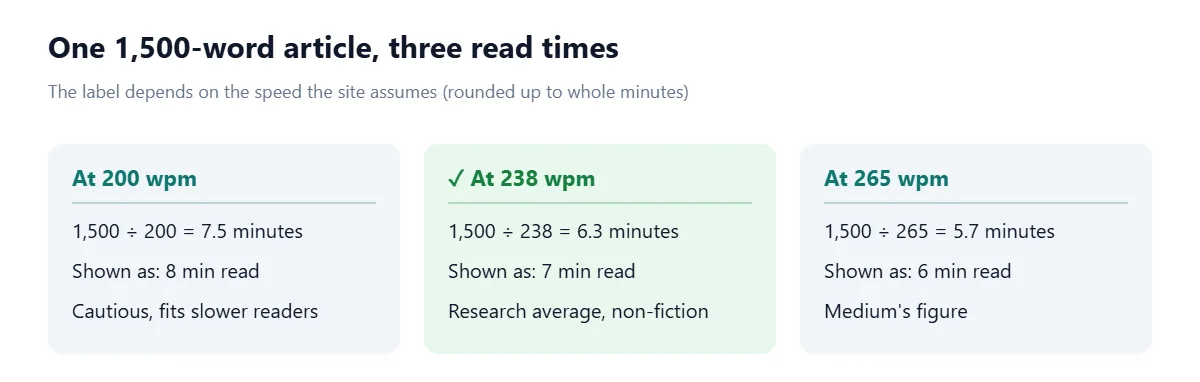
Why 200 when the research average is 238? A reading time label is a promise to the reader. At 200 wpm it holds for most people, including readers toward the slow end of the normal range. At 265 it's accurate for fast readers of easy text and a bit optimistic for everyone else. If you'd rather use the research average, divide your word count by 238.
One more thing most read-time labels ignore: tables, charts, code and images. A reader spends time on a chart that has no words at all. If your article leans on visuals, round the estimate up.
How to measure your own reading speed
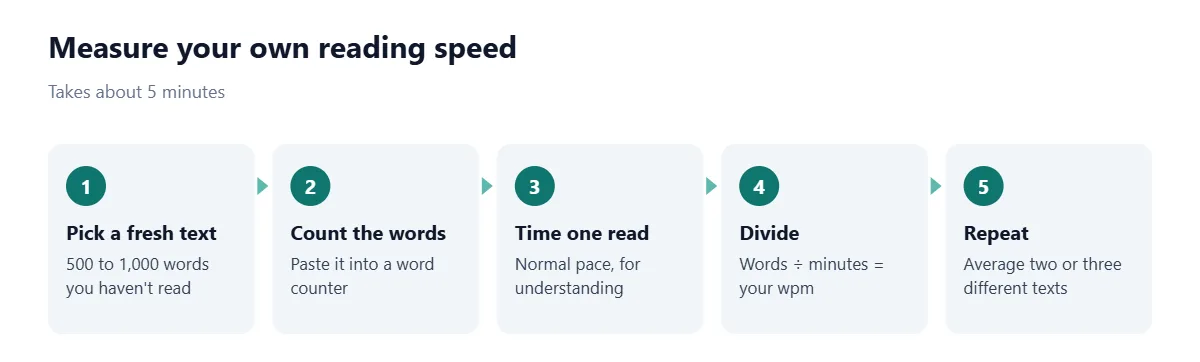
Choose a text you haven't read before, about 500 to 1,000 words, of the kind you usually read. A news article or a chapter of a non-fiction book works well.
Get its word count. Paste it into the Word Counter, or use the Website Word Counter to count the words on a web page from its URL.
Start a timer and read at your normal pace, reading to understand, not to race.
Divide the word count by your time in minutes. 850 words in 3 minutes 30 seconds (3.5 minutes) is about 243 wpm.
Repeat with two or three different texts and take the average. One text can be unusually easy or hard.
Want to check understanding too? Write down three things you remember from the text before you look back at it. If you can't, slow down: your real reading speed is the fastest pace at which you still take the text in.
How to estimate reading time for your own writing
Divide your word count by 238 for a typical adult reader, or by 200 for a cautious estimate that suits most readers. Then adjust:
Add time for visuals. Charts, tables and images all take reading time without adding words.
Add time for difficult material. Technical, legal or academic text reads slower than the averages.
Use the audience's speed, not yours. You read your own writing faster because you already know what it says.
Count the words you'll actually publish. Leave out notes, comments and references the reader won't read. To count words in a finished file, use the Document Word Counter.
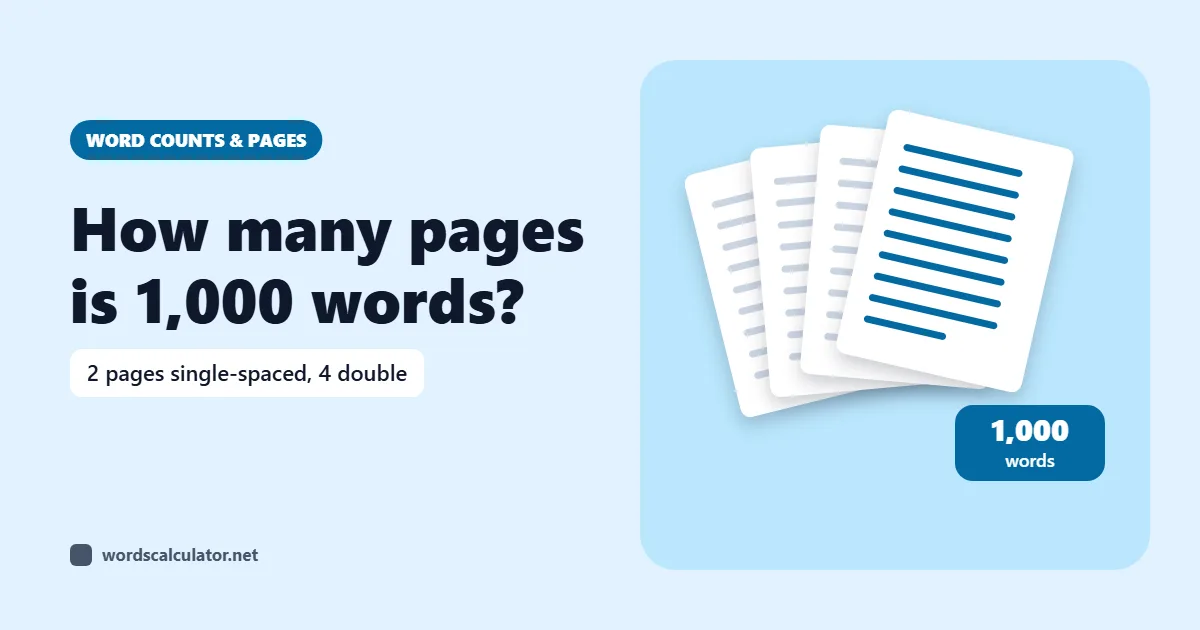
If a teacher or client gives you a length in pages instead, 1,000 words is about 2 single-spaced or 4 double-spaced pages.
Frequently asked questions
How long does it take to read 1,000 words?
About 4 minutes for an average adult reading silently at 238 words per minute. Most people take between 3 minutes 20 seconds and 5 minutes 43 seconds.
How long does it take to read 1,000 words out loud?
About 5 minutes 28 seconds at the average oral reading rate of 183 words per minute. Delivered as a speech at 130 wpm, it takes about 7 minutes 42 seconds.
How long does it take to read 500 words?
About 2 minutes silently at 238 words per minute, or about 2 minutes 44 seconds out loud.
How long does it take to read 2,000 words?
About 8 minutes 24 seconds at 238 words per minute, or 10 minutes at a relaxed 200 wpm.
What is the average reading speed?
About 238 words per minute for non-fiction and 260 for fiction, according to a 2019 review of 190 studies. Most adults read non-fiction at 175 to 300 words per minute.
Is 300 words per minute a good reading speed?
Yes. 300 wpm is at the fast end of the normal adult range for non-fiction, which runs from about 175 to 300 wpm.
How long does it take to skim 1,000 words?
About 1 to 2 minutes, since skimming runs two to four times faster than normal reading. You'll understand less of the text, though.
How many pages is 1,000 words?
About 2 pages single-spaced or 4 pages double-spaced in 12-point Times New Roman with 1-inch margins.
How do you convert words to minutes?
Divide the word count by a reading speed. At the average silent reading speed of 238 words per minute, 1,000 words takes about 4 minutes; reading the same words aloud takes about 5½ minutes.
Sources
Brysbaert, M. (2019). How many words do we read per minute? A review and meta-analysis of reading rate. Journal of Memory and Language, 109.
Rayner, K., Schotter, E. R., Masson, M. E. J., Potter, M. C. and Treiman, R. (2016). So much to read, so little time: How do we read, and can speed reading help? Psychological Science in the Public Interest, 17(1).
Association for Psychological Science. Speed reading promises are too good to be true, scientists find. ScienceDaily, 2016.
Association for Psychological Science. So much to read, so little time: How do we read, and can speed reading help?
Speed reading. Wikipedia.
Medium. Read time. Medium Help Center.
Commins, K. Some simple math about audiobook rates (Audible/ACX 155 wpm, 9,300 words per finished hour), 2011.

Comments