
The ideal meta description length is about 150 to 160 characters and the ideal title tag is about 50 to 60 characters. Google has no official character limit for either one. It cuts them off to fit the width of the screen, so these numbers are safe targets rather than hard rules.
That's the short version. The longer version matters more, because Google often ignores the description you wrote and builds its own from your page. Below you'll see where the common numbers come from, why mobile shows less, how often Google rewrites titles and snippets, and how to write both so they survive.
Meta description length: how long should it be?
Google's own documentation is clear that there isn't a limit: "There's no limit on how long a meta description can be, but the snippet is truncated in Google Search results as needed, typically to fit the device width" (Google Search Central).
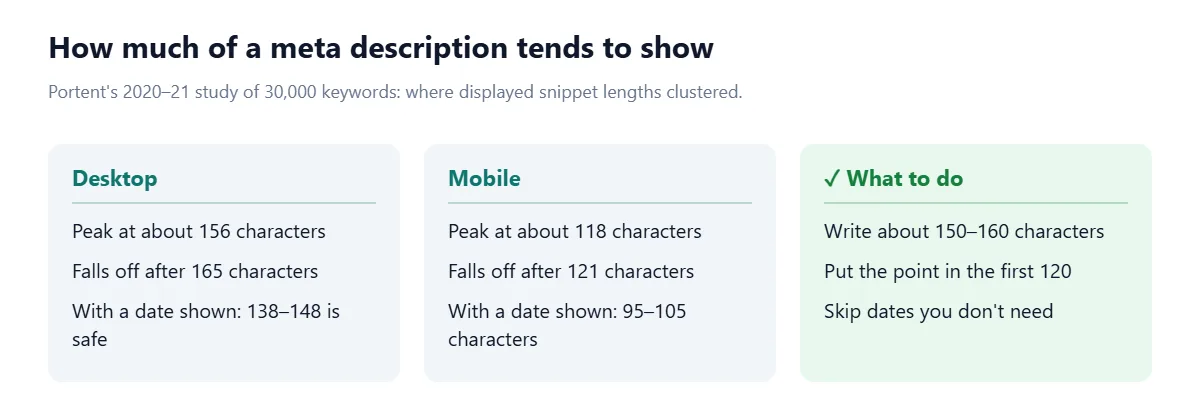
So where does 150–160 come from? From people measuring what actually appears. In Portent's study of 30,000 keywords, desktop snippets peaked at about 156 characters and dropped off sharply after 165. On mobile they peaked at about 118 characters and dropped after 121 (Portent, 2021). A description in the 150–160 range fills the desktop space without being chopped mid-word, and a well-built one still makes sense if the phone cuts it at 120.
Google's SEO Starter Guide describes a good meta description as "a succinct, one- or two-sentence summary of the page" (Google Search Central). Two sentences of normal length land almost exactly in that 140–160 character window, which is a handy way to check yourself without counting.
How long should a title tag be?
Again, Google gives no number. Its title link documentation says the title "is truncated in Google Search results as needed, typically to fit the device width" and asks for titles that are "descriptive and concise" (Google Search Central).
The best evidence for a target comes from rewrite data. Zyppy looked at 80,959 title tags across 2,370 sites and found that titles of 51 to 60 characters were changed least often, about 39 to 42% of the time. Titles over 60 characters were rewritten more than 76% of the time, and titles over 70 characters 99.9% of the time (Zyppy, 2022). Very short titles did badly too: 96.6% of titles with 1 to 5 characters were replaced.
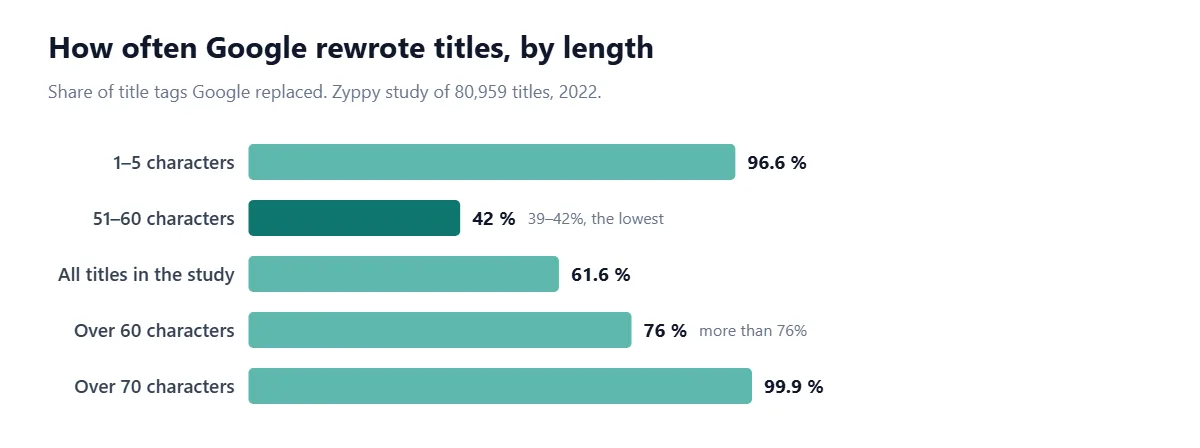
That's why 50–60 characters is the working rule. It is long enough to describe the page and short enough that Google usually keeps what you wrote.
Characters or pixels: which limit is real?
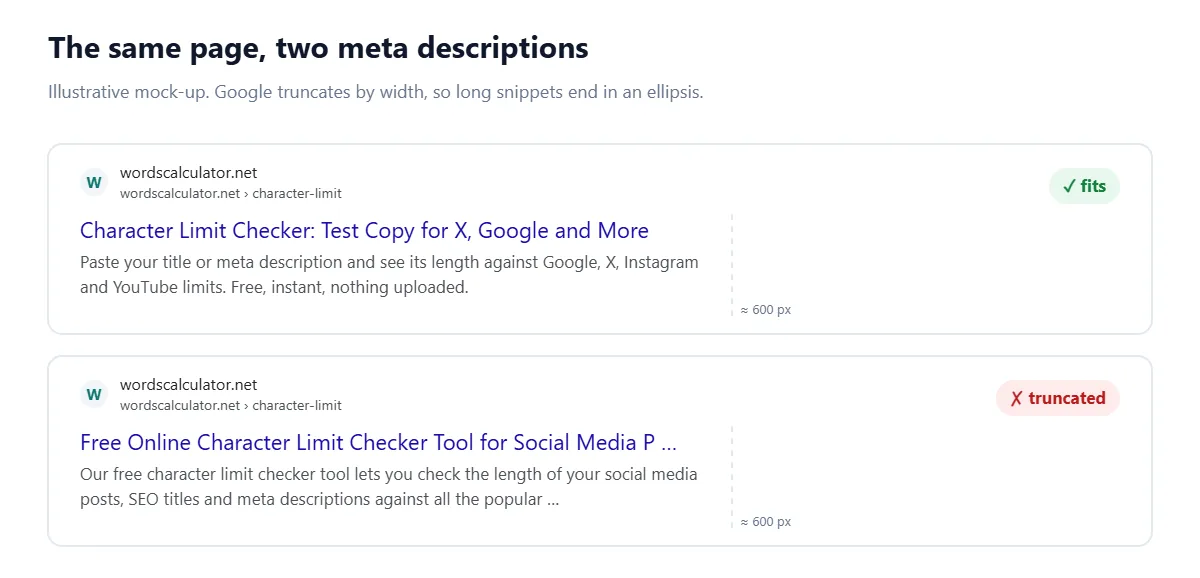
Pixels, in effect. Google trims to fit the space available, and letters take up different amounts of space. A title full of wide letters like W and M runs out of room sooner than one full of i, l and t. Capital letters are wider than lowercase, so a title in ALL CAPS gets cut much earlier.
Google doesn't publish a pixel figure. SEO tools estimate the title space at somewhere around 580 to 600 pixels on desktop (WsCube Tech), but those are third-party measurements and they vary from tool to tool. Character counts are easier to work with and close enough if you write in normal sentence or title case.
Element | Google's official limit | Practical target | Shows on mobile |
|---|---|---|---|
Title tag | None (cut to fit width) | 50–60 characters | Similar; wraps to 2 lines |
Meta description | None (cut to fit width) | 150–160 characters | About 120 characters |
max-snippet setting | Any number you set | Leave unset or -1 | Same |
Meta keywords tag | Not used by Google | Skip it | Not shown |
The mobile column for titles is a rough guide only. Phone results give titles more lines but less width, so the exact cut-off depends on the device. The safe move is the same everywhere: put the words that matter first.
Why does Google rewrite meta descriptions?
Because the snippet is meant to match the search, not the page. Google says snippets "are primarily created from the page content itself" and that it uses your meta description only "if we think it gives users a more accurate description than would be possible purely from the on-page content" (Google Search Central). It also says the same page can show different snippets for different searches.
In practice that happens a lot. Ahrefs checked 20,000 keywords and found Google rewrote meta descriptions 62.78% of the time (Ahrefs, 2020). Portent put the figure at 68% on desktop and 71% on mobile for first-page results (Portent, 2021). The two studies used different keyword sets and dates, so the exact number differs, but both say the same thing: most of the time, the snippet people see is not the one you wrote.
Here's the part most articles skip. In the Ahrefs data, length made almost no difference: Google rewrote 61.46% of descriptions that were too long and 63.69% of ones that were a sensible length. What moved the needle was the search itself. Long-tail searches got rewritten descriptions 65.62% of the time, compared with 59.65% for short, popular searches. A description can't cover every long-tail question, so Google pulls a better-matching sentence from the page.
Why does Google change my title tag?
Google lists the situations where it's likely to replace a title: half-empty titles, obsolete dates, titles that misrepresent the page, repeated boilerplate across many pages, pages with several competing headings and no clear main title, and titles in a different language or script from the page (Google Search Central).
When it replaces a title, it can draw on the title element, the main visible heading, the H1 and other headings, og:title, other prominent text, anchor text from links pointing to the page, and WebSite structured data. That's why a title that matches your H1 is less likely to be swapped out: the two sources agree.
Formatting plays a part too. In the Zyppy study, text inside square brackets was removed 32.9% of the time, against 19.7% for text in parentheses, and pipe separators were dropped more than twice as often as dashes (Zyppy, 2022). If you use a separator before your brand name, a dash is the safer choice.
How to write a meta description that gets used
Answer the search in the first sentence. If someone searched "how long is a meta description", your first sentence should contain the answer, not a welcome.
Keep the key point inside 120 characters. That covers the mobile cut-off seen in Portent's data. The rest can add detail.
Make every page's description unique. Google's guidance asks for distinct descriptions rather than one reused across the site (Google Search Central).
Write sentences, not keyword lists. Google's own bad example is a string of product names; its good example says what the shop sells, its hours and its location.
Use real specifics. Prices, sizes, dates, authors, counts. Google says programmatically generated descriptions are fine for large sites if they stay "human-readable and diverse".
Check the length before you publish. Paste it into the Character Limit Checker and fix anything over 160.
How to write a title tag Google keeps
Lead with the topic. The words people searched for should appear in the first 30 or so characters, before anything gets cut.
Match your H1. It doesn't need to be identical, but it should say the same thing.
Keep branding short and at the end. Google recommends branding titles concisely. "– Words Calculator" is enough; you don't need a tagline too.
Avoid ALL CAPS. Capitals are wider and eat into the space. Use title case or sentence case consistently; our guide to title case vs sentence case explains the difference, and the Case Converter will switch between them.
Don't put dates you won't maintain. Google names obsolete dates as a reason to rewrite a title. If "2026" is in the title, update it when the year changes, or leave it out.
Can you control snippet length with max-snippet?
Yes, but only to make it shorter. The robots meta tag max-snippet:[number] tells Google to use no more than that many characters in a text snippet. A value of 0 means no snippet at all, the same as nosnippet, and -1 lets Google choose whatever length it thinks works best (Google Search Central).
There's also a data-nosnippet attribute you can put on span, div and section elements to keep specific text (a disclaimer or a cookie notice, say) out of snippets. None of these settings make Google show more than it otherwise would, and a low max-snippet can make your result look thin next to competitors. For most sites the best setting is no setting.
Common meta description and title mistakes
Writing to exactly 160 characters and burying the point at the end. On a phone, the last 40 characters may never show.
Copying the same description onto every page. Google calls out duplicate, boilerplate descriptions and is likely to replace them.
Keyword stuffing. Repeating the keyword three times reads badly and Google's guidance warns against it for both titles and descriptions.
Leaving it blank on important pages. Ahrefs found 25.02% of top-ranking pages had no meta description, so it isn't fatal, but you give up the one chance to write the pitch yourself.
Counting only characters. A title that fits at 58 lowercase characters may not fit in capitals. Look at it, don't just count it.
If you're also writing descriptions for video, the same front-loading rule applies there; see our guide to YouTube title and description limits. For plain counts of anything else, the Character Counter shows characters with and without spaces.
Frequently asked questions
What is the ideal meta description length?
About 150 to 160 characters, with the main point in the first 120 characters. Google has no official limit and truncates snippets to fit the screen width.
Is there a character limit for meta descriptions?
No. Google's documentation says there's no limit on meta description length, but it shortens the snippet in search results to fit the device, which on desktop has typically meant about 155 to 165 characters.
How long should a title tag be for SEO?
Aim for 50 to 60 characters. In a study of about 81,000 titles, Google rewrote titles of 51 to 60 characters least often and rewrote almost every title over 70 characters.
What happens if a meta description is too long?
Google cuts it off with an ellipsis where the space runs out. The page isn't penalized, but readers may miss the end of your message, so put the key point first.
How much of a meta description shows on mobile?
Usually less than on desktop. Portent's study found mobile snippets clustered around 118 to 121 characters, so keep your main message within the first 120.
Why is Google not showing my meta description?
Google uses your meta description only when it thinks it describes the page better than the page text does for that search. Studies have found Google rewrites roughly 63 to 71 percent of meta descriptions.
Are title tags measured in characters or pixels?
Google truncates by display width, which works out as pixels, so wide letters and capitals use up space faster. A character count of 50 to 60 is a good stand-in for normal text.
Sources
Google Search Central. Control your snippets in search results. Google, 2026.
Google Search Central. Influencing your title links in search results. Google, 2025.
Google Search Central. Robots meta tag, data-nosnippet, and X-Robots-Tag specifications. Google.
Google Search Central. SEO Starter Guide. Google.
Pecánek, M. How Often Does Google Rewrite Meta Descriptions?. Ahrefs, 2020.
Hall, E. How Often Google Ignores Our Meta Descriptions. Portent, 2021.
Shepard, C. Google Title Rewrite Study. Zyppy, 2022 (updated 2026).
WsCube Tech. Meta Title and Description Character Limit (pixel estimates).

Comments