
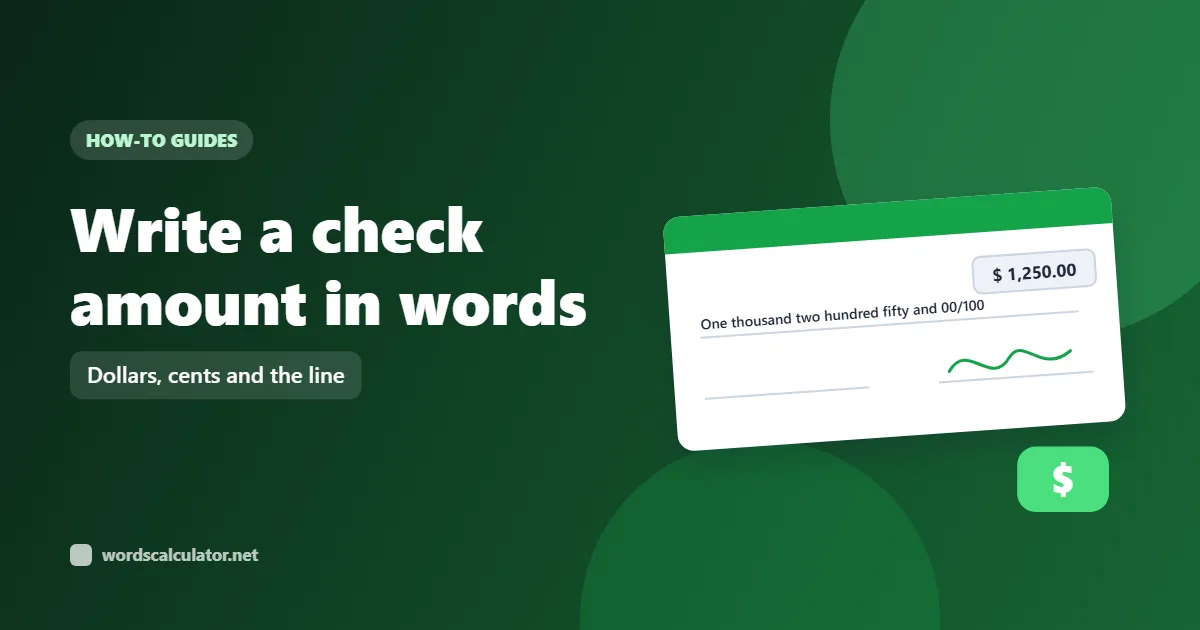
Here's how to write a check amount in words, the part of a check people get wrong most often: spell out the dollar amount, write "and", then write the cents as a fraction over 100. For $1,250.75, that's One thousand two hundred fifty and 75/100, followed by a line through any empty space to the end of the row.
That format works for every personal check in the US, from $5 to $50,000. Below you'll find the step-by-step method, a table of worked examples, how to handle even amounts and amounts under a dollar, what happens if the words and numbers don't match, and how cheques are written in the UK and India.
How to write a check: all six fields
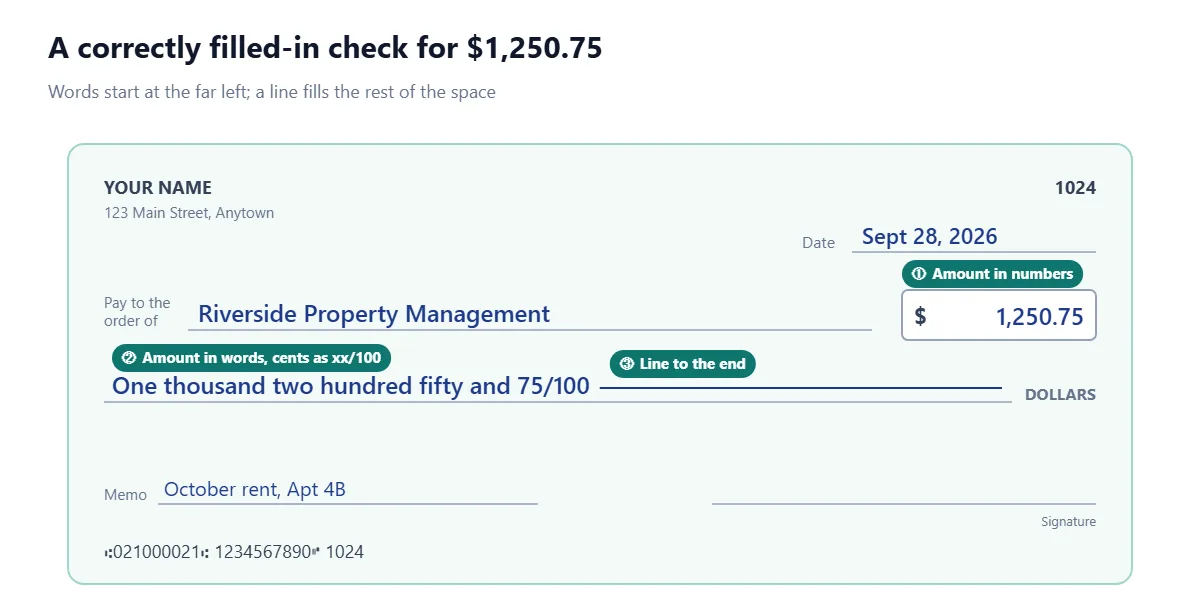
If you're writing a check for the first time, fill in the six blank fields from top to bottom. Use a pen with dark, permanent ink, and don't leave gaps anyone could write into.
Date. Write today's date on the line in the top-right corner, for example 09/30/2026 or September 30, 2026.
Pay to the order of. Write the full name of the person or company you're paying, exactly as they'd want it on their account.
Amount box. In the small box next to the payee, write the amount in numbers, close to the dollar sign: 125.50.
Amount line. On the long line below, write the same amount in words, with the cents as a fraction: One hundred twenty-five and 50/100. Draw a line through the rest of the space.
Memo. Optional, but useful: add what the check is for, or an account or invoice number the payee asked for.
Signature. Sign the line in the bottom-right corner the same way you signed when you opened the account. A check isn't valid without it.
Finally, record the check number, date, payee and amount in your check register or banking app so your balance stays right. The rest of this guide covers the amount line in detail, because it's the part banks read as the legal amount.
How to write a check amount in words, step by step
The written amount goes on the long line below "Pay to the order of", the one that usually ends with the printed word "Dollars". Here's how to fill it in:
Write the number in the box first. In the small box next to the $ sign, write the amount with the cents, such as 236.79. Keep it tight against the $ sign.
Start the words at the far left of the line. Leaving a gap at the start gives someone room to add a word in front of yours.
Spell out the whole dollars. "Two hundred thirty-six". Hyphenate numbers from twenty-one to ninety-nine.
Add "and" plus the cents over 100. "and 79/100". The fraction means 79 cents out of a dollar's 100.
Draw a line to the end. Run a straight line from the last character to the printed word "Dollars" so nothing can be squeezed in.
Check that the words and numbers match before you sign.
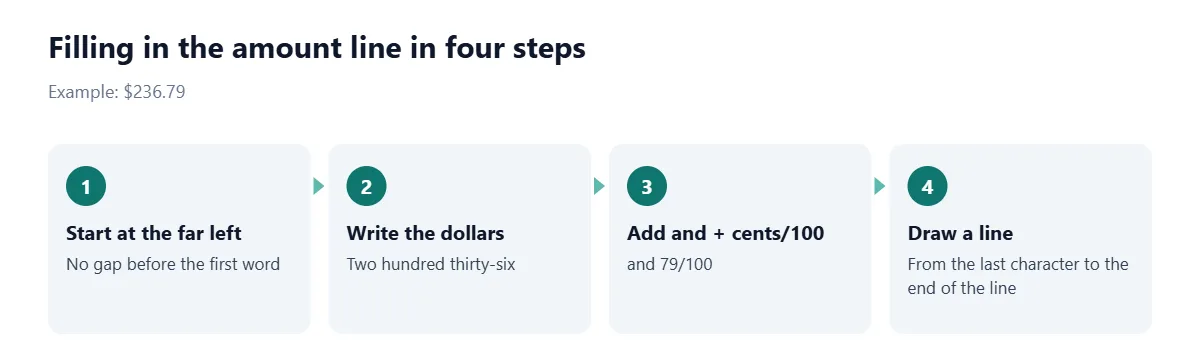
This is the method banks teach. Huntington Bank uses the same example: $236.79 becomes "two hundred thirty-six and 79/100", with a line drawn from the end of your writing to the right-hand side to stop anyone altering the amount.
How to write cents on a check
Cents are always written as a fraction with 100 on the bottom, never in words. Capital One gives the example $44.99 = "Forty-four and 99/100", and U.S. Bank says 10 cents is written 10/100.
Why a fraction? Two reasons. It's compact, so the whole amount fits on one line. And a fraction is harder to alter than words: "and seventy cents" can become "and seventy-five cents" with a few pen strokes, while "70/100" leaves no room to add anything.
Always use two digits. 5 cents is 05/100, not 5/100. It matches the numeric box and removes any doubt.
Write the cents in the box too. WaFd Bank recommends always showing cents, so a round $50 is written 50.00 in the box.
Some people draw the line between the dollars and the fraction. Citizens Bank shows "Five hundred ------------ 50/100", with the dash line filling the gap before the cents. Either placement works as long as there's no blank space left.
Check amount in words: worked examples
Use this table as a model. The words column is exactly what goes on the line, followed by a line to the end.
Amount | Written on the check |
|---|---|
$5.00 | Five and 00/100 |
$19.99 | Nineteen and 99/100 |
$45.50 | Forty-five and 50/100 |
$100.00 | One hundred and 00/100 |
$250.00 | Two hundred fifty and 00/100 |
$1,000.00 | One thousand and 00/100 |
$1,200.00 | One thousand two hundred and 00/100 |
$1,250.75 | One thousand two hundred fifty and 75/100 |
$2,575.30 | Two thousand five hundred seventy-five and 30/100 |
$10,000.00 | Ten thousand and 00/100 |
$0.75 | Zero and 75/100 |
For any amount not listed, our Number to Words converter writes the check wording for you, including the cents fraction, so you can copy it exactly.
How to write a check for an even dollar amount
Even when there are no cents, write them: $500 becomes "Five hundred and 00/100". Bankrate explains that including 00/100 prevents someone from adding cents to your check, and Huntington recommends it for clarity.
You may also see "no/100". PNC says a $50.00 check can be written "Fifty dollars" or "Fifty dollars and no/100". Both are accepted, but 00/100 is the most common form and matches the 50.00 you wrote in the box.
How to write a check for less than a dollar
Checks for under $1 are rare, but they happen with small refunds and account-closing balances. Write the amount in the box as 0.75, then on the line write "Zero and 75/100" or "No dollars and 75/100", the two forms suggested by SuperMoney. Starting with "Zero" or "No dollars" matters: a line that begins with just "75/100" leaves the dollar position empty for someone else to fill.
Using "and", hyphens and "dollars" correctly
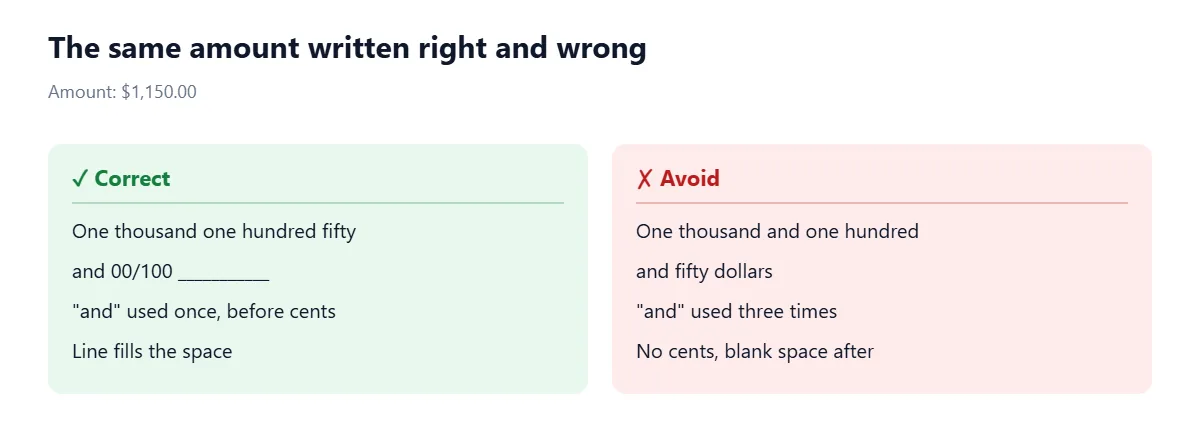
Use "and" only once
On a check, "and" has one job: it separates the dollars from the cents. So $1,150 is "One thousand one hundred fifty and 00/100", not "One thousand and one hundred and fifty". In everyday speech, many people (especially outside the US) say "one hundred and fifty", but on a check that extra "and" makes it look as if the cents start early. Plenty of guides skip this, but it's the easiest way to keep the amount unambiguous.
Hyphenate 21 to 99
Compound numbers from twenty-one to ninety-nine take a hyphen: forty-four, seventy-five, ninety-nine. The banks' own examples all follow this. Round tens (twenty, thirty) and hundreds don't need one.
Should you write "dollars"?
Most checks print "Dollars" at the end of the amount line, so you don't need to write it. PNC suggests adding it for clarity ("Fifty dollars and 25/100"), and that's fine too. Just don't write "dollars" and then leave space before the printed word.
Capital letters
Capitalization doesn't affect whether a check is valid. Bank examples vary: some capitalize the first word ("One thousand..."), others write everything in lowercase. Don't worry about title case or sentence case here; what matters is that the words are legible.
How to write large amounts on a check
Break big numbers into groups the way you'd say them, and leave out commas and extra "and"s:
$1,500.00: One thousand five hundred and 00/100.
$1,600.00: One thousand six hundred and 00/100. Citizens Bank notes that "Sixteen hundred" is also acceptable.
$12,480.00: Twelve thousand four hundred eighty and 00/100.
$150,000.00: One hundred fifty thousand and 00/100.
If the words won't fit on one line, write smaller rather than wrapping onto the memo line. Capital One also suggests writing the numbers in the box large enough to fill the space. For very large payments, ask your bank whether a cashier's check or a transfer is the better option.
What if the words and numbers on a check don't match?
The written words win. Under the Uniform Commercial Code, the model law US states use for checks, section 3-114 says that when an instrument contains contradictory terms, "words prevail over numbers". WaFd Bank puts it simply: the bank will go with the amount you wrote in words.
That doesn't mean a mismatch is harmless. Bankrate warns that a mismatch can delay processing or get the check rejected. And because the words are the legal amount, a mistake there costs more than a slip in the box. If you notice an error, the safest fix is to write "VOID" across the check and start again, as Citizens Bank advises, then shred it.
How to write a cheque amount in words in the UK and India
Outside the US, cheques follow the same idea (the words are the amount that counts) but the wording is different.
UK cheques
UK cheques end the amount with "only". money.co.uk gives the example £56.23 = "Fifty-six pounds and twenty-three pence only", and explains that "only" stops people adding to what you've written. It's also common to draw a line through the rest of the box after "only".
Indian cheques
Indian cheques also end with "only", and the figures in the box end with "/-", as BankBazaar's cheque guide explains. The big difference is the number system: amounts are grouped in lakhs (1,00,000) and crores (1,00,00,000) rather than hundreds of thousands and millions. So ₹1,25,000 is written "One lakh twenty-five thousand only", not "One hundred twenty-five thousand only". Our Number to Words converter has a lakh/crore mode for exactly this.
Detail | US check | UK cheque | Indian cheque |
|---|---|---|---|
Ending | Line to "Dollars" | "only" + line | "only" + line |
Large numbers | Thousands, millions | Thousands, millions | Lakhs, crores |
Box figures | 1,250.75 | 56.23 | 1,25,000/- |
Common check-writing mistakes
Leaving space at the start or end of the line. This is how amounts get changed. Start at the edge and fill the rest with a line.
Writing cents in words. "and seventy-five cents" is easy to alter. Use 75/100.
Leaving out the cents on an even amount. Always add 00/100.
Extra "and"s. Keep "and" for the point where the cents begin.
Using pencil or erasable ink. U.S. Bank recommends a blue or black gel pen.
Words and numbers that don't match. Check both before you sign.
Postdating and assuming it's safe. Citizens Bank notes that banks can cash a postdated check before its date, so only write a check when the money is in your account.
If you write checks often, or you're printing them from accounting software, it helps to have the exact wording in front of you. Type the amount into the converter, choose the check format, and copy the result. If you're matching a batch of printed checks against an invoice list, Compare Text shows any line that differs.
Frequently asked questions
How do you write cents on a check?
Write the cents as a fraction over 100 after the word "and". For example, $44.99 is written "Forty-four and 99/100", and 5 cents is 05/100.
How do you write $1,000 on a check?
Write "One thousand and 00/100" on the amount line and 1,000.00 in the box. Start at the far left and draw a line through the space after the fraction.
How do you write a check for an even amount with no cents?
Add 00/100 after the dollars, such as "Two hundred fifty and 00/100" for $250. Some banks also accept "no/100", but 00/100 is the most common.
How do you write a check for less than a dollar?
Write 0.75 in the box and "Zero and 75/100" (or "No dollars and 75/100") on the line. Starting with "Zero" stops anyone adding a dollar amount in front.
Do you need to write "and" on a check?
Yes, once, between the dollars and the cents. Don't use it inside the dollar amount: $150 is "One hundred fifty and 00/100", not "One hundred and fifty".
What happens if the written amount and the number on a check are different?
The written words legally take priority over the numbers under UCC section 3-114. In practice, a mismatch can also delay the check or get it rejected, so it's better to void it and write a new one.
Do you hyphenate numbers on a check?
Yes. Hyphenate compound numbers from twenty-one to ninety-nine, such as forty-five or seventy-two.
Why do people write "only" on a cheque?
"Only" marks the end of the amount so nothing can be added after it. It's standard on UK and Indian cheques; US checks use a line to the printed word "Dollars" instead.
How do you write a check step by step?
Fill in the date, the payee's name after "Pay to the order of", the amount in numbers in the box, the same amount in words on the line below (with cents as a fraction over 100), an optional memo, and your signature at the bottom right.
How do you write $1,500 on a check?
Write 1,500.00 in the box and "One thousand five hundred and 00/100" on the amount line, then draw a line through the empty space after it.
What do you write in the memo line of a check?
Anything that helps the payee or you identify the payment, such as "September rent", an invoice number or your account number. The memo line is optional and doesn't affect whether the check is valid.
Sources
Huntington Bank. How to Write a Check.
Capital One. How to Write a Check in 6 Easy Steps.
U.S. Bank. How to write a check.
Citizens Bank. How to write a check: A step-by-step guide.
WaFd Bank. How to Write Large and Small Numbers on a Check.
Bennett, R. How to write a check. Bankrate, 2026.
SuperMoney. How to Correctly Write a Check With Cents and Dollars.
Legal Information Institute. UCC § 3-114: Contradictory Terms of Instrument. Cornell Law School.
money.co.uk. How to write a cheque.
BankBazaar. Cheques in India: Writing, Rules, Charges & More.


Comments