
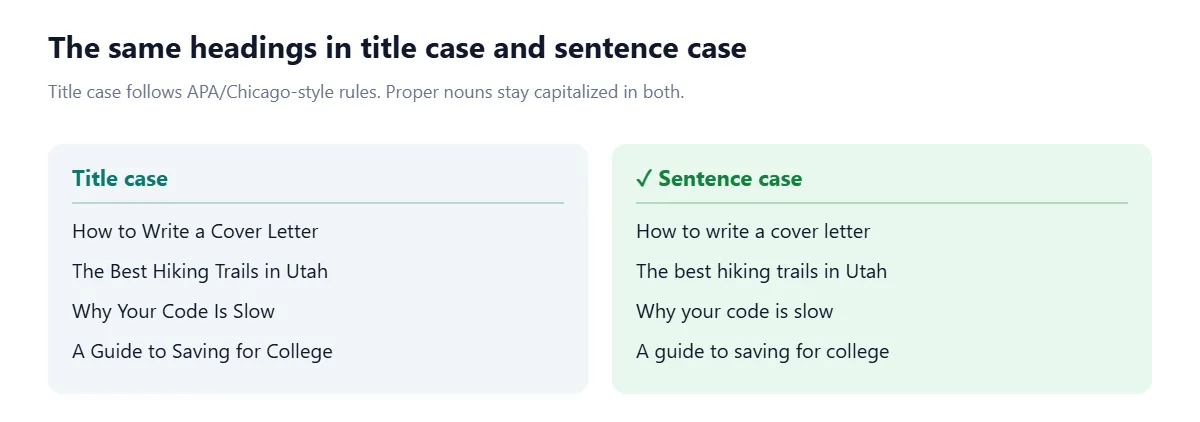
Title case vs sentence case comes down to capitals. Title case capitalizes every major word in a heading ("How to Write a Cover Letter"), while sentence case capitalizes only the first word and any proper nouns ("How to write a cover letter"). Title case is traditional for book and article titles; sentence case is now the default in many web, software and government style guides.
The hard part isn't the definition. It's the small words: is "with" capitalized? What about "is" or "from"? The answer depends on which style guide you follow, and APA, Chicago, MLA and AP each draw the line in a slightly different place. This guide gives you the rules for each, side-by-side examples, and a simple way to decide which case to use.
What is the difference between title case and sentence case?
Both styles capitalize the first word and proper nouns. The difference is what happens to everything else.
Title case (Chicago calls it "headline style" in older editions) capitalizes the important words and leaves the minor ones lowercase: "The Lord of the Rings", "A Room with a View".
Sentence case treats a heading like a sentence. Only the first word and names are capitalized: "The lord of the rings" would be wrong as a book title, but "How we cut our build time in half" is a perfectly normal sentence-case blog heading.
Neither is more correct than the other. They're conventions, and the right one is whichever your style guide, publisher or brand has chosen. What is always wrong is mixing them: three headings in title case and two in sentence case make a page look unedited.
Title case rules: which words do you capitalize?
The core rules are the same in every major style guide. Capitalize:
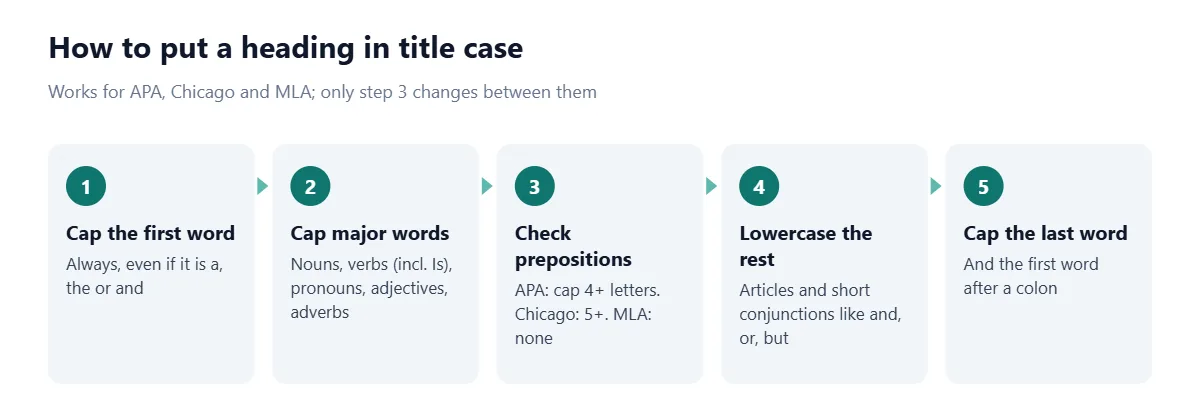
The first word of the title, whatever it is ("A", "The", "And").
The last word, even if it's a short word like "on" or "up" ("Things to Look Out For").
Major words: nouns, pronouns, verbs, adjectives and adverbs.
The first word after a colon, since it starts a subtitle: "Deep Work: Rules for Focused Success".
One trap catches a lot of people: short verbs are major words. "Is", "Are", "Be" and "Was" are verbs, so they're capitalized in title case even though they're only two or three letters long. "Why Your Code Is Slow" is correct; "Why Your Code is Slow" is not. Pronouns work the same way, so "It", "He" and "Us" get a capital too.
Which words are not capitalized in a title?
In title case, the minor words stay lowercase unless they're the first or last word. These are:
Word type | Examples | Lowercase in title case? |
|---|---|---|
Articles | a, an, the | Yes, in all major guides |
Coordinating conjunctions | and, but, or, nor, for | Yes, in all major guides |
Short prepositions | in, of, on, at, to, by | Yes, in all major guides |
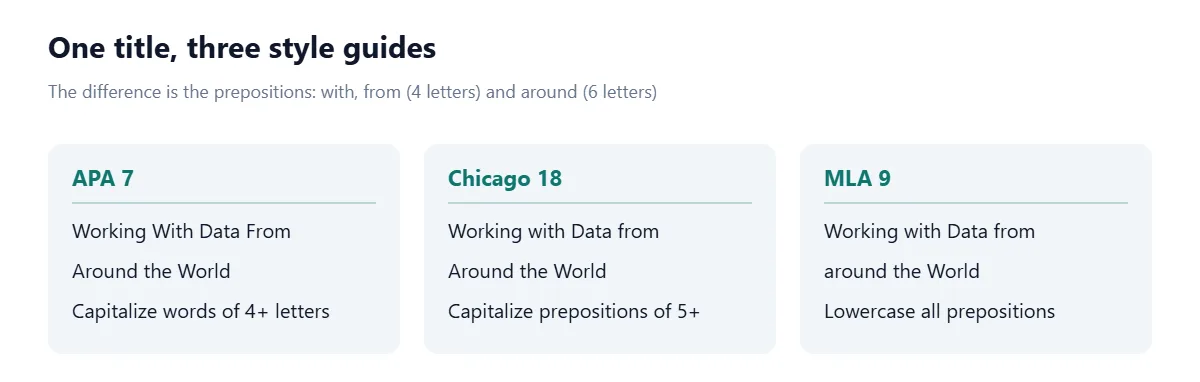
4-letter prepositions | with, from, into, over | APA capitalizes; Chicago and MLA don't |
Long prepositions | about, around, between | APA and Chicago capitalize; MLA doesn't |
Subordinating conjunctions | because, if, when, that | No, capitalize them |
Short verbs and pronouns | is, be, it, we | No, capitalize them |
The table shows why title case feels inconsistent: the preposition rule really is different from guide to guide. APA style capitalizes any word of four letters or more, so "With" and "From" go up. The Chicago Manual of Style changed its rule in the 18th edition (2024): prepositions of five or more letters are now capitalized ("Much Ado About Nothing"), shorter ones stay lowercase ("A Room with a View"). And the MLA Style Center says a preposition in the middle of a title is lowercased "no matter how long" it is.
How APA, Chicago, MLA and AP style titles
Here's how the four big guides, plus the two most-used tech style guides, handle titles and headings. "Where it's used" is the typical field, not a rule.
Style guide | Titles and headings | Prepositions | Where it's used |
|---|---|---|---|
APA 7 | Title case; sentence case for work titles in references | Capitalize if 4+ letters | Psychology, social sciences |
Chicago 18 | Title case | Capitalize if 5+ letters | Books, publishing, history |
MLA 9 | Title case | Always lowercase | Literature, humanities |
AP | Sentence case for headlines; title case for works | Works: lowercase if 3 letters or fewer | News, PR |
Microsoft, Google | Sentence case | Not applicable | Software, docs, UI |
APA: title case in the paper, sentence case in the references
APA is the guide that uses both styles in one document, which is why students search for this so often. According to UNC Charlotte's APA guide, title case is used for the paper's title, all headings, table and figure titles, and the names of journals, websites and magazines. Sentence case is used mainly in the reference list for the titles of articles, books and reports.
So the same book appears twice in different styles: "The Body Keeps the Score" in your text, and "The body keeps the score" in your references. In sentence case, APA still capitalizes proper nouns, the first word after a colon, and nouns followed by a numeral ("Study 2").
AP: sentence case for headlines
News writers follow the AP Stylebook, which uses sentence case for headlines. As summarized in Kellogg School of Management's AP-based style guide, only the first word and proper nouns are capitalized in headlines, and the first word after a colon is always capitalized. Titles of books, films and songs mentioned in a story are a different matter: those go in title case, with articles and prepositions or conjunctions of three letters or fewer in lowercase.
What is sentence case?
Sentence case means writing a heading or title the way you'd write a normal sentence: capitalize the first word and any proper nouns, and leave every other word in lowercase. "Our guide to writing in Paris" is in sentence case; "Our Guide to Writing in Paris" is in title case.
Everything that's always capitalized stays that way: names, places, brands, acronyms such as NASA, and the pronoun I. After a colon, many style guides (APA among them) capitalize the next word too, so "Sleep study: A review of the evidence" is correct sentence case for an APA reference title.
When to use sentence case
Sentence case has become the default for most writing on screens. The Microsoft Writing Style Guide says to use it "in most titles and headings" and for UI labels such as buttons and checkboxes. Google's developer documentation style guide says the same for document titles and headings. Use sentence case for:
Website and blog headings, especially long ones. A heading that wraps onto two lines is easier to scan without a capital on every word.
App and software interfaces: buttons, menus, form labels, error messages.
Email subject lines and notifications, which read more like a message than a headline.
Reference list entries in APA style.
News headlines if you follow AP style.
The US government's main website switched in 2023. In its write-up of the change, the USAGov team said about 60% of its page titles were longer than 30 characters and often wrapped to several lines on phones, and that dropping capitals makes longer text easier to skim. They were candid that they "could not find a definitive answer" on which style is more accessible, but noted research recommending that writers avoid title case for readers with dyslexia.
When to use title case
Title case still has its place, and some things need it no matter what your house style says.
Titles of works: books, films, songs, reports and articles when you name them in running text. Even Microsoft, which prefers sentence case everywhere else, lists book and song titles and white paper titles as exceptions.
Academic papers in APA, Chicago or MLA style: the paper title and headings.
Book covers and chapter titles in traditional publishing.
Official names and job titles used as titles: "Director of Marketing".
Short, formal headings such as slide titles, where your organization's template expects it.
Title case vs sentence case for SEO titles and headlines
Capitalization isn't something to optimize for search. Pick whichever matches your brand voice and apply it to every page, because inconsistency is far more noticeable in search results and navigation menus than either style on its own.
What does matter is length. A title-cased headline and a sentence-cased one have the same number of characters, but capitals are wider than lowercase letters, so a title in title case can take up more horizontal space. If your title is close to the limit, test it in the Character Limit Checker, and see our guide on meta title and description length for the numbers. The same applies to video titles; our YouTube title and description limits guide covers where those get cut off.
Common title case and sentence case mistakes
Lowercasing short verbs. "Is", "Are" and "Be" are verbs and get a capital in title case. Word length only matters for prepositions, conjunctions and articles (and for all words in APA, where the cutoff is four letters).
Capitalizing every word. "The Art Of War" is not title case; "of" stays lowercase in every guide.
Lowercasing proper nouns in sentence case. It's "How we moved to Google Cloud", not "How we moved to google cloud". Brand names keep their own styling.
Forgetting the word after a colon. In title case, a subtitle starts with a capital. In sentence case, most guides (APA, Microsoft, Google, AP) also capitalize the first word after a colon.
Mixing styles on one page. Decide once, write it down, and apply it to headings, buttons and navigation.
Trusting auto-formatting blindly. Most title case tools can't tell whether "up" is a preposition or part of a phrasal verb ("Set Up Your Account"). Always read the result.
How to convert text to title case or sentence case
Retyping a list of headings is slow and error-prone. Paste them into our Case Converter and switch between sentence case, title case, UPPERCASE and lowercase in one click. Then give the result a quick read for the two things no converter can know: proper nouns in sentence case, and the preposition rule of the style guide you're using.
If you're editing a whole document, run your headings through the converter, then check the finished piece in the Word Counter to make sure it's still inside any length limit.
Frequently asked questions
What is the difference between title case and sentence case?
Title case capitalizes all major words in a heading, such as nouns, verbs and adjectives. Sentence case capitalizes only the first word, the first word after a colon, and proper nouns, the way you'd write a normal sentence.
Is "is" capitalized in title case?
Yes. "Is" is a verb, and verbs are always capitalized in title case, however short they are. Only articles, short conjunctions and (depending on the style guide) prepositions stay lowercase.
Which words should not be capitalized in a title?
Articles (a, an, the), coordinating conjunctions (and, but, or, nor, for) and short prepositions (in, of, on, to) stay lowercase unless they are the first or last word. Style guides differ on longer prepositions such as "with" or "about".
Does APA use title case or sentence case?
Both. APA 7 uses title case for the paper title, headings and journal names, and sentence case for the titles of articles, books and reports in the reference list.
Are prepositions capitalized in Chicago style?
Since the 18th edition (2024), Chicago capitalizes prepositions of five or more letters, such as "About" and "Between". Prepositions of four letters or fewer, such as "with" and "from", stay lowercase unless they begin or end the title.
Does AP style use title case for headlines?
No. AP style uses sentence case for headlines, capitalizing only the first word and proper nouns. Titles of books, films and other works mentioned in a story use title case.
Should website headings use title case or sentence case?
Either works if you're consistent, but sentence case is the more common choice for web and app content. The Microsoft and Google style guides both recommend sentence case for headings, and USA.gov switched to it in 2023.
Is the first word after a colon capitalized?
Yes in title case, because it starts a subtitle. In sentence case, APA, AP, Microsoft and Google also capitalize it; Chicago capitalizes it when what follows the colon is a complete sentence.
What is sentence case?
Sentence case capitalizes only the first word of a title or heading and any proper nouns, like a normal sentence: "How to write a cover letter in 2026".
Sources
University of Chicago Press. Announcing The Chicago Manual of Style, 18th Edition. CMOS Shop Talk, 2024.
University of Chicago Press. Chicago Style Q&A: Capitalization, Titles. The Chicago Manual of Style Online.
Modern Language Association. In MLA style, should any part of a two-word preposition be capitalized in a title?. MLA Style Center.
UNC Charlotte Writing Resources Center. Title Formatting (APA).
Kellogg School of Management. Content style guide (AP style rules). Northwestern University.
Microsoft. Capitalization. Microsoft Writing Style Guide.
Google. Capitalization. Google developer documentation style guide.
USAGov. Making the case for sentence case on USAGov's websites. 2023.

Comments