
Can you start a sentence with but? Yes. It is grammatically correct, it appears throughout centuries of respected English writing, and major authorities, including The Chicago Manual of Style, Fowler's and Merriam-Webster, say the old classroom rule against it has no basis.
So why do so many people still worry about it? Below you'll find what the style guides actually say, whether you need a comma after an opening But, how it differs from However, and how the same logic applies to And, Because, So and Or.
Can you start a sentence with but in formal writing?
Yes, even in formal writing. The Chicago Manual of Style says there is a widespread belief, with no historical or grammatical foundation, that it is an error to begin a sentence with a conjunction such as and, but or so. It goes further and notes that a substantial percentage, often as many as 10 percent, of the sentences in first-rate writing begin with conjunctions.
Grammatically, there is nothing to object to. "But" is a coordinating conjunction, and a sentence that opens with one is a complete sentence as long as the rest of it is: "But the results were clear." The conjunction simply links the new sentence to the idea before it, which is exactly what readers need when the direction of an argument changes.
Where you should be careful is with a specific teacher, editor or house style that still forbids it. That is a preference of that reader, not a rule of English, and it is worth following when they are the one grading or publishing your work.
Where did the "never start a sentence with but" rule come from?
Nobody can point to a single origin, but Merriam-Webster offers the most likely explanation. Its usage notes say that nearly everybody admits to having been taught at some point that the practice was wrong, and that the ban probably began with teachers trying to stop young writers from chaining clause after clause with and. The shortcut became a rule, and the rule outlived its purpose.
Merriam-Webster also lists schoolbooks that repeated the prohibition, from James Brown in 1826 to George Hitchcock in 1908 and Jacob Cloyd Tressler in 1929. Meanwhile, the writers people actually admire kept doing it. Even Strunk and White's The Elements of Style, a book many people assume enforces the rule, contains the line "But since writing is communication, clarity can only be a virtue." The honest answer to "can you start a sentence with but?" has been yes all along.
What style guides say about starting a sentence with but
Ask the major references "can you start a sentence with but?" and the verdict is unusually consistent. Here is a summary, with each source linked in the list at the end.
Authority | Verdict on opening But / And |
|---|---|
The Chicago Manual of Style | Allowed; the belief it is wrong has no foundation |
Fowler's Modern English Usage | Allowed; the ban "has no foundation" |
Garner's Modern American Usage | Allowed; calls the ban "rank superstition" |
Merriam-Webster usage notes | Allowed; everyone agrees it's all right |
Strunk and White (in practice) | Uses it in its own text |
Fowler's dictionary of usage is blunt about the persistence of the myth: the widespread public belief that But should not be used at the beginning of a sentence seems to be unshakeable, yet it has no foundation. Garner's calls the ban "rank superstition" and says an opening But is highly desirable in any number of contexts.
Do you need a comma after but at the start of a sentence?
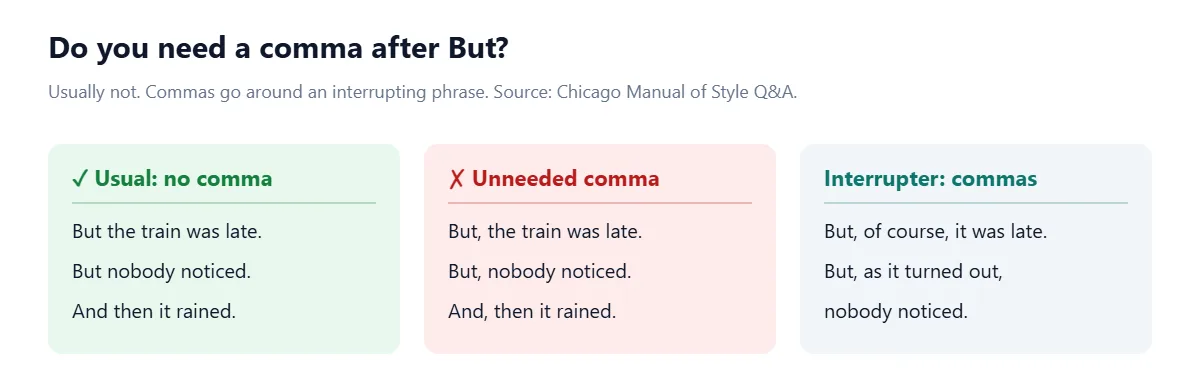
Usually not. Asked this exact question, the Chicago Manual of Style's editors answered "Not usually" and gave "But I don't want to meddle" as a correct example. The conjunction leads straight into the clause, so a comma would only add a pause the sentence doesn't need.
The exception is an interrupter: a phrase dropped in right after But, such as "of course", "as it turned out" or "in fact". Then you put commas around the interrupting phrase, as in "But, of course, Natia knew that more guests would arrive". The commas belong to the interrupter, not to But.
But vs However at the beginning of a sentence
These two look interchangeable, but they are punctuated differently. But is a coordinating conjunction. However is a conjunctive adverb, and the San José State University Writing Center points out that a conjunctive adverb cannot join two independent clauses with only a comma, and that it takes a comma after it when it starts a sentence.
Pattern | With But | With However |
|---|---|---|
Start of sentence | But it rained. | However, it rained. |
Joining two clauses | We planned, but it rained. | We planned; however, it rained. |
Comma splice (wrong) | n/a | We planned, however it rained. |
In practice, But is shorter and more conversational, and However feels more formal and slows the reader slightly. Neither is more correct. If you keep writing "However," at the start of sentences only because you were told not to use But, you may be making your prose stiffer for no reason. For more on joining clauses, see our guide to the colon vs the semicolon.
Can you start a sentence with and?
Yes, for the same reasons. Fowler's notes that the supposed ban on And has been cheerfully ignored by standard authors from Anglo-Saxon times onwards. The King James Bible is a famous example: in the first five verses of Genesis, four begin with And, including "And God said, Let there be light: and there was light."
An opening And works best for adding weight or momentum: "And that was only the first week." It works poorly when it starts sentence after sentence, which is the habit the classroom rule was trying to break in the first place.
Can you start a sentence with because?
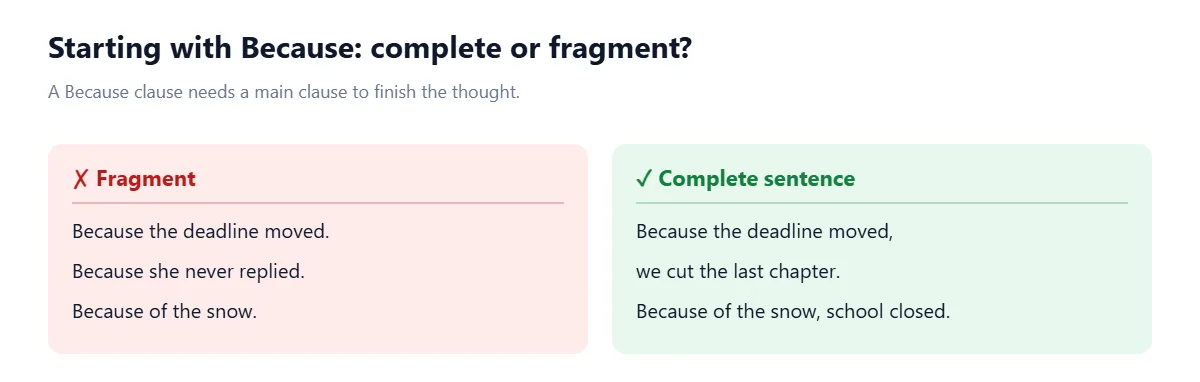
Yes. Chicago's editors confirm it is grammatically correct to start a sentence with because. The catch is different from But. Because is a subordinating conjunction, so the clause it introduces can't stand alone. Las Positas College's writing center explains that such clauses must be attached to another sentence.
That gives you two patterns. "Because the deadline moved, we cut the last chapter" is a complete sentence: a dependent clause, a comma, then a main clause. "Because the deadline moved." on its own is a fragment, fine in dialogue or a punchy reply ("Why? Because I said so.") but usually marked wrong in an essay. Our guide to the sentence fragment shows how to fix each type.
Starting a sentence with so, or, yet and nor
Chicago's statement names so alongside and and but, and the same reasoning covers the other coordinating conjunctions. Each one has its own flavor at the start of a sentence:
So signals a result or a conclusion: "So we changed the plan." In speech it is often a filler, so in writing make sure it really introduces a consequence.
Or offers an alternative or a warning: "Or you could wait until spring."
Yet adds a contrast with a hint of surprise: "Yet the sales kept climbing."
Nor continues a negative idea and flips the word order: "Nor did anyone call back." It reads as formal, so use it sparingly.
When should you avoid starting a sentence with but?
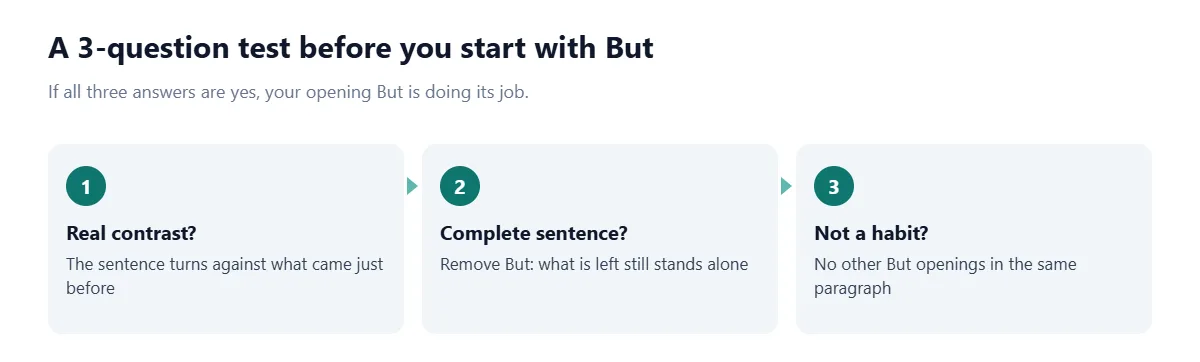
The rule is a myth, but good judgment still applies. Skip the opening But when:
There is no real contrast. "I went to the store. But I bought milk." Nothing in the second sentence pushes against the first.
You are doing it every few lines. A conjunction at the start of a sentence gets attention. Used constantly, it stops working and starts to sound like speech transcribed.
Your reader has said not to. A teacher's rubric, a journal's house style or a client's brand guide can forbid it. Follow the person who decides.
The sentence would read better joined. "It was cheap. But it broke." can be emphatic, but "It was cheap, but it broke" is often smoother.
The sentence is already long. If the sentence after But runs past 25 words, the contrast gets lost. Our Sentence Counter flags long sentences so you can split them.
Examples of sentences that start with but
Here is how an opening "But" looks across different kinds of writing:
Essay: "Most studies found a small effect. But the largest trial, with the longest follow-up, found none."
Business email: "The vendor offered a discount. But the contract locks us in for three years."
Fiction: "She had locked the door. But the window was open."
Speech: "We hit every target this year. But targets are not the same as progress."
Marketing: "Most apps track you. But this one stores nothing."
In each case, the short sentence before sets up an expectation and But overturns it. That pairing is the whole point. To see how often your own drafts lean on certain sentence openers, paste them into the Word Counter and read the sentence list aloud.
So, can you start a sentence with but? The bottom line
Yes. Starting a sentence with But, And or So is correct English, recommended by the major style references and used by good writers for centuries. Make sure the sentence after it is complete, skip the comma unless an interrupter follows, and save it for real turns in your argument. If you write for someone who still enforces the old rule, follow their preference, but know that it is a preference.
Can you start a sentence with but?
Yes. Starting a sentence with but is grammatically correct, and The Chicago Manual of Style, Fowler's and Merriam-Webster all say the rule against it has no foundation.
Can you start a sentence with but in an essay?
Yes, it is correct in formal writing, including essays. Some teachers still prefer you avoid it, so follow your instructor's rubric if it says so.
Do you put a comma after but at the beginning of a sentence?
Usually not. Add commas only when an interrupting phrase follows, as in "But, of course, it was too late."
Can you start a sentence with and?
Yes. Opening a sentence with and is correct and has been common since Old English; the King James Bible does it in four of the first five verses of Genesis.
Can you start a sentence with because?
Yes, as long as the sentence includes a main clause, as in "Because it rained, we stayed in." A because clause on its own is a sentence fragment.
Is it better to use however instead of but?
Not necessarily. However is more formal and needs a comma after it at the start of a sentence, while but is shorter and needs no comma; both are correct.
Why were we taught not to start a sentence with but?
Most likely because teachers wanted to stop young writers from stringing clauses together with and and but. Merriam-Webster traces the rule to that classroom shortcut, not to any rule of English grammar.
Can you start a sentence with so?
Yes. The Chicago Manual of Style names so along with and and but as conjunctions that can correctly begin a sentence.
Sources
Merriam-Webster. Is it ever okay to start a sentence with 'and'?. Merriam-Webster.
The Chicago Manual of Style. Chicago Style Q&A: Comma after But or And at the beginning of a sentence. University of Chicago Press.
The Chicago Manual of Style. Chicago Style Q&A: Starting a sentence with because. University of Chicago Press.
Fogarty, M. Can I Start a Sentence with a Conjunction?. Quick and Dirty Tips.
Common English usage misconceptions. Wikipedia (quotes Chicago, Fowler and Garner).
Scribbr. Comma Before or After But. Scribbr.
San José State University Writing Center. Conjunctive Adverbs. SJSU.
Las Positas College Reading and Writing Center. Fragments. Las Positas College.
Genesis 1:1-5, King James Version. Bible Gateway.

Comments