
The colon vs semicolon difference comes down to one job each: a colon introduces something that explains, lists or completes what came before, while a semicolon joins two complete sentences that are closely related and equal in weight. “I have one goal: finish by Friday” needs a colon; “I have one goal; my partner has three” needs a semicolon.
The two marks look alike and both sit in the middle of a sentence, which is why the colon vs semicolon mix-up is so common. Below you'll find every standard use of each mark, a side-by-side table, a three-question test, and the mistakes editors fix most.
Colon vs semicolon: the main difference
Think of a colon as an arrow. It tells the reader that what follows will define, explain or fill in what came before. The Naval Postgraduate School's Graduate Writing Center says the colon “generally signals identity”: the part after it restates or specifies the part before (NPS Graduate Writing Center). The Blue Book compares it to an equal sign (GrammarBook.com).
Think of a semicolon as a hinge between two sentences. It's stronger than a comma and softer than a period. UNC's Writing Center describes it as joining two independent clauses while keeping them “somewhat separate, like a period would do” (UNC Writing Center). NPS adds that a semicolon signals “a close conceptual relation between discrete ideas.”
Colon (:) | Semicolon (;) | |
|---|---|---|
Main job | Introduce or explain | Join equal sentences |
Before it | A complete sentence | A complete sentence |
After it | Word, phrase, list, quote or sentence | A complete sentence (or list item) |
Reads like | “namely” or “here it is” | “and” or “also,” without the word |
Other uses | Time, ratios, salutations, subtitles | Lists with commas, citations |
When to use a colon
Butte College's punctuation tip sheet sums up the colon's main purpose: it is used “to introduce or call attention to the words that follow it” (Butte College). There are five common uses.
1. Before a list
Use a colon after a complete sentence to introduce a list. Purdue OWL notes colons are used “at the beginning of lists of several or more items” (Purdue OWL).
*The kit includes four tools: a hammer, a level, a tape measure and a drill.*
2. Before an explanation or example
Purdue says a colon can stand in for “it is” or “they are”: *There is only one thing to do: talk to your daughter's teacher about it.* When a full sentence follows, Butte College says the second clause should summarize, explain or give an example of the first.
*The results were clear: the new layout cut checkout time.*
3. Before a quotation
*Her advice was blunt: “Write the ending first.”*
4. Before a word or phrase you want to stress
*After six drafts, the essay needed only one thing: sleep.*
5. In set formats
Butte College lists the conventional uses: after the salutation in a formal letter (*Dear Sir:*), between hours and minutes (*6:30 a.m.*), in ratios (*22:1*), between a title and subtitle (*Grammar and Style: A Handbook*), and in bibliographic entries between the city and the publisher (Butte College).
How to use a semicolon
The semicolon has three standard jobs. Most writers only need the first two.
1. Join two closely related sentences
Use a semicolon between two independent clauses when there is no joining word. Purdue's example: *I am going home; I intend to stay there* (Purdue OWL). If you add a coordinating conjunction (*and, but, or, nor, for, so, yet*), use a comma instead: *I am going home, and I intend to stay there.*
2. Before however, therefore and similar words
Purdue says to use a semicolon when you join two independent clauses with a conjunctive adverb such as “however, moreover, therefore, consequently, otherwise, nevertheless, thus” (Purdue OWL). NPS stresses that this is required: a comma alone is not enough even when *however* is present (NPS Graduate Writing Center).
Right: *It rained all afternoon; however, we still had our picnic.*
Wrong: *It rained all afternoon, however, we still had our picnic.*
3. Separate list items that contain commas
When list items have their own commas, semicolons mark where each item ends. NPS's example: *U.S. capitol cities include Sacramento, California; Lansing, Michigan; and Carson City, Nevada* (NPS Graduate Writing Center). The same logic separates multiple sources in one parenthetical citation: *(Roussel 1912; Rimsky-Korsakov 1888)*.
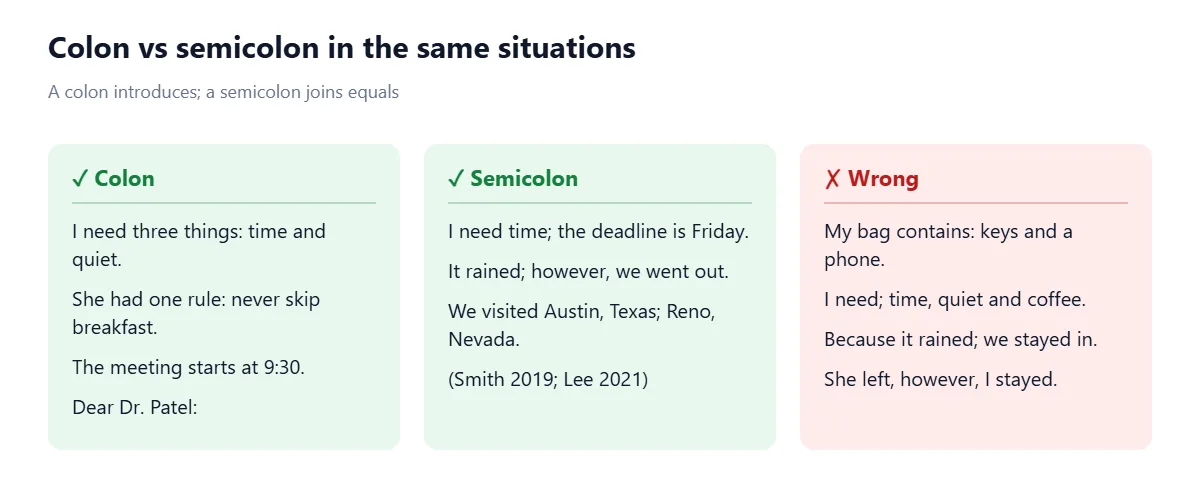
Colon vs semicolon examples side by side
The clearest way to see the colon vs semicolon split is to keep the first half of a sentence the same and change what follows.
Sentence | Mark | Why |
|---|---|---|
The plan had one flaw: no budget. | Colon | Phrase explains “flaw” |
The plan had one flaw; the budget had several. | Semicolon | Two equal sentences |
We tried everything: calls, emails, letters. | Colon | List follows |
We tried calling; nobody answered. | Semicolon | Related sentences |
Sales rose; therefore, we hired. | Semicolon | Conjunctive adverb |
Remember the rule: measure twice, cut once. | Colon | Restates “the rule” |
Teams came from Ames, Iowa; Provo, Utah; and Troy, Ohio. | Semicolon | Items contain commas |
Colon vs semicolon: a quick test
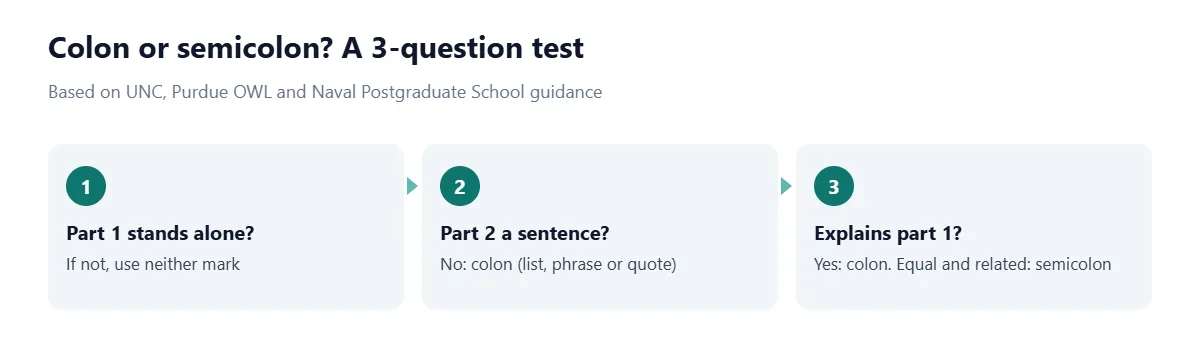
UNC's key test for a colon is to ask whether the material before it can stand on its own (UNC Writing Center). The same question works for semicolons. If the first half can't stand alone, you need neither mark, and probably a comma or no punctuation at all.
If the first half can stand alone, look at the second half. A list, a phrase or a single word means colon. A full sentence means either mark is possible, so ask one more question: does the second sentence explain, prove or illustrate the first? Then a colon. Are the two simply related ideas of equal weight? Then a semicolon.
Colon vs semicolon in lists
Lists are where the colon vs semicolon confusion is most visible, because both marks can appear in the same sentence. The colon opens the list; semicolons separate items only when the items contain commas.
Colon opens a simple list: *The tour stops in three cities: Lisbon, Porto and Faro.*
Colon opens, semicolons separate: *The panel included three speakers: Ana Ruiz, the editor; Tom Hale, a reporter; and Mia Chen, a lawyer.*
Never a semicolon to open a list: *The tour stops in three cities; Lisbon, Porto and Faro* is wrong.
Whether you put a comma before the last item in a simple list is a separate style choice; see our guide to the Oxford comma.
Common colon and semicolon mistakes
A colon after a verb or preposition. NPS marks *The DIME paradigm comprises: diplomacy, information…* as wrong, because “comprises” leaves the clause unfinished (NPS). The Blue Book gives the same warning with *I like: cars, bikes, trains* (GrammarBook.com). Delete the colon, or add *the following*.
A colon after such as, including or for example. These words already introduce the list. *Bring snacks such as fruit and nuts*, with no colon.
A semicolon after a dependent clause. *Because it rained; we stayed in* is wrong. A dependent clause takes a comma: *Because it rained, we stayed in.*
A comma where a semicolon belongs. Two sentences joined by only a comma make a comma splice. Our guide to the run-on sentence covers the fixes.
Overusing semicolons. Three in one paragraph is usually a sign the sentences want to be shorter. A period is often the cleaner choice.
Can a colon replace a semicolon?
Sometimes. NPS notes that a semicolon or a colon is required when two independent clauses are joined without a conjunction, so both marks are grammatical there (NPS Graduate Writing Center). The colon vs semicolon choice then depends on meaning, not grammar.
*The test was hard: half the class failed.* The second clause explains why the test counts as hard, so a colon fits.
*The test was hard; the essay was easy.* Two separate facts of equal weight, so a semicolon fits.
*The test was hard: the essay was easy.* Grammatical, but misleading, because the colon promises an explanation that never comes.
The reverse swap fails more often. A semicolon can never introduce a list, a single word or a quotation, so if what follows isn't a full sentence, the colon vs semicolon question answers itself.
Do you capitalize after a colon or semicolon?
After a semicolon, use lowercase unless the next word is a proper noun, because the semicolon continues the same sentence. After a colon, it depends on your style guide:
Chicago: lowercase the first word after a colon within a sentence, “even if the words after the colon are themselves a grammatically complete sentence” (CMOS Shop Talk).
APA: capitalize the first word after a colon only if it begins a complete sentence (Grammarly).
No house style? UNC suggests lowercase when a fragment follows, and either choice for a full sentence as long as you're consistent (UNC Writing Center).
We cover AP, MLA and title rules in detail in do you capitalize after a colon.
If your sentences keep needing semicolons, they may simply be long. Paste a draft into the Sentence Counter to see the average and longest sentence, or use the Word Counter to check length and reading time before you submit.
Frequently asked questions
What is the difference between a colon and a semicolon?
A colon introduces something that explains, lists or completes the sentence before it. A semicolon joins two complete, closely related sentences of equal weight.
Can a colon replace a semicolon?
Only between two complete sentences, and only when the second explains or illustrates the first. If the two sentences are simply related, a semicolon is the better choice.
Do you use a colon or semicolon before a list?
A colon, after a complete sentence: I packed three things: a map, water and a jacket. Semicolons only separate list items that already contain commas.
Do you use a semicolon before however?
Yes, when however joins two complete sentences: It rained; however, we went out. When however interrupts a single sentence, set it off with commas instead.
Can you use a colon after including or such as?
No. Words like including, such as and for example already introduce the list, so no colon is needed after them.
Do you capitalize after a semicolon?
No, unless the next word is a proper noun or the pronoun I. The semicolon keeps both clauses in one sentence.
Do you capitalize after a colon?
It depends on the style guide. Chicago uses lowercase within a sentence; APA capitalizes when a complete sentence follows.
How do you use a semicolon in a list?
Use semicolons between list items when the items contain commas, such as Austin, Texas; Reno, Nevada; and Salem, Oregon.
Sources
Purdue OWL. Commas vs. Semicolons in Compound Sentences. Purdue University.
Purdue OWL. Punctuation: Semicolons, Colons, and Parentheses. Purdue University.
The Writing Center, UNC Chapel Hill. Semicolons, colons, and dashes. University of North Carolina at Chapel Hill.
Graduate Writing Center. Semicolons and colons. Naval Postgraduate School.
Butte College. The Colon (TIP Sheet). Butte College.
The Blue Book of Grammar and Punctuation. Colon vs. Semicolon. GrammarBook.com.
CMOS Shop Talk. When to Capitalize after a Colon. The Chicago Manual of Style, 2022.
Grammarly. Capitalization After Colons. Grammarly.

Comments