
A sentence fragment is a group of words punctuated like a sentence that is missing one of the three things every complete sentence needs: a subject, a verb, or a complete thought. “Because the bus was late.” is a fragment; “We missed class because the bus was late.” is a sentence.
Excelsior University's Online Writing Lab includes the sentence fragment in its list of the 20 most common writing errors. They're easy to miss because they often sound fine when you read them aloud. This guide covers the five types you'll actually meet, a quick test for any sentence, a table of examples to practice on, and the cases where a fragment is a perfectly good choice.
What is a sentence fragment?
Purdue OWL defines sentence fragments as “sections of a sentence that are not grammatically whole sentences” (Purdue OWL). Merriam-Webster's definition explains why they're so easy to miss: a fragment is a word, phrase or clause that “usually has in speech the intonation of a sentence” but lacks the grammatical structure of a written one (Merriam-Webster).
In other words, fragments sound like sentences because in conversation they work as sentences. “Where are you going?” “To the library.” Nobody blinks. On the page, in an essay, the same pattern looks unfinished.
What makes a complete sentence?
The UNC Writing Center lists three components: a subject (“the actor in the sentence”), a predicate (“the verb or action”) and a complete thought, meaning it “can stand alone and make sense” (UNC Writing Center).
Subject: who or what the sentence is about. *The committee* voted.
Verb (predicate): what the subject does or is. The committee *voted*.
Complete thought: the idea doesn't leave you waiting for more. Compare “The committee voted.” with “When the committee voted.”
Length has nothing to do with it. “Go.” is a complete sentence, because commands have an implied subject. Hunter College's Reading/Writing Center explains that in an imperative sentence “the subject ('you') is implied and therefore omitted,” so “Don't leave the room” means “[You] don't leave the room” (Hunter College). Meanwhile a 40-word string can still be a sentence fragment if it never gets a main verb.
The 5 types of sentence fragments
Writing-center handouts usually group fragments into three families: missing subject, missing or incomplete verb, and dependent clause (Hunter College; Mt. SAC Writing Center). In real drafts, two more patterns show up so often that they deserve their own names. Here are all five.
Type | Fragment | What's missing |
|---|---|---|
Dependent clause | Although she studied all week. | A complete thought |
Missing subject | Spent the whole weekend on it. | Who spent it? |
Incomplete verb | The team practicing every night. | A helping verb (was) |
Added detail | For example, the chemistry lab. | Subject and verb |
Noun phrase or list | A quiet room with good light. | A verb |
1. Dependent clause fragments
This is the type UNC calls the most problematic, because it has a subject and a verb and still can't stand alone (UNC Writing Center). The culprit is a subordinating word at the start: *because, since, although, if, when, after, before, while, unless*, or a relative pronoun like *which* or *who*.
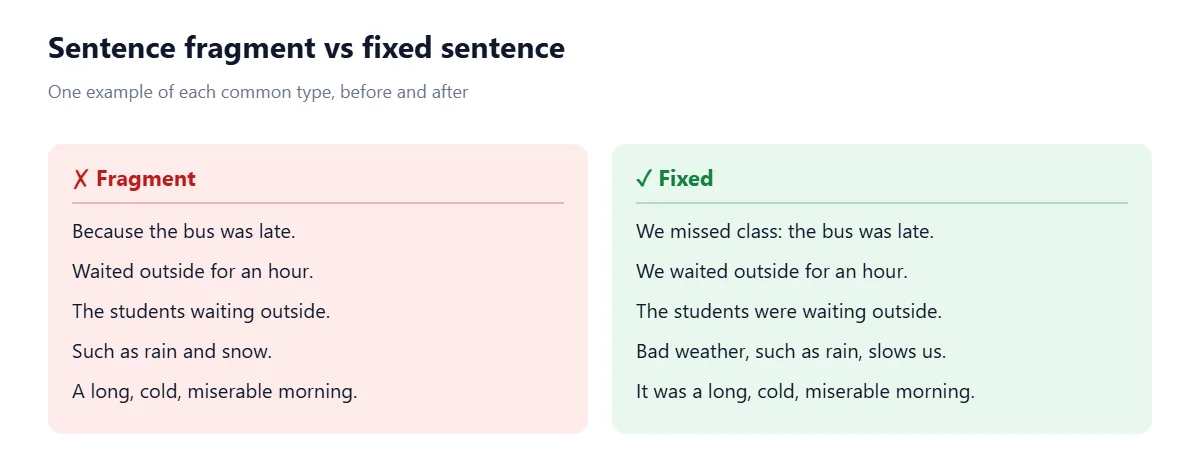
Fragment: *Because their car was in the shop.*
Fixed: *They took the bus because their car was in the shop.* (UNC's own example)
If you want to go deeper into why these clauses depend on others, our guide to dependent and independent clauses explains the difference with more examples.
2. Missing-subject fragments
These usually follow a sentence that already named the subject, so the writer's brain carries it over. Purdue's example is “Looked at the OWL website,” which needs someone, such as *students*, to do the looking (Purdue OWL).
Fragment: *I finished the draft on Friday. Then sent it to my tutor.*
Fixed: *I finished the draft on Friday and then sent it to my tutor.*
3. Incomplete-verb fragments (-ing and to forms)
A word ending in *-ing*, or a *to* form like *to win*, looks like a verb but can't carry a sentence alone. Purdue's example “They trying to improve” needs *were* to become a sentence (Purdue OWL).
Fragment: *The coach hoping for a better season.*
Fixed: *The coach is hoping for a better season.*
Fragment: *To finish before the deadline.*
Fixed: *We stayed late to finish before the deadline.*
4. Added-detail fragments
These start with words that add examples or explanation: *for example, such as, especially, including, like, also, except*. Writers often break them off after a full sentence. They lack their own subject and verb, so they need to rejoin the sentence they belong to.
Fragment: *The library has quiet spaces. Especially on the third floor.*
Fixed: *The library has quiet spaces, especially on the third floor.*
5. Noun phrase and list fragments
A noun with lots of description can feel weighty enough to be a sentence. It isn't until something happens to it. These often appear after a colon should have been used, or at the start of a paragraph as a kind of heading.
Fragment: *Three reasons to start early. Time, focus and fewer errors.*
Fixed: *There are three reasons to start early: time, focus and fewer errors.*
How to fix a sentence fragment
Every fix comes down to one of four moves. Hunter College lists the same options: add the missing subject or verb, attach the fragment to an independent clause, or delete the subordinating word (Hunter College).
Attach it to the sentence before or after. This is usually the best fix, because the fragment was meant to be part of that sentence. *I need a laptop. Preferably a light one.* → *I need a laptop, preferably a light one.*
Add what's missing. Give it a subject (*She spent the weekend on it*) or complete the verb (*The team was practicing*).
Drop the subordinating word. *Because the results were clear.* → *The results were clear.* Use this only when the clause really can stand alone in context.
Rewrite it. When none of the above reads well, rebuild the sentence around the idea you wanted to say.
Is this a complete sentence? A quick test
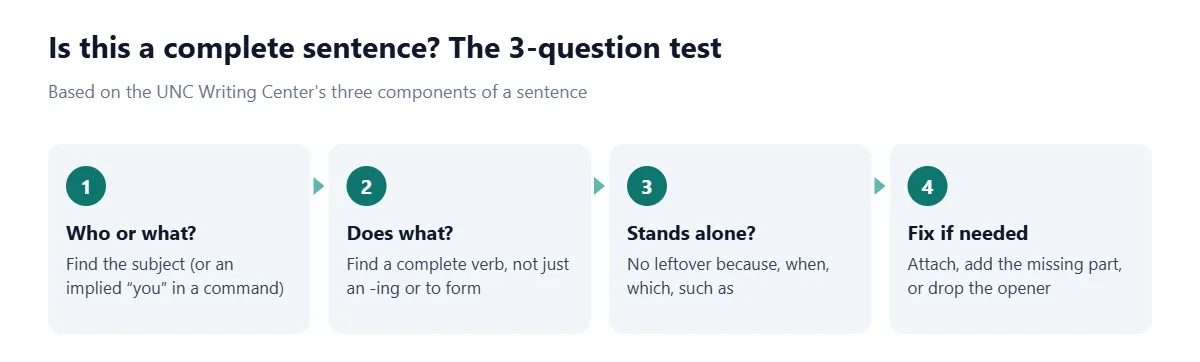
Run any doubtful sentence through three questions, in this order:
Who or what is doing something? If you can't point to a subject, and it isn't a command, it's a fragment.
What are they doing? Look for a verb that could change tense (*walks, walked, will walk*). A bare *-ing* or *to* form doesn't count.
Could it start a conversation? Read it on its own, with no sentence before it. If it starts with *because*, *which*, *such as* or *when* and leaves you waiting, it's a dependent piece.
One practical habit: proofread the last paragraph first and work backward one sentence at a time. Out of context, a fragment can't lean on the sentence before it, so it's much easier to hear what's missing.
Sentence fragment examples: fragment or sentence?
Decide for each line, then check the right-hand column.
Word group | Verdict | Why |
|---|---|---|
Stop. | Sentence | Command; implied “you” |
After the storm passed. | Fragment | Dependent clause |
The storm passed. | Sentence | Subject, verb, complete |
Which surprised everyone. | Fragment | Relative clause alone |
She laughed. | Sentence | Subject and verb |
Running late again. | Fragment | No subject, -ing only |
Being the oldest, she led. | Sentence | Main clause: she led |
For instance, the 2020 data. | Fragment | No verb |
Although nobody asked. | Fragment | Dependent clause |
Nobody asked. | Sentence | Complete thought |
Are sentence fragments ever okay?
Yes, when you choose them. Grammarly's guide describes “rhetorical fragments” used for dramatic effect in creative writing (Grammarly). You'll see them all the time in places where rhythm matters more than formal structure:
Fiction and dialogue: *She opened the door. Nothing. Just the wind.* Real speech is full of fragments, so dialogue without them can sound stiff.
Marketing and headlines: *Fast setup. No credit card. Cancel anytime.*
Blog posts and emails: a short fragment after a long sentence can add emphasis. Like this.
Answers to questions: *Why does it matter? Two reasons.*
The test for an intentional fragment is simple: would a reader see it as a choice or a slip? One deliberate fragment in a paragraph of complete sentences reads as style. Several in a row, or any in a research paper, read as errors. In academic and formal writing, keep to complete sentences.
Sentence fragment vs run-on sentence
These are opposite problems. A sentence fragment has too little to be a sentence; a run-on has two sentences jammed together without the right punctuation. UNC covers both on one page for that reason (UNC Writing Center).
Fragment | Run-on | |
|---|---|---|
Problem | Missing a piece | Too many pieces joined badly |
Example | Because I was tired. | I was tired I went to bed. |
Typical fix | Attach or complete it | Period, semicolon or conjunction |
Fixing one sometimes creates the other. If you join fragments with commas and no conjunction, you can end up with a comma splice. Our guide to the run-on sentence shows the five fixes, and can you start a sentence with but explains why “But I was tired.” is not a fragment.
To catch fragments and overlong sentences in your own draft, paste it into the Sentence Counter. It counts your sentences, shows the average and longest, and flags any over 25 words, which is where fragments and run-ons tend to hide.
Frequently asked questions
What is a sentence fragment?
A sentence fragment is a group of words punctuated as a sentence that is missing a subject, a verb, or a complete thought. For example, “Because the bus was late.” is a fragment.
How do you fix a sentence fragment?
Attach it to a nearby sentence, add the missing subject or verb, or remove the subordinating word that makes it dependent. Attaching is usually the most natural fix.
Is “Stop.” a complete sentence?
Yes. Commands have an implied subject, you, so a one-word imperative like Stop or Go is a complete sentence.
Can a sentence fragment be long?
Yes. Length doesn't matter; a long phrase without a main verb, or a long clause starting with because or although, is still a fragment.
Is a sentence starting with because always a fragment?
No. “Because it rained, we stayed home.” is complete because it includes an independent clause. Only “Because it rained.” on its own is a fragment.
Are sentence fragments ever acceptable?
Yes, as a deliberate choice in fiction, dialogue, advertising and informal writing. In academic and formal writing, use complete sentences.
What is the difference between a fragment and a run-on?
A fragment is missing something a sentence needs; a run-on joins two complete sentences without proper punctuation or a conjunction.
How can I tell if my sentence is complete?
Check for a subject, a complete verb and an idea that can stand on its own. If all three are present, or it is a command, it is a complete sentence.
Sources
The Writing Center, UNC Chapel Hill. Fragments and Run-ons. University of North Carolina at Chapel Hill.
Purdue OWL. Proofreading for Errors. Purdue University.
Merriam-Webster. Sentence fragment. Merriam-Webster Dictionary.
Hunter College Reading/Writing Center. Sentence Fragments. CUNY.
Mt. San Antonio College Writing Center. Sentence Fragments. Mt. SAC.
Grammarly. What Is a Sentence Fragment?. Grammarly.
Excelsior OWL. Sentence Fragment: 20 Most Common Writing Errors. Excelsior University.

Comments