
In the who vs whom choice, use who when the word is the subject of its clause (it does the action, like *he* or *she*) and whom when it is the object (it receives the action, like *him* or *her*). The fastest test: if you could answer with *him*, write whom; if you could answer with *he*, write who.
That rule settles most who vs whom decisions in a few seconds. The trouble starts with longer sentences, questions that end in a preposition, and the pair *whoever* and *whomever*. Below you'll find the test, a step-by-step method for the hard cases, a table of examples, and an honest answer to whether anyone still needs *whom* at all.
Who vs whom: the rule in one sentence
*Who* is a subject pronoun. It sits in the same slot as *I, he, she, we* and *they*. *Whom* is an object pronoun, the same slot as *me, him, her, us* and *them*. The Blue Book of Grammar and Punctuation puts it the same way: use *who* wherever you would use a subjective pronoun and *whom* wherever you would use an objective one (GrammarBook.com).
The William & Mary Writing Resources Center frames it as performer and receiver: who performs the action, whom receives it (William & Mary). So in “Who fixed the printer?” the person is doing the fixing, and in “Whom did IT send?” the person is being sent.
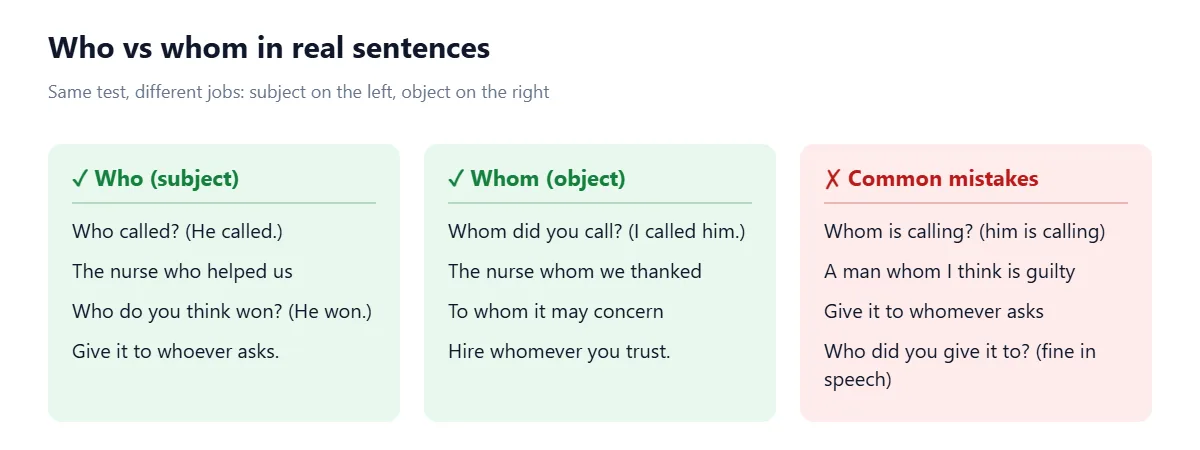
Who = subject: *Who* is coming tonight? (*She* is coming.)
Whom = object of a verb: *Whom* did you invite? (I invited *her*.)
Whom = object of a preposition: To *whom* should I send it? (Send it to *them*.)
The he/him trick for who or whom
Most native speakers have no instinct for *who* and *whom*, but everyone hears the difference between *he* and *him*. The trick borrows that instinct. Notice that *him* and *whom* both end in m, which makes the pairing easy to remember.
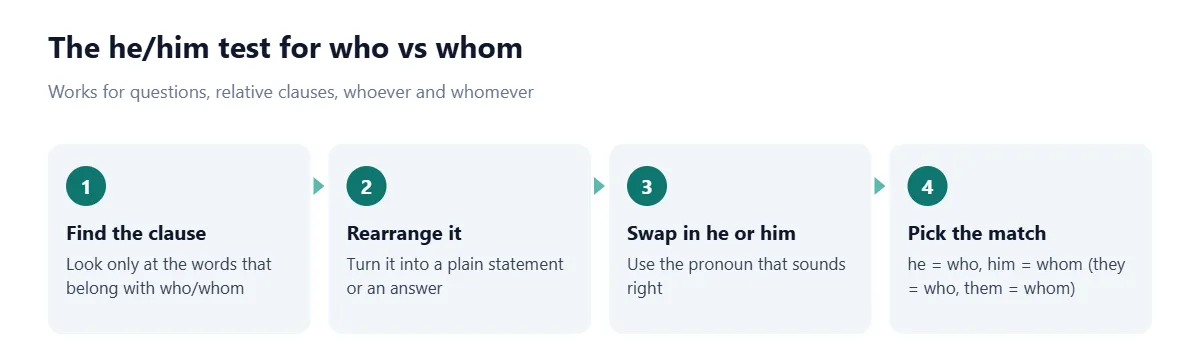
Find the clause that contains the who/whom slot. Ignore the rest of the sentence.
Rearrange it into a plain statement, or answer the question.
Drop in *he* or *him* (or *they* or *them*) and listen for the one that sounds right.
Write *who* if *he* fits, *whom* if *him* fits.
The San José State University Writing Center teaches the same swap, and adds a useful detail: when the clause already has its own subject, try the test pronoun at the end of the clause, not the start (SJSU Writing Center). In “the coach (who/whom) she had never met,” the clause is *she had never met ___*. She had never met *him*, so the answer is whom.
Who vs whom in questions
Questions are where the who vs whom choice causes the most hesitation, because the word order is flipped. Answer the question in your head and the choice becomes obvious.
Question | Answer it | Correct word |
|---|---|---|
___ is on the phone? | *She* is on the phone. | Who |
___ did you see at the party? | I saw *him*. | Whom |
___ should I vote for? | Vote for *them*. | Whom |
___ wrote this report? | *They* wrote it. | Who |
___ are you meeting? | I'm meeting *her*. | Whom |
___ do you think will win? | I think *he* will win. | Who |
The last row is a trap, and we'll come back to it. For now, notice that *do you think* didn't change anything: the person is still the one who will win.
To whom, with whom: who vs whom after a preposition
When a preposition comes directly before the pronoun, the pronoun is its object, so formal English uses *whom*: *to whom, for whom, with whom, about whom, from whom*. That's why the old letter opening is “To whom it may concern,” and why Hemingway's title is *For Whom the Bell Tolls*.
Move the preposition to the end and most people switch to *who*: “Who did you speak to?” Merriam-Webster lists exactly this pair, marking “To whom did you speak?” as formal and “Who did you speak to?” as the more common form (Merriam-Webster). Both are correct English. They simply sit at different levels of formality.
Who vs whom in relative clauses
A relative clause describes a noun: *the teacher who inspired me*, *the candidate whom the board chose*. Here the main sentence doesn't matter at all. As the William & Mary handout says, isolate the clause and ask what job the pronoun does inside it (William & Mary).
The teacher who inspired me retired. (*She* inspired me: subject.)
The candidate whom the board chose starts Monday. (The board chose *him*: object.)
The friend with whom I traveled lives in Ohio. (I traveled with *her*: object of a preposition.)
In object positions you have two easy alternatives that sound natural in any register. You can use *that* (“the candidate that the board chose”) or drop the pronoun entirely (“the candidate the board chose”). Editors often take the second option when *whom* would sound stiff and *who* would look careless.
The “who I think” trap
This is the mistake most guides skip, and it's the one careful writers make most often. When a phrase like *I think*, *they say* or *we believe* sits inside the clause, it pulls you toward *whom*, because *think* looks like a verb that needs an object. It isn't one here.
Take “She is the candidate (who/whom) I think will win.” Lift out *I think* and you're left with *___ will win*. *She* will win, so the answer is who. The Blue Book flags the same error with the example “a woman whom I think is a genius,” which should be “a woman who I think is a genius” (GrammarBook.com).
This error even has a name: hypercorrection. Writers reach for *whom* because it sounds more educated, and end up putting it in a subject slot. If you're ever unsure, *who* in the wrong place reads as casual; *whom* in the wrong place reads as a mistake.
Whoever vs whomever
The same test applies, with one extra rule: the case of *whoever* or *whomever* is decided by its own clause, not by what comes before it. The Blue Book walks through three examples that show how this works (GrammarBook.com).
Sentence | Inside the clause | Answer |
|---|---|---|
Give it to ___ asks first. | *He* asks first. | whoever |
We will hire ___ you recommend. | You recommend *him*. | whomever |
___ is elected will serve four years. | *He* is elected. | whoever |
Invite ___ you like. | You like *them*. | whomever |
The prize goes to ___ scores highest. | *She* scores highest. | whoever |
The first row is the one people get wrong. The word *to* makes *whomever* feel right, but *to* governs the whole clause, and the pronoun is the subject of *asks*. Linguist Gabe Doyle makes the mirror-image point on *Motivated Grammar*: in “Whomever the Republicans nominate should assume…,” the phrase is a subject, but inside it the pronoun is the object of *nominate*, so *whomever* is technically right (Motivated Grammar).
Is whom still used, or can you always say who?
In conversation, the who vs whom distinction has largely faded and *who* has taken over. Merriam-Webster describes *whom* as “a more formal word than who” that “is not commonly used in ordinary speech and writing, where it can seem awkward and unnatural” (Merriam-Webster). Grammar Monster goes further and notes that some sources already treat *whom* as obsolete, and advises using *who* when in doubt (Grammar Monster).
That doesn't mean the distinction is gone. The William & Mary handout points out that academic writing still expects precision here (William & Mary). A practical rule of thumb:
Use the formal rule in essays, cover letters, legal and business documents, published articles and anything a teacher or editor will mark.
Use who freely in texts, chat, emails to colleagues, dialogue and scripts. “Whom are you texting?” sounds odd in a group chat.
Always use whom directly after a preposition (*to whom, of whom, with whom*). “To who it may concern” looks wrong to almost every reader, even those who never use *whom* otherwise.
Who vs whom examples: quick quiz
Try these before you check the answers. Each one uses a pattern covered above.
___ left the door open?
The singer ___ we heard last night was brilliant.
She is someone ___ I believe can lead the team.
With ___ are you traveling?
Send the invitation to ___ wants one.
___ did the manager promote?
Answers: 1 who (*he* left it), 2 whom (we heard *her*), 3 who (*she* can lead; *I believe* is the trap), 4 whom (after a preposition), 5 whoever (*he* wants one), 6 whom (the manager promoted *him*).
Common who vs whom mistakes to avoid
Using whom as a subject to sound formal. “Whom shall I say is calling?” fails the test: *he* is calling, so it's *who*.
Letting a preposition decide for whoever. “To whomever is responsible” should be “to whoever is responsible.”
Treating who's as a form of whom. *Who's* is *who is* or *who has*. The possessive is *whose*: “Whose coat is this?”
Mixing registers. A formal report that uses *whom* in one paragraph and “who did they hire” in the next looks inconsistent. Pick a level and keep it.
If you're polishing a formal piece, read it once just for pronouns. Short sentences make the test easier to apply, and the Sentence Counter will flag any sentence over 25 words that might be hiding a misplaced *whom*. For the clause terms used in this guide, see our explainer on dependent vs independent clauses, and for another pair that trips up careful writers, read affect vs effect.
Once the draft reads well, paste it into the Word Counter to check length, sentences and reading time before you send it.
Frequently asked questions
What is the easiest way to remember who vs whom?
Swap in he or him. If he fits, use who; if him fits, use whom. Both him and whom end in m, which makes the pairing easy to remember.
Is it to who or to whom?
To whom is correct in standard written English, because a pronoun right after a preposition is an object. The exception is a clause like to whoever asks, where the pronoun is the subject of its own verb.
Is it who I think or whom I think?
It is usually who I think, as in the person who I think will win. Remove I think and test the rest: he will win, so the word is who.
Can I just use who all the time?
In speech and casual writing, yes; who in object position is widely accepted. In formal writing, academic work and directly after a preposition, use whom where the rule calls for it.
Is whom outdated?
Whom is less common than it used to be and sounds formal in conversation, but it is still standard in formal writing and fixed phrases like to whom it may concern.
What is the difference between whoever and whomever?
Whoever is a subject and whomever is an object, decided by the pronoun's own clause. Give it to whoever asks (he asks), but hire whomever you trust (you trust him).
Is it with who or with whom?
With whom is correct in formal writing, as in the colleague with whom I worked. In casual speech, people usually say who did you work with instead.
Is “whom shall I say is calling” correct?
No. The pronoun is the subject of is calling (he is calling), so the correct form is who shall I say is calling.
Sources
Merriam-Webster. Whom (simple definition and usage). Merriam-Webster.
William & Mary Writing Resources Center. Who vs. Whom. William & Mary, 2018.
San José State University Writing Center. Who, Whom, Whoever, Whomever. SJSU.
The Blue Book of Grammar and Punctuation. Who vs. Whom. GrammarBook.com.
The Blue Book of Grammar and Punctuation. Whoever vs. Whomever Revisited. GrammarBook.com.
Doyle, G. Whoever v. Whomever: Cases collide. Motivated Grammar, 2009.
Grammar Monster. Whom or Who?. Grammar Monster.

Comments