
The Oxford comma is the comma placed before the final and or or in a list of three or more items, as in "red, white, and blue." It's optional in grammar, but Chicago, APA and MLA style all require it, while AP style leaves it out of simple lists.
It's also called the serial comma or the Harvard comma. It's one small mark, but it has its own fan clubs, a long history at Oxford University Press, and at least one court case worth $5 million. Here's how it works, when it changes meaning, and how to decide.
What is the Oxford comma?
Merriam-Webster defines the serial comma as "a comma used to separate the second-to-last item in a list from a final item introduced by the conjunction and or or," and lists Oxford comma and Harvard comma as other names for it (Merriam-Webster).
In practice it looks like this:
With a serial comma: We need flour, sugar, and eggs.
Without it: We need flour, sugar and eggs.
Both sentences are correct. In a short list of plain nouns, nobody misreads either one. The extra comma only starts to matter when the items are longer, contain their own "and," or could be read as a description of the item before them.
Oxford comma examples
Here are common list patterns and how each style handles them. The first column follows Chicago, APA and MLA; the second follows AP's rule for simple lists.
List type | Chicago, APA, MLA | AP style (simple series) |
|---|---|---|
Three nouns | tea, coffee, and juice | tea, coffee and juice |
Ending in or | email, call, or text | email, call or text |
Verbs | We wrote, edited, and published it. | We wrote, edited and published it. |
Adjectives | a cheap, fast, and reliable car | a cheap, fast and reliable car |
Item contains and | toast, ham and eggs, and juice | toast, ham and eggs, and juice |
Two items only | tea and coffee (no comma) | tea and coffee (no comma) |
Notice the fifth row. When one of the items already contains "and," even AP adds the final comma. Purdue OWL's summary of AP style says a comma goes before the final conjunction in a complex series when part of the series also contains a conjunction (Purdue OWL).
When the Oxford comma changes the meaning
The classic problem is a list that starts with a noun followed by two names or descriptions. Without the final comma, the last two items can read as an explanation of the first.
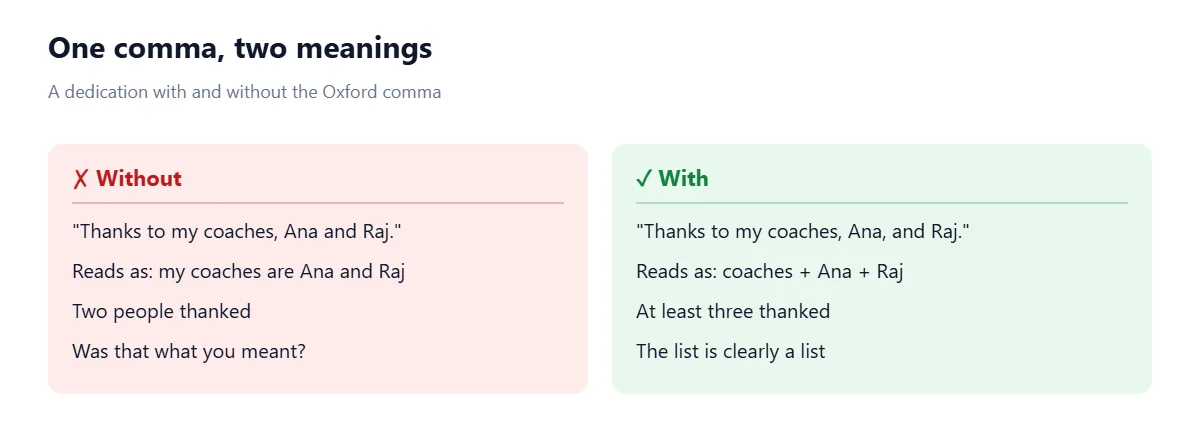
Here are a few more, all easy to misread:
"I had lunch with my roommates, a nurse and a pilot." Are your roommates a nurse and a pilot, or did four people eat lunch?
"The menu offers pancakes, chicken and waffles and fruit." Without commas around the pair, nobody can tell which items go together. "Pancakes, chicken and waffles, and fruit" fixes it.
"Choose from the red, blue or green and white jerseys." Is "green and white" one two-tone jersey? A comma after "blue" plus clearer wording helps.
The serial comma can cause confusion too
This is the part most guides skip. The serial comma can create its own ambiguity when the first item could be read as the subject of a description. "I had lunch with my roommate, a nurse, and a pilot" might mean three people, or it might mean your roommate (who is a nurse) and a pilot. Wikipedia's article on the serial comma collects several examples where the comma helps, hurts, or makes no difference (Wikipedia).
The lesson is that no comma rule fixes every list. When a sentence is still unclear, rewrite it. Moving the single item to the front often works: "I had lunch with a pilot, a nurse and my roommate" can only be three people, with or without the final comma.
Which style guides use the Oxford comma?
This is where the debate really comes from. Different publishing traditions made different choices, and each one is consistent within its own world.
Style guide | Oxford comma? | Notes |
|---|---|---|
Chicago Manual of Style | Yes, required | Since the 1906 first edition (CMOS 6.19) |
APA (7th edition) | Yes, required | Publication Manual, p. 155 |
MLA | Yes | Used in all series of three or more |
AP Stylebook | No, in simple lists | Yes in complex series |
New Hart's Rules (Oxford) | Yes | Where the name comes from |
The Times (UK) | No | Tells writers to avoid it |
New York Times, Economist | No | Follow house styles that omit it |
The Guardian | Sometimes | Used where it prevents ambiguity |
Chicago's position is the firmest. A CMOS Shop Talk article explains that "Chicago requires it" and that the rule appears in the very first edition of 1906 (CMOS Shop Talk). APA Style requires serial commas in lists of three or more, citing page 155 of the 7th edition of its Publication Manual (Royal Roads University). The MLA Style Center says "most publications use the serial comma, because it helps writers avoid ambiguity" (MLA Style Center).
AP is the main holdout, and even AP isn't absolute. Its rule is "Do not use commas before a conjunction in a simple series," with the exception for complex series noted above. Newspaper and house styles for The New York Times and The Economist also omit it, while The Guardian uses it selectively, according to Wikipedia's summary of major style guides.
The Oxford comma lawsuit: O'Connor v. Oakhurst Dairy
The best-known real-world case is from Maine. In 2014, delivery drivers sued Oakhurst Dairy for unpaid overtime. Maine law exempted workers involved in "the canning, processing, preserving, freezing, drying, marketing, storing, packing for shipment or distribution of" certain foods. The drivers distributed milk but didn't pack it.
The question was whether "packing for shipment or distribution" meant one activity (packing, whether for shipment or for distribution) or two separate ones. With no comma before "or distribution," the list could be read either way. In March 2017 the U.S. Court of Appeals for the First Circuit sided with the drivers, and Judge David Barron's opinion opens with the line "For want of a comma, we have this case" (O'Connor v. Oakhurst Dairy).
In February 2018 the dairy settled for $5 million, covering about 127 drivers (Portland Press Herald). The drivers had originally sought more than $10 million (Bangor Daily News).
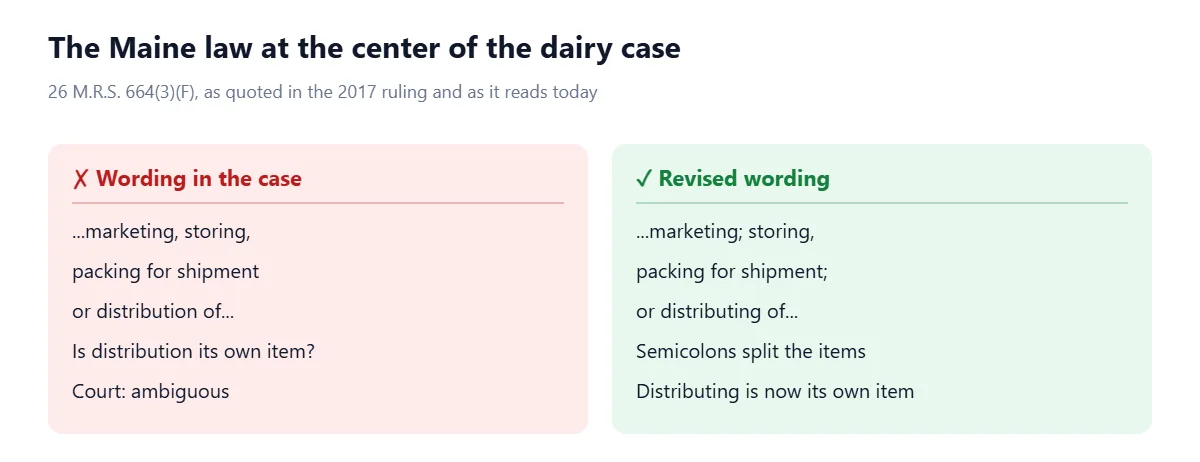
Two details are often left out of retellings. First, the court didn't rule on the comma alone. It found the wording ambiguous, then applied the principle that Maine's overtime law should be read in favor of workers. Second, the fix wasn't a serial comma. The current statute uses semicolons: "marketing; storing, packing for shipment; or distributing of" (Maine Legislature). When list items get complicated, semicolons are often clearer than any comma.
Why is it called the Oxford comma?
The name comes from Oxford University Press, whose printers and editors used it as house style. According to CMOS Shop Talk, the 1905 revision of Horace Hart's Rules for Compositors and Readers at Oxford added an example sentence with a serial comma: "Peter was a wise, holy, and energetic man." Hart's rules became the basis of Oxford's style guide, and the comma kept the university's name.
It's also called the Harvard comma, because Harvard University Press uses it as house style too, according to Wikipedia. The neutral term, serial comma, is what Chicago, APA and MLA use in their own guidance.
Is the serial comma American or British?
Neither, strictly. It's named after a British university, yet it's more common in American writing, as Grammarly notes (Grammarly). American academic writing generally uses it, because APA, MLA and Chicago all require it. In Britain, The Times tells its writers to avoid it and The Guardian uses it only to prevent ambiguity, while Oxford's own style guide keeps it.
So the split is less about country and more about the type of publication. News writing on both sides of the Atlantic tends to drop it; books and academic writing tend to keep it.
When you should always use a comma before the last item
Even if you normally skip the serial comma, add it in these situations:
An item contains "and" or "or": "Our sponsors are Lee and Sons, Park and Co., and Hart Ltd."
The last two items could read as a description: "I met the board, the CEO, and the founder."
The items are long phrases or clauses: "She cleaned the kitchen, answered every email in her inbox, and still made the 9 a.m. train."
Legal, medical or technical text: anywhere a misreading costs money or causes harm, remove the doubt.
And if the items have commas inside them, switch to semicolons. The MLA Style Center recommends serial semicolons in that case, placed wherever the serial commas would normally go: "Austin, Texas; Portland, Maine; and Boise, Idaho." Our guide to the colon vs semicolon covers more semicolon uses.
Common Oxford comma mistakes
Adding it to a two-item list. "Salt, and pepper" is wrong in every style. A serial comma needs at least three items.
Confusing it with the comma between clauses. In "I called, and she answered," the comma joins two independent clauses. That's a different rule; see dependent vs independent clauses. Leaving that comma out and joining two full sentences with a comma alone creates a different problem, the comma splice, a type of run-on sentence.
Mixing styles in one document. Using it in some lists and not others looks careless. Grammarly's advice, and every style guide's, is to pick one and stay consistent.
Fixing ambiguity with commas alone. If a list still reads two ways, rewrite it instead of adding more punctuation.
How to choose, and stay consistent
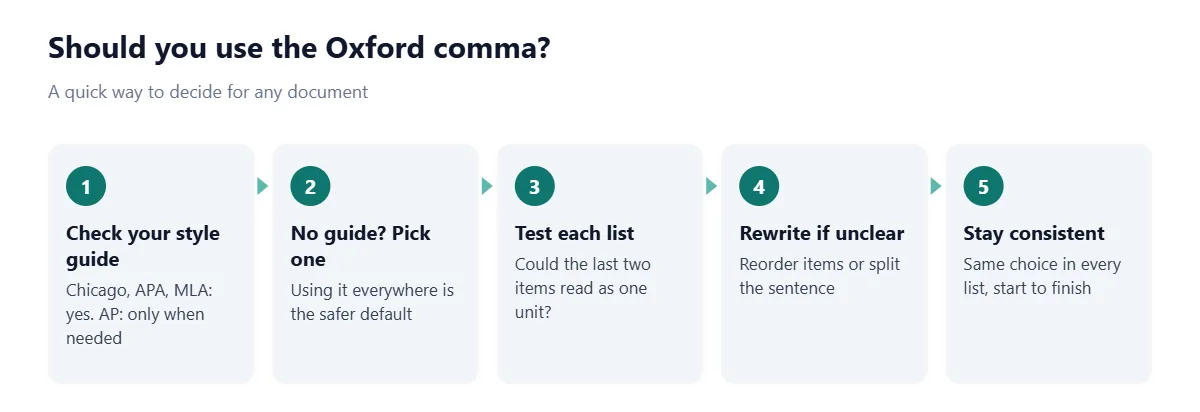
If a teacher, publisher or employer gives you a style guide, follow it. For school papers that usually means APA, MLA or Chicago, so use the serial comma. For news, PR and many corporate blogs following AP, leave it out of simple lists.
If nobody gives you a rule, using the Oxford comma everywhere is the safer default. It never makes a simple list wrong, and it prevents the misreadings above. Then do a quick consistency pass: search your draft for " and " and " or " and check each list as you go.
If you're editing someone else's text, the Compare Text tool shows every comma you added or removed between two versions. And for a final check of length and sentence count before you hand it in, paste the draft into the Word Counter.
Frequently asked questions
What is the Oxford comma?
The Oxford comma is the comma before the final and or or in a list of three or more items, as in apples, pears, and plums. It's also called the serial comma or Harvard comma.
Is the Oxford comma correct?
Yes. Using it and leaving it out are both grammatically correct; the choice is a matter of style. What matters is following your style guide and being consistent.
Does AP style use the Oxford comma?
Not in simple lists. AP says not to put a comma before the conjunction in a simple series, but it does use one when an item in the list contains its own conjunction or in a complex series of phrases.
Does APA use the Oxford comma?
Yes. APA Style requires a serial comma before the last item in a list of three or more, as set out in the 7th edition of the Publication Manual.
Does MLA use the serial comma?
Yes. The MLA Style Center recommends the serial comma in every series of three or more items because it helps avoid ambiguity.
Does Chicago style use the serial comma?
Yes. The Chicago Manual of Style requires the serial comma and has recommended it since its first edition in 1906.
What was the Oxford comma lawsuit?
O'Connor v. Oakhurst Dairy, a Maine overtime case. In 2017 a federal appeals court found a list without a serial comma ambiguous and ruled for the drivers, and the dairy settled for $5 million in 2018.
Do you use the Oxford comma with only two items?
No. With two items there is no comma before and: tea and coffee. The serial comma only applies to lists of three or more.
Sources
Merriam-Webster. Serial comma. Merriam-Webster Dictionary.
Harper, R. Oxford, Chicago, and the serial comma. CMOS Shop Talk, University of Chicago Press, 2020.
Royal Roads University. What is the serial comma in APA Style?. WriteAnswers.
Suffern, E. Serial commas and serial semicolons. MLA Style Center, 2017.
Purdue Online Writing Lab. AP style. Purdue University.
Serial comma. Wikipedia.
Grammarly. What is the Oxford comma, and why do people care so much about it?.
U.S. Court of Appeals for the First Circuit. O'Connor v. Oakhurst Dairy, No. 16-1901. Justia, 2017.
Portland Press Herald. Oakhurst OT case of missing-comma fame settled for $5 million. 2018.
Bangor Daily News. Drivers, and Oxford comma, come up big in Oakhurst Dairy lawsuit settlement. 2018.
Maine Legislature. Title 26, section 664: Minimum wages; overtime rate.

Comments