
A dependent clause has a subject and a verb but can't stand alone as a sentence, while a main (or independent) clause can. "Because it rained" is dependent; "we stayed inside" is independent. Every complete sentence needs at least one independent clause, and a dependent clause has to lean on one.
This guide covers definitions, a five-step test, the words that start them, the three kinds of subordinate clause, comma rules, and how clauses combine into the four sentence types. Examples throughout are original, so you can see each rule in a fresh sentence.
What is a clause?
A clause is a group of words with both a subject and a predicate, which is the verb plus whatever goes with it (Hamilton College). That's what separates a clause from a phrase. "After the long meeting" has no verb of its own, so it's a phrase. "After the meeting ended" has a subject (meeting) and a verb (ended), so it's a clause.
Clauses come in two kinds: independent and dependent. The difference is whether the clause expresses a complete thought on its own.
What is an independent clause?
Merriam-Webster defines an independent clause as "a clause that could be used by itself as a simple sentence but that is part of a larger sentence" (Merriam-Webster). It's also called a main clause. Each of these is one, and each could end with a period:
The printer jammed.
Maya fixed it in two minutes.
Our office ordered a new one.
A main clause can be very short. "She laughed." is complete: one subject, one verb, one finished thought.
What is a dependent clause?
Merriam-Webster defines a dependent clause as "a clause that does not form a simple sentence by itself and that is connected to the main clause of a sentence" (Merriam-Webster). It's also called a subordinate clause. Hamilton College's writing center puts it plainly: a dependent clause can not stand alone as a sentence and must be attached to an independent clause.
Here are three subordinate clauses. Each has a subject and a verb, but each leaves you waiting:
because the printer jammed
when Maya fixed it
which our office ordered last week
The reason they feel unfinished is the first word. "Because," "when" and "which" signal that the clause is supporting some other idea. Remove that word and you're usually left with a main clause: "the printer jammed."
Dependent clause vs independent clause: key differences
Feature | Main (independent) | Subordinate (dependent) |
|---|---|---|
Has a subject and verb | Yes | Yes |
Complete thought | Yes | No |
Can stand alone | Yes, as a sentence | No, it's a fragment alone |
Typical first word | A noun or pronoun | because, if, when, who, which |
Other names | Main clause | Subordinate clause |
Example | The shop closed. | after the shop closed |
The only reliable difference is the complete thought. Length doesn't matter: "I agree" is independent, while "although everyone on the committee had read the full report twice" is dependent.
How to identify a dependent clause
Use this quick test on any group of words you're unsure about.
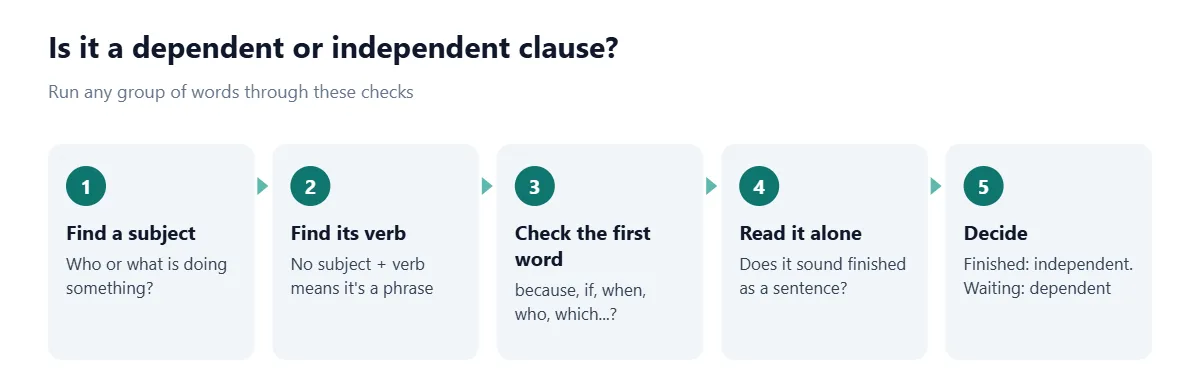
One trap: questions. "When does the shop close?" starts with "when" but is a complete question, so it's a main clause. The test is whether the words make sense alone, not just which word comes first.
Practice: spot the clauses
Try labeling these before you read the answers in the right-hand columns. Each sentence has exactly one of each kind.
Sentence | Dependent (subordinate) | Independent (main) |
|---|---|---|
If you finish early, you can leave. | If you finish early | you can leave |
The cake that Leo baked won first prize. | that Leo baked | The cake won first prize |
We waited inside until the storm passed. | until the storm passed | We waited inside |
Whoever finds the keys gets a reward. | Whoever finds the keys | (it) gets a reward |
She smiled because the test was over. | because the test was over | She smiled |
The fourth row is the tricky one. "Whoever finds the keys" is a noun clause acting as the subject, so the main clause only makes sense with it in place. That's normal: some subordinate clauses sit inside the main clause rather than next to it. The second row works the same way, with "that Leo baked" sitting in the middle of the main clause to say which cake you mean.
Words that start a dependent clause
Most subordinate clauses begin with a subordinating conjunction or a relative pronoun. The UNC Writing Center groups common subordinating conjunctions by meaning, such as time (after, when, while, until), cause and effect (because, since) and conditions (if, unless) (UNC Writing Center). Here is a fuller list by meaning:
Meaning | Subordinating conjunctions | Example clause |
|---|---|---|
Time | after, before, when, while, until, since, as soon as | until the rain stops |
Cause | because, since, as | because the bus was full |
Condition | if, unless, provided that, in case | unless you call first |
Contrast | although, though, even though, whereas | although the price dropped |
Purpose | so that, in order that | so that everyone can hear |
Place | where, wherever | wherever you sit |
Comparison | than, as if, as though | as if nothing happened |
Some of these words do other jobs too. "Since" can mean "because" or "from that time," and "before" can be a preposition ("before lunch"), in which case it starts a phrase, not a clause. Check for the subject and verb.
Relative pronouns
The other big family is relative pronouns: who, whom, whose, which and that. A clause that starts with one of these is a relative clause, a kind of subordinate clause that describes a noun (UNC Writing Center). In "The laptop that I bought last year still works," the clause "that I bought last year" tells you which laptop. For help choosing between two of these words, see who vs whom.
The three types of subordinate clause
A subordinate clause always does the job of a single part of speech inside the larger sentence. Grammar Monster sorts them into three types (Grammar Monster):
Adverb clause: acts like an adverb, telling when, why, where, how or under what condition. "We'll start as soon as Dana arrives."
Adjective (relative) clause: describes a noun. "The dog that lives next door barks at 6 a.m."
Noun clause: works as a subject, object or complement. "What she said surprised everyone." "I know that you tried."
Noun clauses are the ones people miss. In "What she said surprised everyone," the clause is the subject of the whole sentence. Take it out and there is no sentence left, which is a good reminder that "dependent" describes grammar, not importance.
Comma rules for subordinate and main clauses
Most clause punctuation comes down to a handful of rules.
Dependent clause first: use a comma
Purdue OWL says to use a comma after a subordinate clause that opens the sentence, and no comma when it comes after the main clause (Purdue OWL). Hamilton College gives the same rule: if it comes first, it must be followed by a comma.
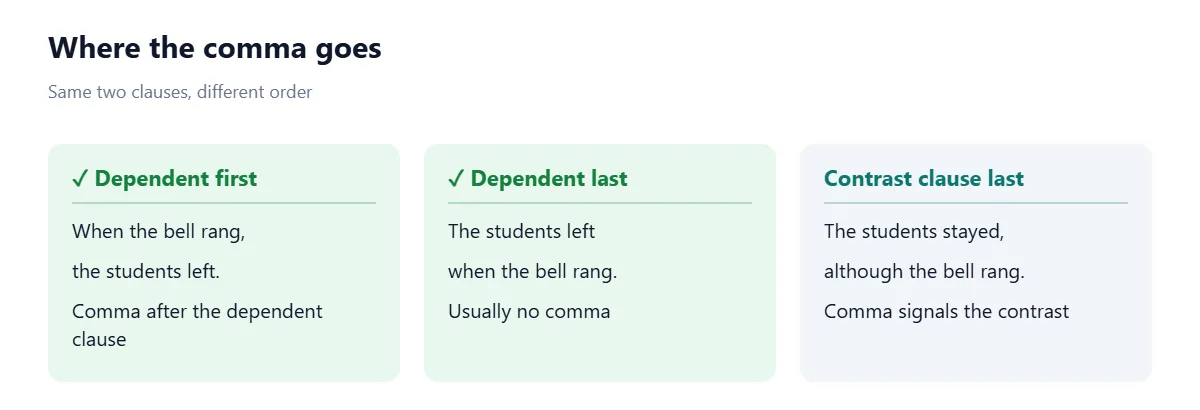
Subordinate clause last: usually no comma, except for contrast
When the subordinate clause comes second, you normally skip the comma. The exception is a clause of contrast. The Editor's Manual advises a comma before clauses beginning with although, though, whereas, while and even if, because the pause emphasizes the contrast (The Editor's Manual). "I liked the film, although the ending dragged" reads better with the comma.
Relative clauses: commas only if the information is extra
A relative clause that identifies which noun you mean takes no commas: "Students who study hard will do well." A clause that adds extra information about a noun that's already clear takes commas, and it can't use "that" (UNC Writing Center). Compare "My brother who lives in Denver" (I have more than one brother) with "My brother, who lives in Denver," (I have one).
Joining two main clauses
Two main clauses need more than a comma between them. Use a comma plus a coordinating conjunction (for, and, nor, but, or, yet, so), a semicolon, or a semicolon with a word like however or therefore followed by a comma (Yale Poorvu Center). "The printer jammed, so Maya fixed it" and "The printer jammed; Maya fixed it" both work. A comma alone creates a comma splice, a kind of run-on sentence.
Simple, compound, complex and compound-complex sentences
Counting the two kinds of clause tells you a sentence's type. These definitions follow Purdue OWL (Purdue OWL).
Sentence type | Main clauses | Subordinate clauses | Example |
|---|---|---|---|
Simple | 1 | 0 | The kettle boiled. |
Compound | 2 or more | 0 | The kettle boiled, and I made tea. |
Complex | 1 | 1 or more | When the kettle boiled, I made tea. |
Compound-complex | 2 or more | 1 or more | When the kettle boiled, I made tea, and Sam found the biscuits. |
Mixing the four types is one of the easiest ways to give writing rhythm. A page of simple sentences sounds choppy, and a page of compound-complex sentences wears readers out. If you want to see how long your sentences are running, the Sentence Counter shows your average sentence length and flags any sentence over 25 words.
Common mistakes with subordinate clauses
Leaving a subordinate clause on its own. "Because their car was in the shop." is a fragment. The UNC Writing Center calls these the most common problem fragments. Attach the clause to a main clause or remove the marker word. Our guide to the sentence fragment covers every type.
Adding a comma before every subordinate clause. "She left early, because she was tired" doesn't need the comma unless you want to signal a contrast or pause.
Forgetting the comma after an opening clause. "If you're late you'll miss the start" needs a comma after "late."
Using that in a nonrestrictive clause. "My car, that is blue, is parked outside" should be "which is blue."
Stringing several subordinate clauses together. "Because the deadline moved, which nobody expected, since the client asked..." Split it into two sentences.
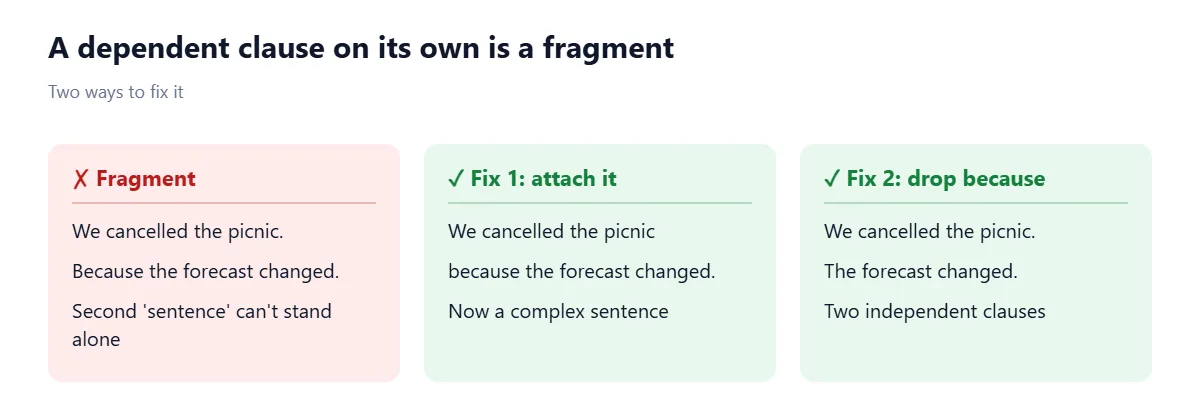
When you proofread, look for sentences that begin with because, although, when or which and check that each one has a main clause attached. Pasting a draft into the Word Counter shows your sentence count, and a sudden jump after you fix fragments is normal: you've turned stray clauses into complete sentences.
Frequently asked questions
What is a dependent clause?
A dependent clause is a group of words with a subject and a verb that can't stand alone as a sentence, such as "because it rained." It's also called a subordinate clause and must be attached to a main clause.
What is an independent clause?
An independent clause has a subject and a verb and expresses a complete thought, so it works as a sentence on its own, such as "We stayed inside." It's also called a main clause.
What is the difference between a dependent and an independent clause?
Both have a subject and a verb, but only the independent one expresses a complete thought. The dependent one usually starts with a word like because, if, when, who or which and needs a main clause to finish the sentence.
What are 5 examples of dependent clauses?
Because the store was closed; although she was tired; when the movie ends; who lives next door; if you need help. Each one needs a main clause to complete it.
Do you put a comma after a dependent clause?
Yes, when it comes first: "When the bell rang, we left." When it comes after the main clause, you usually don't need one, except before contrast words like although or whereas.
Is a dependent clause the same as a subordinate clause?
Yes. They are two names for the same thing: a clause that can't stand alone as a sentence.
Can a sentence have only a dependent clause?
No. On its own it's a sentence fragment. Every complete sentence needs at least one main clause.
What is a complex sentence?
A complex sentence has one main clause and at least one subordinate clause, such as "When the kettle boiled, I made tea."
Sources
Merriam-Webster. Dependent clause. Merriam-Webster Dictionary.
Merriam-Webster. Independent clause. Merriam-Webster Dictionary.
Hamilton College Writing Center. Clauses.
Hamilton College Writing Center. Using commas.
The Writing Center, UNC Chapel Hill. Fragments and run-ons.
The Writing Center, UNC Chapel Hill. Relative clauses.
Purdue Online Writing Lab. Sentence types. Purdue University.
Purdue Online Writing Lab. Punctuation in types of sentences. Purdue University.
Grammar Monster. Subordinate clause.
Tyagi, I. Independent vs. dependent clauses. Yale Poorvu Center for Teaching and Learning (PDF).
The Editor's Manual. Comma rules: a quick guide with examples.

Comments