
How long should a cover letter be? Aim for 250 to 400 words on one page, split into three or four short paragraphs. That is enough room to make a specific case for the job, and short enough for a hiring manager to read in about two minutes.
Below you'll find what career centers actually recommend, a word budget for each paragraph, lengths for email, online forms, internships and academic jobs, and a step-by-step way to cut a long draft down without losing what makes it good.
How long should a cover letter be, according to career centers?
University career centers agree to a striking degree. The University of Cincinnati says a cover letter should ideally be one page, typically three to four paragraphs, and that "a good length is about 250–400 words, depending on the role" (University of Cincinnati). The University of Washington's English department gives the same shape: three to four paragraphs, limited to one page (University of Washington).
A 2026 guide on Northeastern University's careers blog uses the same numbers: keep it to one page, write three to four short paragraphs, and aim for 250 to 400 words, adding that shorter is usually better as long as you hit the key points (Northeastern University Careers).
Why so short? A cover letter isn't a second resume. Its job is to connect two or three of your strongest points to this specific role and give the reader a reason to open your resume. At the 200 words per minute our Word Counter uses to estimate reading time, 400 words takes two minutes. Most readers will give you that, but not much more.
Cover letter length at a glance
Measure | Target | Notes |
|---|---|---|
Words | 250 to 400 | Under 200 often reads as generic |
Paragraphs | 3 or 4 | Opening, 1 or 2 body, closing |
Pages | 1 | Including header and signature |
Font size | 11 to 12 pt | Arial, Calibri, Georgia, Times New Roman |
Margins | About 1 inch | Don't shrink them to fit more |
Reading time | 1.5 to 2 minutes | At about 200 words per minute |
The font and margin advice comes from the same career guides: the Northeastern guide suggests standard fonts at 11 to 12 points with one-inch margins, and Cincinnati lists Arial or Times New Roman at 10 to 12 points with standard margins. If you're curious how font and spacing change the fit, the Words Per Page Calculator shows it. A single-spaced page holds roughly 500 words in a 12-point font, depending on the typeface and margins, which is why a 400-word letter plus your contact details and sign-off fills most of a page.
How many paragraphs should a cover letter have?
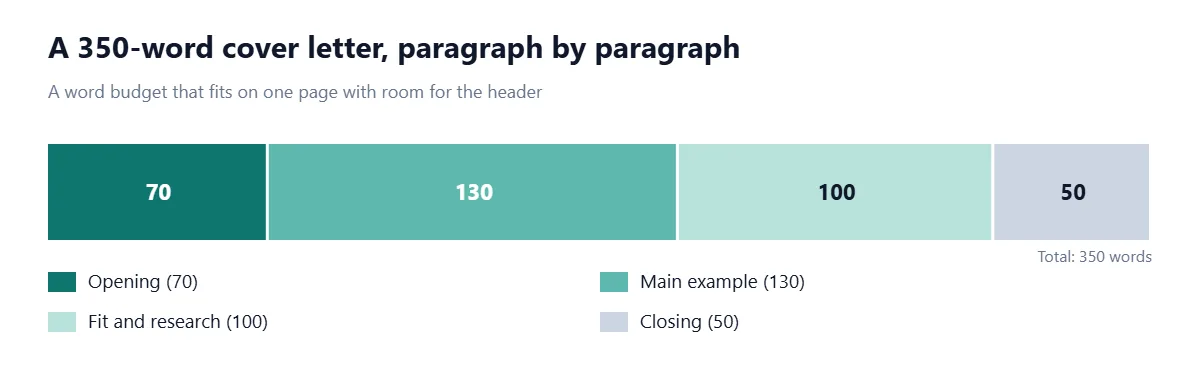
Three or four. Each one has a clear job, and giving each a rough word budget is the easiest way to hit the right total without guessing.
Opening (50 to 75 words). Name the role and the company, and give one concrete reason you want this job. Cincinnati suggests also saying how you found the listing and opening with an engaging line.
Main example (100 to 150 words). One accomplishment that matches the job's top requirement: what you did, how, and the result. Use numbers where you have them.
Fit and research (75 to 125 words). A second example, or what you know about the company and why your skills fit its work. This is the paragraph to drop if you're writing a three-paragraph letter.
Closing (40 to 60 words). Restate your interest, thank the reader and say what happens next, such as asking for an interview.
The Northeastern guide puts the principle well: two solid examples beat five vague ones. Most overlong letters try to cover every job on the resume. Pick the two stories that match the job ad most closely and cut the rest.
How long should a cover letter be for different situations?
The one-page rule covers most job applications, but a few common situations call for something shorter or longer.
Situation | Typical length | Source or reasoning |
|---|---|---|
Standard job application | 250 to 400 words, 1 page | University career centers |
Internship or first job | 250 to 350 words | Fewer examples to draw on |
Email with letter attached | One short paragraph | Anna Maria College career services |
Cover letter in the email body | 150 to 300 words | Phones show less per screen |
Online form text box | Whatever the box allows | Check the counter before pasting |
Academic faculty job | 1.5 to 2 pages | Purdue OWL, UNC Writing Center |
Senior academic role | Up to 4 pages | UNC Writing Center |
How long should a cover letter be for an internship?
The same one-page range applies, but you'll usually land toward the lower end because you have fewer relevant experiences. That's fine. A focused 280-word letter built on one class project and one part-time job reads better than 400 words of padding.
How long should a cover letter be for an academic job?
Faculty applications are the big exception. Purdue OWL says the typical academic cover letter is "usually one and a half to two pages long, but not more than two," roughly five to eight paragraphs (Purdue OWL). The UNC Writing Center says early-career scholars typically write no more than two pages, and senior scholars up to four (UNC Writing Center). Harvard's career office adds that norms differ by discipline, so ask people in your field (Harvard Career Services).
Email cover letters vs attached letters
If you're emailing an application with your cover letter attached as a file, the email itself should be brief. Anna Maria College's career guide advises keeping it to about one paragraph, noting that short emails are more likely to be read, and mentioning in the message that your documents are attached (Anna Maria College).
If the employer asks for the cover letter in the body of the email, write it as a slightly tighter version of your normal letter. Drop the address block, put the role in the subject line, and stay toward the low end of the word range. A clear subject line helps the message get routed, for example: "Junior Data Analyst application: Jane Rivera." Then open with a greeting, keep each paragraph to two or three sentences so it reads well on a phone, and end with your full name, phone number and a link to your LinkedIn profile or portfolio. For general guidance, see how long an email should be.
Cover letter character limits on online applications
Many application forms give you a text box instead of a file upload, and some of those boxes have a character limit. Limits vary by employer and system, so there's no single number to plan around. The safe approach is to check the counter under the box, or paste a test paragraph to see where it stops.
To estimate before you paste, count characters rather than words. The sample opening paragraph below is 58 words and 341 characters including spaces:
At that rate, a 300-word letter runs to roughly 1,750 characters, so a 1,500-character box holds only about 260 words. Your own ratio depends on your word lengths, so check the real text in the Character Counter, which counts with and without spaces.
Do hiring managers actually read cover letters?
Not all of them, but enough that a good one pays off. In a field experiment, ResumeGo sent 7,287 fictitious job applications through job boards between July 2019 and January 2020. Applications with a cover letter tailored to the job had a 53% higher callback rate than applications with no cover letter at all, and generic cover letters fell in between (ResumeGo).
The useful takeaway isn't a perfect word count. It's specificity. A short letter that clearly answers "why this job, why me" beats a long one that could be sent to any employer. The study did not test length directly, so treat any claim that a particular word count gets more callbacks with caution.
Can a cover letter be two pages, or too short?
When people ask about length, they often really mean: is it okay to go over one page? For almost every non-academic job, two pages is too long. Every career center cited here sets one page as the limit. If your letter spills onto a second page, the problem is almost always content, not formatting.
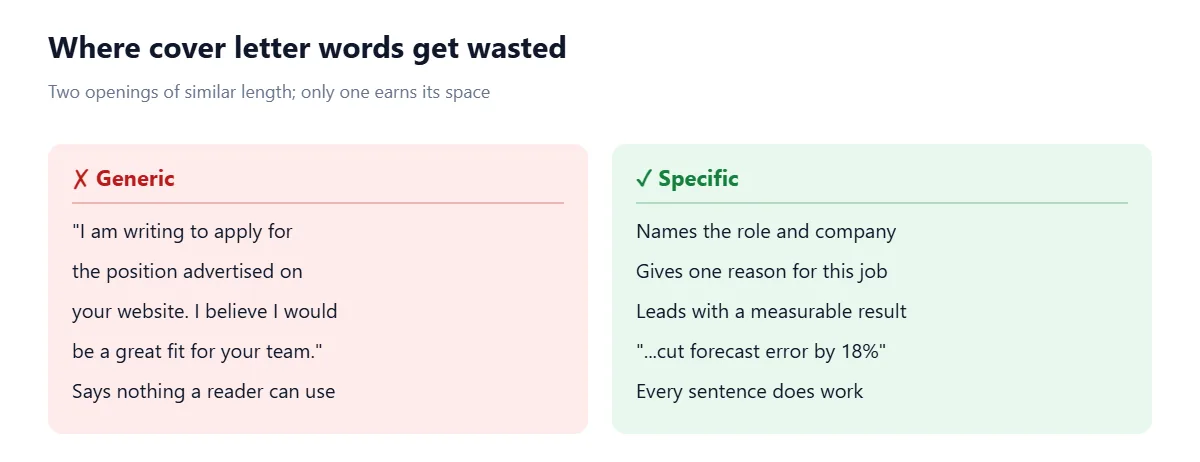
Too short is a real risk too. A three-sentence letter of 80 words usually reads as a form letter, and the ResumeGo results suggest generic letters do worse than tailored ones. If you're under about 200 words, check whether you've given at least one concrete example with a result. If not, that's what to add. A good test is to cover the company name and read the letter back: if it could be sent to any employer unchanged, it's too thin, however long it is.
How to cut a cover letter to one page
If your draft is 550 words, don't start by shrinking the font. Cut content first, in this order:
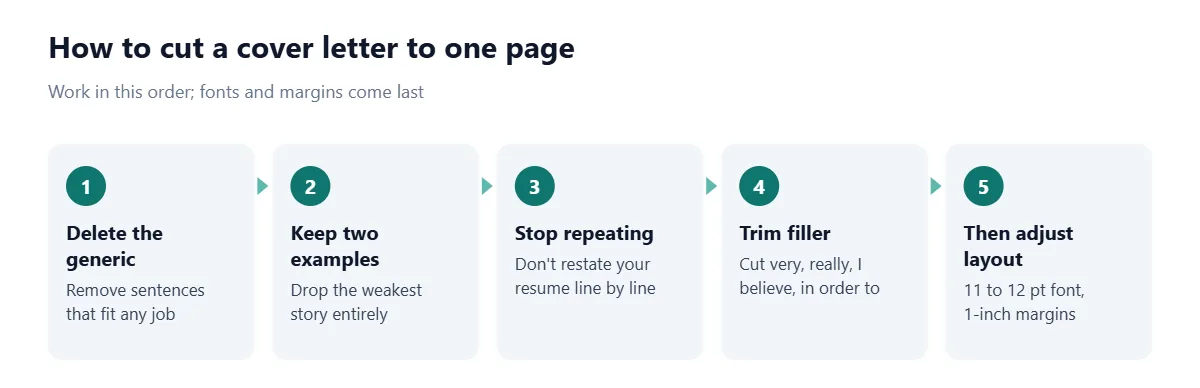
Generic sentences. "I am a hard-working team player" could appear in any letter. Delete it or replace it with evidence.
A third or fourth example. Keep the two strongest stories and remove the rest entirely, rather than shortening all of them.
Resume repetition. Don't list your jobs again. Add the context the resume can't show: why it mattered and what you learned.
Filler words. Phrases like "I believe that," "in order to" and "really" add length without meaning. Our list of filler words to cut has more.
Long sentences. Splitting a 40-word sentence into two often reveals words you don't need.
Paste each version into the Word Counter as you edit. Watching the total drop from 550 to 380 is a good way to keep going, and the reading time it shows tells you how long a busy recruiter will spend. Once the letter is done, our guide to how long a resume should be covers the other half of the application.
Frequently asked questions
How long should a cover letter be in words?
Between 250 and 400 words for most job applications. That fits on one page in three or four paragraphs, as university career centers recommend.
How many paragraphs should a cover letter have?
Three or four: an opening, one or two body paragraphs with specific examples, and a short closing. Academic cover letters are longer, often five to eight paragraphs.
Can a cover letter be two pages?
For most jobs, no; career centers recommend one page. Academic faculty applications are the exception, where 1.5 to 2 pages is typical.
Is 200 words too short for a cover letter?
It's on the short side but can work if every sentence is specific. Most guidance puts the ideal range at 250 to 400 words.
How long should a cover letter be for an internship?
One page and about 250 to 350 words. With less experience, focus on one or two relevant projects, classes or jobs rather than filling space.
How long should an email cover letter be?
If your letter is attached, keep the email to about one short paragraph. If the letter goes in the email body, stay toward the low end of 250 to 400 words.
What font size should a cover letter use?
Usually 11 or 12 point in a standard font such as Arial, Calibri, Georgia or Times New Roman, with margins of about one inch.
Do cover letters still matter?
Often, yes. In a ResumeGo field experiment of 7,287 applications, tailored cover letters got a 53% higher callback rate than applications without one.
Sources
University of Cincinnati. How to write a standout cover letter (step-by-step guide for students). 2024.
University of Washington Department of English. Writing the cover letter.
Northeastern University Careers. How to write a cover letter that actually gets you hired in 2026. 2026.
Purdue Online Writing Lab. Academic cover letters. Purdue University.
The Writing Center, UNC Chapel Hill. Academic cover letters.
Harvard FAS Mignone Center for Career Success. GSAS CV and cover letter guide.
Anna Maria College Career Services. How to write a cover letter (PDF).
ResumeGo. Cover letters: just how important are they?. 2020.

Comments