
How long should a resume be? For most people the answer is one page, and two pages once you have roughly 10 or more years of relevant experience. Students and recent graduates should stay on one page, while senior professionals, academics and federal applicants follow different rules covered below.
Page count is really a proxy for something else: how quickly a stranger can see that you fit the job. This guide answers the length question with the length by experience level, the number of words that actually fits on a page, what changed for US federal resumes in 2025, and a practical way to trim a resume that has grown too long.
How long should a resume be by experience level?
University career centers broadly agree on the split. The USC Career Center says one-page resumes are standard in the US and two pages are acceptable with 10+ years of work experience. UC Davis puts it as one page for recent graduates and two pages if you have extensive work history. Penn's career services tells undergraduates and recent grads to use a one-page resume, while PhDs and postdocs can expand onto two or more pages.
Here is the right length for each stage of a career. The word ranges are our rule of thumb for a cleanly formatted resume, not an official limit.
Your situation | Pages | Approx. words |
|---|---|---|
Student or recent graduate | 1 | 300 to 450 |
1 to 5 years of experience | 1 | 350 to 550 |
5 to 10 years | 1, sometimes 2 | 450 to 700 |
10+ years, mid or senior level | 2 | 600 to 900 |
Executive or 25+ years | 2, rarely 3 | 700 to 1,100 |
US federal job (USAJOBS) | 2 maximum | up to about 1,000 |
Academic CV | No fixed limit | Varies widely |
UK-style CV | 2 sides of A4 | 500 to 900 |
Notice that the dividing line is relevant experience, not age or total years worked. Someone with 12 years in retail who is moving into data analysis may still be better served by one tight page, because most of those years don't speak to the new role.
Is a one-page resume still the rule?
It is the default for early-career applicants, and for a good reason: recruiters skim. In a 2018 eye-tracking study, the job site Ladders found recruiters spent an average of 7.4 seconds on the initial screen of a resume, mostly scanning job titles and section headings down the left side. A first page that makes your fit obvious in that window matters more than anything on page two.
That said, the one-page rule is not a law. A ResumeGo experiment in which 482 recruiters screened 7,712 sample resumes found that recruiters were 2.3 times as likely to choose the two-page versions, and the preference was stronger for mid-level and managerial roles. ResumeGo sells resume writing and the test was a simulation, so treat the result as a signal rather than proof. The sensible reading is this: a second page doesn't hurt you when it is full of relevant, recent achievements. It hurts when it is padding.
How long should a resume be after 10 years? Often two pages
Go to two pages when cutting to one would force you to drop things a hiring manager genuinely needs to see. Common cases:
You have 10 or more years of relevant experience and several roles with measurable results.
The job is technical or regulated and expects lists of systems, certifications, licenses or clearances.
You are applying for a senior or management role where scope (team size, budget, markets) needs room.
You are applying to a US federal job, where required details such as hours per week for each role take space.
If you go to two pages, fill most of the second one. A resume that spills five lines onto page two looks like a formatting accident. Either trim those five lines or add the strongest material you left out. And put your name and a page number on page two in case the pages get separated.
Can a resume be three pages or longer?
Rarely, for a private-sector resume. Indeed's career guide suggests three pages can be acceptable once you have around 25 years of continuous experience, and many executive resumes stop at two anyway. The main exception is academia. A curriculum vitae is a full record of your publications, grants, teaching and presentations, so its length simply follows your record.
If you are writing a three-page resume for a corporate role, ask whether pages two and three are doing work a hiring manager will read. Usually the answer is a list of older jobs that could be condensed into a single "Earlier experience" line.
How long should a federal resume be? The USAJOBS two-page limit
For federal jobs, the answer to how long should a resume be is now set by rule. This is the biggest recent change, and many guides still describe the old practice of five-page federal resumes. Since September 27, 2025, resumes submitted for federal jobs through USAJOBS must be no longer than two pages, according to the US Office of Personnel Management (OPM). The rule was still in force as of September 2026.
The consequence of ignoring it is severe. OPM's guidance to agencies says that if the only resume an applicant submits is longer than two pages, the applicant is ineligible for further consideration. For jobs that need a full CV, typically in medical and research fields, agencies may request the CV separately as an "other document".
OPM's own formatting suggestions for fitting everything in are 0.5-inch margins, 14-point titles and 10-point body text in a sans-serif font such as Lato, Calibri, Helvetica, Arial or Verdana. Your two pages still need to show that you meet the minimum qualifications in the announcement, with job titles, employers, dates and hours per week for each role.
How many words should a resume be?
A one-page resume usually holds about 350 to 550 words, and a two-page resume about 600 to 900. That is far less than a page of plain prose, because headings, dates, white space and short bullet lines all take room. A page of ordinary single-spaced text holds roughly 500 words or more, which you can see in our guide to how many pages 1,000 words fills.
When people ask about resume length, they usually mean pages, but thinking in words helps you plan. If your draft is 800 words and you want one page, you know you need to cut about a third, and you can decide where those cuts come from before fiddling with margins. Paste your resume into the Word Counter to get a quick total, or drop the file into the Document Word Counter if it is already a Word or PDF file.
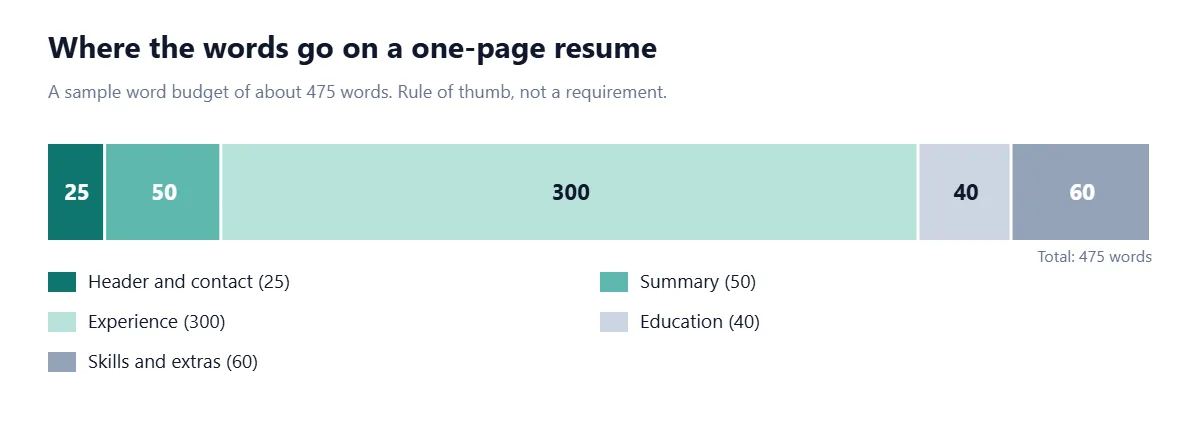
The experience section should carry the most weight. If your summary or skills list is eating a quarter of the page, that space is probably better spent on one more achievement with a number attached.
How to make your resume shorter without losing substance
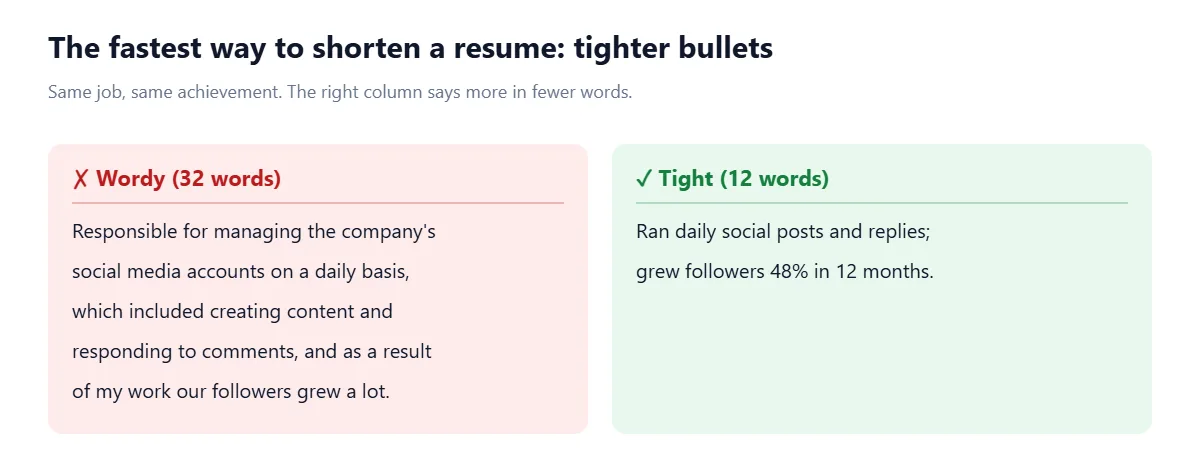
Most resumes are too long because of loose wording, not because of too much experience. Start with the sentences, then the structure, and only then the layout.
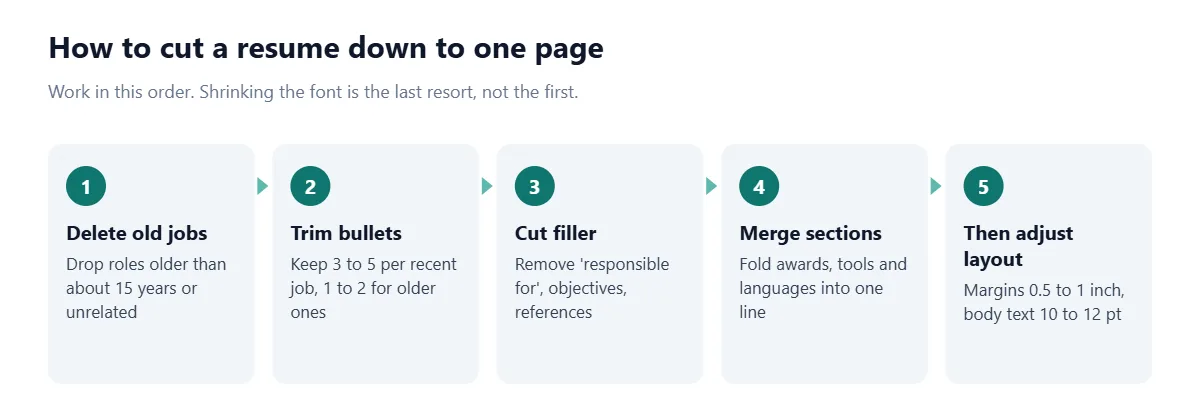
Remove what is not relevant. Indeed suggests focusing on roughly the last 15 years of experience. Older or unrelated jobs can go, or shrink to one line each.
Limit the bullets. Three to five bullets for recent roles and one or two for older ones is plenty. Keep each bullet to one or two lines.
Cut the filler phrases. "Responsible for", "duties included" and "various" add words without adding facts. Start each bullet with a strong verb and end it with a result.
Drop sections that do nothing. Objectives, "References available upon request" and long hobby lists rarely earn their space.
Adjust the layout last. Margins between 0.5 and 1 inch and body text between 10 and 12 points are the ranges career centers and OPM suggest.
What font size and margins make a resume the right length?
Layout matters, but within limits. USC recommends Times New Roman or Arial at 11 to 12 points with 1-inch margins, UC Davis allows 10 to 12 point text with your name at 14 to 20 points, and OPM suggests 10-point body text with 0.5-inch margins for federal resumes.
Going below 10 points to squeeze onto one page backfires. The recruiter may be reading on a laptop or a phone, and tiny text signals that you could not decide what to cut. If you want to see how font, spacing and margins change capacity, try the Words Per Page Calculator before you start shrinking things.
Resume vs CV: are the length rules different?
Yes, and the words mean different things depending on where you are. In the US, a resume is a short, tailored marketing document, while a CV is the long academic record described above. Penn's career services sums it up: a resume is a concise summary tailored to a position, while a CV is a full history of your academic credentials.
In the UK and much of Europe, "CV" is simply the everyday word for a resume. There, the University of Leicester's careers service says a CV is generally two sides of A4 unless you are told otherwise. So a British applicant sending two pages is following the local norm, not overdoing it.
Common resume length mistakes to avoid
Most mistakes come from applying one length rule to everyone. Watch for these:
Treating one page as sacred. If a senior candidate cuts real achievements to hit one page, the resume gets shorter and weaker.
Treating two pages as a target. If you have three years of experience, a second page is almost always filler.
A half-empty last page. Fill it or cut it.
Shrinking text instead of editing. Small fonts and tiny margins make a resume harder to skim in exactly the seconds that count.
Ignoring the application's own rules. A job posting, an online form or a federal announcement can set a limit that overrides any general advice.
Sending the same length everywhere. Tailoring a resume to each job usually makes it shorter, because you drop what that employer won't care about.
Your resume often travels with a cover letter, and that has its own sweet spot. Our guide on how long a cover letter should be covers it in the same way.
The bottom line on resume length
So, how long should a resume be for you? Start with one page. Move to two only when you have more relevant, recent results than one page can hold, and then use the full second page. Follow any limit an employer sets, especially the two-page cap on federal resumes. And remember that every line should help a busy reader decide to call you, which is a better test than any page count.
How long should a resume be for a student?
One page. Students and recent graduates rarely have enough relevant experience to fill two, and career centers such as USC, UC Davis and Penn all recommend one page at this stage.
Is a two-page resume OK?
Yes, if you have about 10 or more years of relevant experience or are applying for a senior, technical or federal role. Fill most of the second page; a few stray lines look like a formatting mistake.
How many words should a one-page resume be?
About 350 to 550 words is typical for a well-formatted one-page resume. A two-page resume usually runs about 600 to 900 words.
Can a federal resume be more than two pages?
No. Since September 27, 2025, resumes for federal jobs on USAJOBS must be two pages or less, and an applicant whose only resume is longer is ineligible for further consideration, according to OPM.
How far back should a resume go?
Usually about 15 years. Older roles can be removed or condensed into a single line unless they are directly relevant to the job.
How long should a resume be for an internship?
One page. Internship applicants are students or recent graduates, and recruiters expect one page at that level.
Is a CV longer than a resume?
In the US, yes: an academic CV lists your full record and has no fixed length, while a resume is one or two pages. In the UK, CV just means resume and is usually two sides of A4.
What font size should a resume be?
Body text between 10 and 12 points is the range most career centers recommend, with your name larger. Going below 10 points to fit one page makes the resume harder to read.
Sources
US Office of Personnel Management. Applicant Guidance on the Two-Page Resume Limit. OPM, 2025.
US Office of Personnel Management. Agency Guidance on the Two-Page Limit on Resume Length. OPM, 2025.
USC Career Center. Resume Format Guidelines. University of Southern California.
UC Davis Internship and Career Center. Resumes. University of California, Davis.
Penn Career Services. Write a Resume/CV. University of Pennsylvania.
University of Leicester Career Development Service. CVs. University of Leicester.
Ladders. Eye-Tracking Study. Ladders, 2018.
ResumeGo. One-page vs two-page resumes study. ResumeGo.
Indeed Editorial Team. How Long Should a Resume Be?. Indeed.

Comments