
Affect vs effect comes down to one rule: affect is usually a verb that means to influence something, and effect is usually a noun that means the result. So the weather "affects" your mood, and a sunny day has a good "effect" on it.
That rule covers almost every sentence you'll write. The rest of this guide gives you a test you can run in your head, the exceptions that catch out even careful writers, a practice table, and the related pairs (affected and effected, affective and effective) that cause the same trouble.
What is the difference between affect and effect?
The two words sound almost the same in everyday speech, which is why spell-checkers never catch the mix-up. But they do different jobs in a sentence, and that's the key to telling them apart.
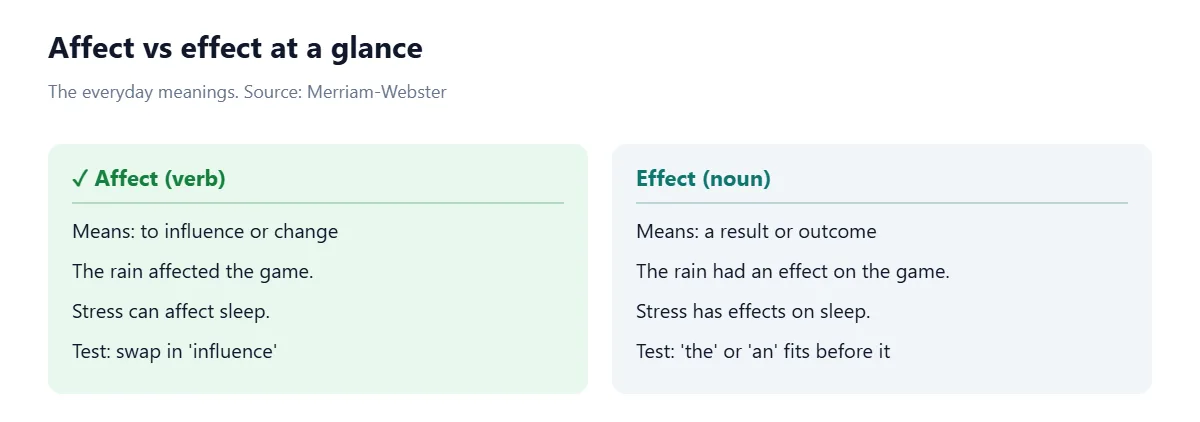
Affect (verb): to produce an effect on someone or something, to influence or change it. Merriam-Webster's example is "Ocean currents affect the weather" (Merriam-Webster, affect).
Effect (noun): a change that results when something is done or happens; an outcome. You "have" an effect, "feel" an effect or "notice" an effect (Merriam-Webster, effect).
Merriam-Webster sums it up the same way: the most common use of "affect" is as a verb meaning "to produce an effect on," and the most common use of "effect" is as a noun referring to a change or result. Notice that the definition of "affect" uses the word "effect". That's a handy reminder of how the two fit together: one causes, the other is what you get.
Affect vs effect: the 3-second test
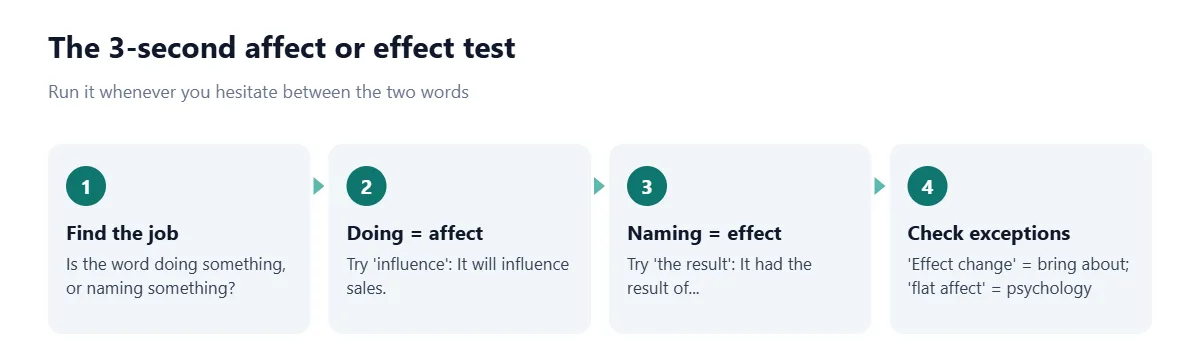
You don't need to memorize definitions. Ask what the word is doing in your sentence.
Is it an action? If the word is the verb, the thing that's happening, you almost always want "affect". Try replacing it with "influence" or "change". "The delay will influence our launch" works, so it's "The delay will affect our launch."
Is it a thing? If you could put "the", "an", "any" or an adjective (big, side, lasting) in front of it, you want "effect". "The delay had a big effect on our launch."
Still unsure? Swap in "result". "The delay had a big result on our launch" is clumsy but grammatical in shape, which tells you a noun belongs there, so "effect" is right.
The grammar clue is more reliable than meaning, because both words are about cause and consequence. Look at the little words around the gap. "Will ___", "can ___", "to ___" and "didn't ___" all need a verb, so they take "affect". "An ___", "the ___", "no ___" and "side ___" need a noun, so they take "effect".
Memory tricks for affect and effect
Pick the one that sticks for you. All three point to the same rule.
RAVEN: Remember, Affect is a Verb, Effect is a Noun. University writing centers teach this one widely, including Touro University and the University of Waterloo, which says it resolves the choice the vast majority of the time.
A for action, E for end result. Affect starts with A, like action. Effect starts with E, like end result. Merriam-Webster recommends the same pairing (Merriam-Webster).
Cause comes before effect. In the alphabet, A comes before E. In real life, you affect something first, and the effect follows.
Affect vs effect examples in sentences
Here are pairs that use the same idea both ways, so you can see how the grammar changes the word.
Affect (verb) | Effect (noun) |
|---|---|
Caffeine affects my sleep. | Caffeine has an effect on my sleep. |
Will the strike affect flights? | What effect will the strike have on flights? |
Her speech affected everyone. | Her speech had a powerful effect on everyone. |
Rising rates affect borrowers. | Borrowers feel the effects of rising rates. |
The edit didn't affect the meaning. | The edit had no effect on the meaning. |
How does sugar affect children? | What are the effects of sugar on children? |
The new rules affect all staff. | The new rules take effect on Monday. |
Notice the last row. "Take effect", "go into effect", "in effect", "come into effect" and "put into effect" are fixed phrases, and they always use the noun. The same goes for "side effects", "special effects", "sound effects" and "personal effects" (your belongings).
When is effect a verb? ("effect change")
This is the first exception, and it's the one that shows up in business and policy writing. As a verb, "effect" means "to cause or bring about (something)," and Merriam-Webster's example is "effect a transformation in company culture" (Merriam-Webster).
The difference from "affect" is real, not just a spelling quirk. The MLA Style Center puts it neatly: to "effect" something is to bring it into existence, while to "affect" something is to influence something that already exists (MLA Style Center).
"The new manager wants to effect change." She wants to make change happen.
"The new manager wants to affect change." She wants to alter change that's already under way, which is rarely what anyone means.
"We effected a settlement within a day." We reached (brought about) a settlement.
"The offer affected our willingness to settle." The offer influenced how willing we were.
So "effect change" is correct and "affect change" is almost always a slip. If you can swap in "bring about" or "achieve", the verb you want is "effect".
When is affect a noun? (psychology)
The second exception is mostly confined to psychology, medicine and social work. As a noun, "affect" means the observable signs of an emotion: facial expression, gestures, tone of voice (Merriam-Webster). It's stressed on the first syllable, AF-fect, which is the one place the two words sound clearly different.
"The patient presented with a flat affect." (little visible emotion)
"His affect didn't change when he heard the news."
"The child's bright affect returned after lunch."
Unless you're writing a clinical note or a psychology paper, you'll rarely need this one. If you see "affect" used as a noun in ordinary writing, it's usually a mistake for "effect".
One more: affect meaning "to pretend"
"Affect" has a second verb sense: to put on a false appearance of something. "He affected a French accent" or "She affected indifference" (Merriam-Webster). The adjective "affected" in this sense means artificial or showy: "an affected laugh." It's still a verb, so the RAVEN rule holds.
Affected vs effected
The affect vs effect rule carries straight over to the past tenses. Most of the time you want affected: "Thousands of homes were affected by the storm." Use effected only when you mean something was brought about: "The repairs were effected within a week."
A quick check: if you can replace the word with "influenced", "hit" or "changed", write "affected". If "carried out" or "achieved" fits, write "effected".
Affective vs effective (and other related words)
The adjectives cause similar confusion, though in practice one of them is far more common.
Word | Meaning | Example |
|---|---|---|
effective | produces the intended result | An effective ad campaign |
affective | relating to feelings or emotions | Affective symptoms such as low mood |
effectively | in a way that works | She argued effectively. |
affected (adj.) | artificial or put on; or harmed | An affected accent; affected areas |
unaffected | not changed; or natural | Prices were unaffected. |
ineffective | fails to get results | An ineffective policy |
"Affective" belongs to the same specialist corner as the noun "affect": Merriam-Webster defines it as "relating to, arising from, or influencing feelings or emotions" (Merriam-Webster, affective). Outside psychology, you almost certainly want "effective".
Common affect vs effect mistakes
These are the affect vs effect slips editors fix most often. Each one breaks the verb/noun rule in a predictable spot.
"This will effect everyone." After "will", you need a verb meaning influence: "affect".
"The medicine had no affect." After "no", you need a noun: "effect".
"The law goes into affect in May." Fixed phrase: "into effect".
"We want to affect real change." You want to bring it about: "effect".
"Side affects may include nausea." Always "side effects".
"How did the move effect you?" After "did", it's a verb: "affect".
Most of these happen while typing fast, not because the writer doesn't know the rule. When you proofread, search your draft for both words (Ctrl+F or Cmd+F) and run the test on each one. If you draft in the Online Text Editor, you can paste the final version into the Word Counter to check length before you submit.
Affect vs effect quiz: test yourself
Cover the right-hand column and fill each gap, then check your answers.
Sentence | Answer | Why |
|---|---|---|
The cuts will ___ every team. | affect | After "will": a verb |
The cuts had a huge ___. | effect | After "a huge": a noun |
The policy takes ___ in June. | effect | Fixed phrase "take effect" |
Volunteers ___ed real change. | effect | Means brought about |
Did the noise ___ your work? | affect | After "did": a verb |
The ___s of the drug wore off. | effect | Plural noun |
The therapist noted a flat ___. | affect | Psychology noun |
Nobody was ___ed by the outage. | affect | Means influenced |
If you got all eight, you understand affect vs effect better than most published writers. If you missed the fourth or seventh, that's normal: they're the exceptions, and they're rare outside formal or clinical writing.
Why do people mix up affect and effect?
In fast, casual speech the first vowels of the two words often sound alike, so your ear gives you no help. Both words also deal with cause and consequence, so meaning alone doesn't separate them. That's why the grammar test works better than trying to feel which one is right.
A second reason is that both exceptions are real. Writers who have seen "effect change" in a report, or "flat affect" in a medical drama, sometimes overcorrect and start using the rare forms in ordinary sentences. Stick with the main rule unless you specifically mean "bring about" or "visible emotion".
If you write a lot of reports or essays, it helps to keep a short personal list of word pairs you tend to mix up. Our guide to filler words to cut covers another set of habits worth catching on a final read, and Compare Text shows exactly what changed between your draft and the edited version.
Frequently asked questions
Is it affect or effect on someone?
Use "effect on" with a noun phrase: "It had a big effect on me." If you want a verb, drop "on" and use "affect": "It affected me."
Is it affect change or effect change?
It's usually "effect change", which means to bring about change. "Affect change" would mean to influence a change that is already happening, which is rarely what people mean.
What is an easy way to remember affect vs effect?
Use RAVEN: Remember, Affect is a Verb, Effect is a Noun. Or think A for action and E for end result.
Can affect be used as a noun?
Yes, but mainly in psychology, where "affect" means the visible expression of emotion, as in "a flat affect." In everyday writing, the noun you want is almost always "effect".
Can effect be used as a verb?
Yes. "Effect" as a verb means to cause or bring about, as in "effect a change" or "effect a settlement." It's formal and much less common than "affect" as a verb.
Is it 'take affect' or 'take effect'?
It's "take effect". The phrases "take effect", "go into effect", "come into effect" and "in effect" always use the noun "effect".
Is it side effects or side affects?
It's always "side effects". A side effect is a result, so it takes the noun.
What is the difference between affected and effected?
"Affected" means influenced or changed ("areas affected by flooding"). "Effected" means brought about or carried out ("repairs were effected quickly").
Sources
Merriam-Webster. Affect definition and meaning. Merriam-Webster.
Merriam-Webster. Effect definition and meaning. Merriam-Webster.
Merriam-Webster. Affect vs. Effect: How to Pick the Right One. Merriam-Webster.
Merriam-Webster. Affective definition and meaning. Merriam-Webster.
Brown, Z. To Affect or Effect: to What Effect?. MLA Style Center, 2022.
Touro University Writing Center. Affect or Effect: Use the Correct Word Every Time. Touro University.
Bentia, M. Affect vs Effect. University of Waterloo Writing and Communication Centre, 2018.

Comments