
The UCAS personal statement character limit is 4,000 characters including spaces, shared across three questions, and each answer must be at least 350 characters. This format started with 2026 entry and applies to applications for 2027 entry, which can be submitted from 1 September 2026.
The limit sounds generous until you realize it's characters, not words, and that spaces count. Below you'll find the three questions, how many words 4,000 characters really is, sensible ways to split it, how to count exactly as UCAS does, and what to cut when you're over.
What is the UCAS personal statement character limit?
UCAS says the 4,000 overall character limit, including spaces, remains the same under the new format, and that each of the three answers has a minimum of 350 characters. You can use the 4,000 characters across the answers in any way you choose.
Two details that trip people up:
The questions are free. UCAS confirms in its adviser FAQs that the question text isn't included in the character count, so you get the full 4,000 characters for your answers.
Spaces are included. Every space between words counts as a character. So does punctuation.
As of September 2026, these rules apply to 2027 entry. UCAS opened applications for 2027 entry on 12 May 2026, and completed applications can be sent from 1 September 2026.
What are the three UCAS personal statement questions?
Since 2026 entry, the free-form statement has been replaced by three questions, announced by UCAS as part of its admissions reforms:
Why do you want to study this course or subject?
How have your qualifications and studies helped you to prepare for this course or subject?
What else have you done to prepare outside of education, and why are these experiences useful?
UCAS says admissions staff will review the three answers as a whole, much like the old single statement. Universities will see your answers clearly split by question, but how exactly they appear depends on each university's software.
How many words is 4,000 characters?
About 550 to 700 words. English words average 4.79 letters in Peter Norvig's analysis of the Google Books corpus, and each word also brings a space and some punctuation, so a typical word costs roughly six characters. 4,000 ÷ 6 ≈ 667 words.
Your own number depends on your vocabulary. Writing about "electrophysiology" and "interdisciplinary approaches" uses characters fast. Plain, direct sentences fit more words. That's one reason to count characters, not words, from your first draft.
Characters (with spaces) | Approximate words | What it means for UCAS |
|---|---|---|
350 | 50–60 | Minimum for one answer |
1,000 | 140–170 | A short answer |
1,333 | 190–220 | An even three-way split |
2,000 | 280–330 | Half the statement |
4,000 | 550–700 | The full limit |
For more on the conversion, see our guide to how many words 280 characters is, which explains the average word length behind these estimates.
How should you split 4,000 characters between the three questions?
There's no required split. UCAS says the amount you write for each question can vary depending on your course and experience, as long as each answer meets the 350-character minimum. An even split is about 1,333 characters each, and it's a sensible starting point.
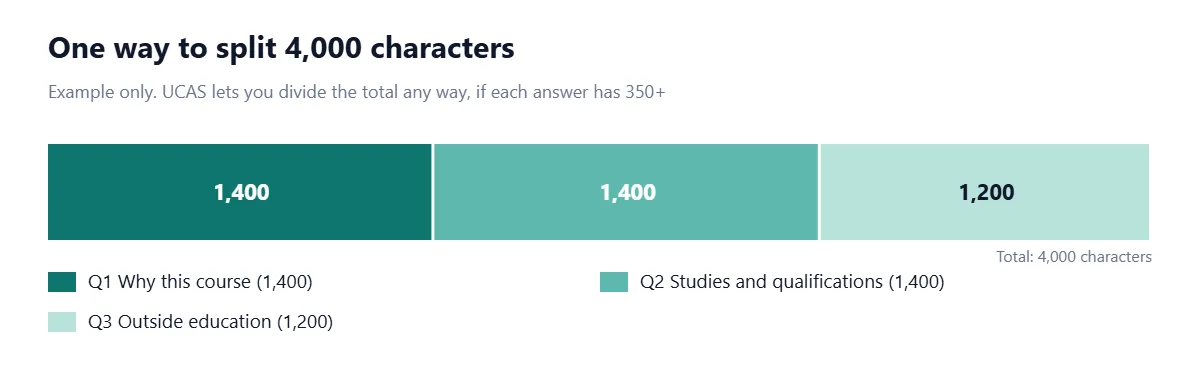
Then adjust for your course. UCAS notes that weighting depends on the university and course, and gives an example: for nursing or medicine, question three often matters more because work experience is a requirement. Here are some reasonable starting points:
Your situation | Q1 Why | Q2 Studies | Q3 Outside |
|---|---|---|---|
Even starting point | 1,333 | 1,333 | 1,334 |
Academic subject (e.g. history, maths) | 1,300 | 1,700 | 1,000 |
Medicine, nursing, vet, teaching | 1,100 | 1,200 | 1,700 |
Creative or vocational course | 1,200 | 1,200 | 1,600 |
Changing subject from your A levels | 1,600 | 1,400 | 1,000 |
These are our suggestions, not UCAS rules. Always check the guidance on each university's course page. Some say what they want to see in each answer, and that's worth more than any general template.
Is there still a 47-line limit?
Probably not in the way there used to be, but check. UCAS's older guidance for the single free-form statement said you had 4,000 characters and 47 lines. UCAS's current guidance for 2026 entry onwards mentions only the 4,000-character total and the 350-character minimum per answer, and we couldn't find a line limit stated for the three-question format.
The practical takeaway: don't use blank lines between paragraphs to pad or space out your answers, and preview your statement in the UCAS application before you submit. If anything is cut off or flagged, the preview is where you'll see it.
How does UCAS count characters?
UCAS counts every character, including spaces and punctuation. Its older guidance also warned that some word processors get different values because they don't count tabs and paragraph spacing as individual characters. That's why your Word or Google Docs count can differ slightly from the number UCAS shows.
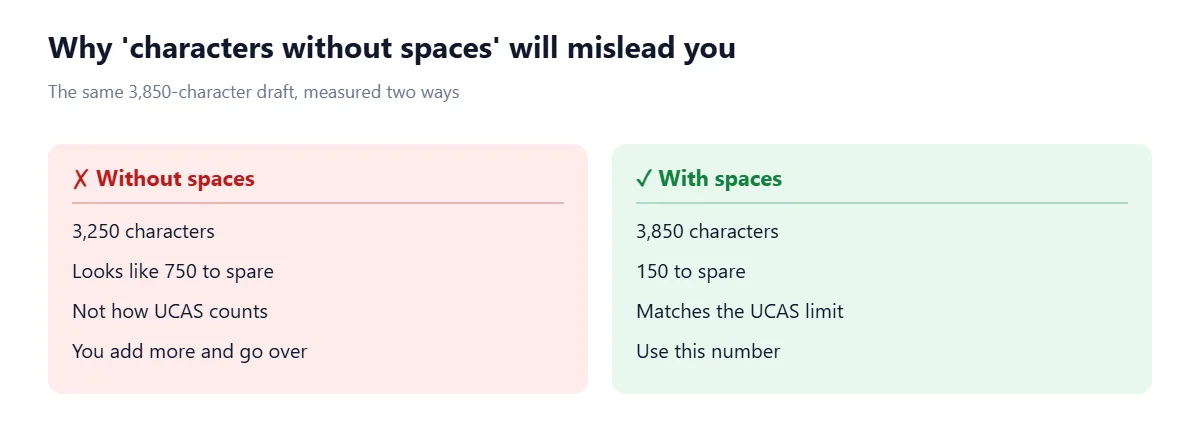
To get the right number in common tools:
Google Docs: Tools › Word count shows both Characters and Characters without spaces. Use Characters.
Microsoft Word: click the word count in the status bar to see characters, paragraphs and lines. If two character figures are shown, use the one that includes spaces.
Our tool: the Character Counter shows characters with and without spaces as you type, and nothing you paste is uploaded.
How to check your UCAS character count step by step
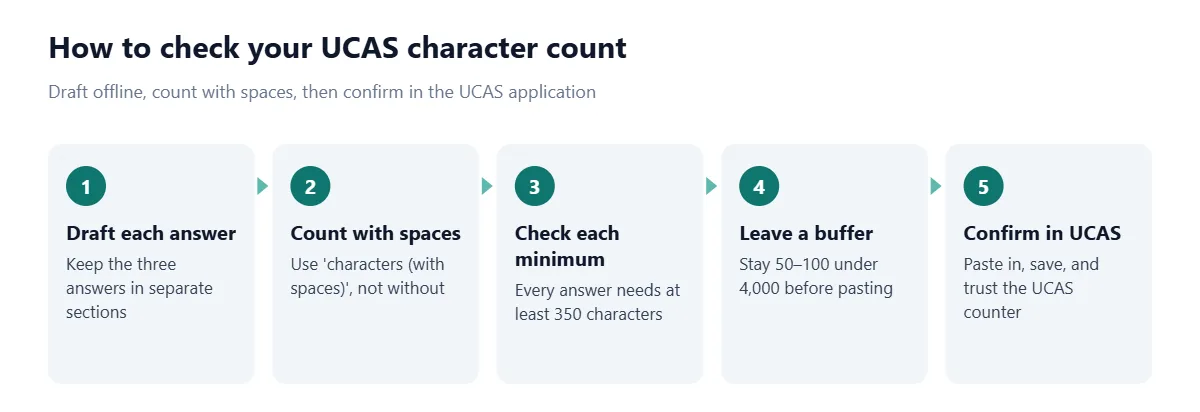
Write your three answers in a document, each under its own heading so you can count them separately.
Select one answer at a time and check its character count with spaces. Each must be 350 or more.
Check the combined total of all three answers, without the headings.
Leave a small buffer of 50 to 100 characters, so a different count in UCAS doesn't push you over.
Paste each answer into the UCAS application, save, and use the UCAS counter as the final word.
If your answers came from a document with odd line breaks or double spaces, run them through the Text Cleaner first. Stray spaces cost characters.
When is the UCAS deadline for 2027 entry?
For courses at Oxford and Cambridge and most courses in medicine, dentistry and veterinary medicine or science, the equal consideration date is 15 October 2026 at 18:00 UK time. For most other undergraduate courses it's 13 January 2027 at 18:00 UK time, according to UCAS's 2027 entry dates.
Give yourself time to cut. Getting a first draft from 5,500 characters down to 4,000 usually takes more than one sitting.
How to cut your personal statement when you're over 4,000 characters
Cut repeated evidence. If two activities show the same quality, keep the one where you can say what you learned.
Drop the question restated. You don't need to open answer one with "I want to study this course because". The question is already there, and it doesn't count toward the limit.
Replace long phrases. "Due to the fact that" becomes "because", saving 13 characters. "In order to" becomes "to", saving 9.
Name specifics instead of describing them. "A book about the history of mathematics" costs more than its title and author, and says less.
Remove qualifiers. "Really", "very", "quite" and "extremely" rarely add anything.
Here's a worked example of sentence-level trimming, with character counts including spaces:
Before (116 characters): "I have always been really interested in the subject of biology due to the fact that I enjoy learning about the body."
After (64 characters): "Biology fascinates me because I want to know how the body works."
That one sentence gave back 52 characters, more than the length of a short clause. Do the same to five or six sentences and a draft that was 300 over fits. If you're still over after that, go back to the bigger cuts above: a whole example you can lose is worth more than a dozen trimmed words. For tips on checking counts in each app, see our guide on how to check word count.
Can you use AI to write a UCAS personal statement?
UCAS says generating all or a large part of your statement with an AI tool and presenting it as your own could be considered cheating. Its Verification Team runs checks for patterns of similarity, and universities may be told if a statement is flagged. UCAS also can't pre-screen statements before you submit.
UCAS does suggest acceptable uses, such as brainstorming ideas, trying out structures and checking readability. The words you submit should be your own.
Paste each answer into the Character Counter to see characters with and without spaces, words and lines as you edit.
Frequently asked questions
How many characters is the UCAS personal statement?
4,000 characters including spaces, shared across three questions. Each answer must have at least 350 characters, and the question text doesn't count toward the total.
Does the UCAS character limit include spaces?
Yes. UCAS counts spaces and punctuation, so always check the 'characters with spaces' figure in your word processor.
How many words is a UCAS personal statement?
About 550 to 700 words, because the limit is 4,000 characters and a typical English word uses about six characters including the space after it.
What is the minimum length for each UCAS question?
Each of the three answers must be at least 350 characters, about 50 to 60 words.
Is the UCAS personal statement the same for 2027 entry?
Yes. The three-question format with a 4,000-character limit started with 2026 entry and continues for 2027 entry.
Do the UCAS questions count toward the 4,000 characters?
No. UCAS confirms the question text isn't included, so you have the full 4,000 characters for your answers.
Do I have to split the characters equally between the questions?
No. You can divide the 4,000 characters however suits your course, as long as each answer meets the 350-character minimum.
Is there a line limit on the UCAS personal statement?
UCAS's current guidance for 2026 entry onwards states only the 4,000-character limit and 350-character minimums. The old single statement also had a 47-line limit, so preview your statement in UCAS before submitting.
Sources
UCAS. How to write your personal statement: 2026 entry onwards. UCAS.
UCAS. Personal statement toolkit (adviser FAQs). UCAS.
UCAS. Reforming admissions. UCAS.
UCAS. Dates and deadlines for uni applications. UCAS, accessed September 2026.
UCAS. What is a personal statement? (earlier guidance). UCAS.
UCAS. A guide to using AI and ChatGPT with your personal statement. UCAS.
UCAS. Can you check my personal statement against the similarity detection software?. UCAS FAQs.
Norvig, P. English Letter Frequency Counts: Mayzner Revisited. Norvig.com.
Google. Get the word count for a document. Google Docs Editors Help.
Microsoft. Show word count. Microsoft Support.

Comments