
How many words is 280 characters? It's about 47 words of everyday English, counting spaces and punctuation. Depending on how long your words are, it ranges from roughly 40 words for technical writing to 56 for short, simple words.
The divide-by-6 rule works because the average English word is a little under 5 letters long, and every word also needs a space and the occasional comma or full stop. Below you'll see where that number comes from, a chart for common limits, and the cases where it falls apart.
How many words is 280 characters?
At about 6 characters per word, 280 ÷ 6 ≈ 47 words. That's roughly two or three medium-length sentences: if your sentences average 15 words, 47 words is just over three of them.
To test it, we wrote a plain-English post of exactly 280 characters about a book club moving to Thursday nights. It came to 50 words. Here's what those 280 characters were made of:
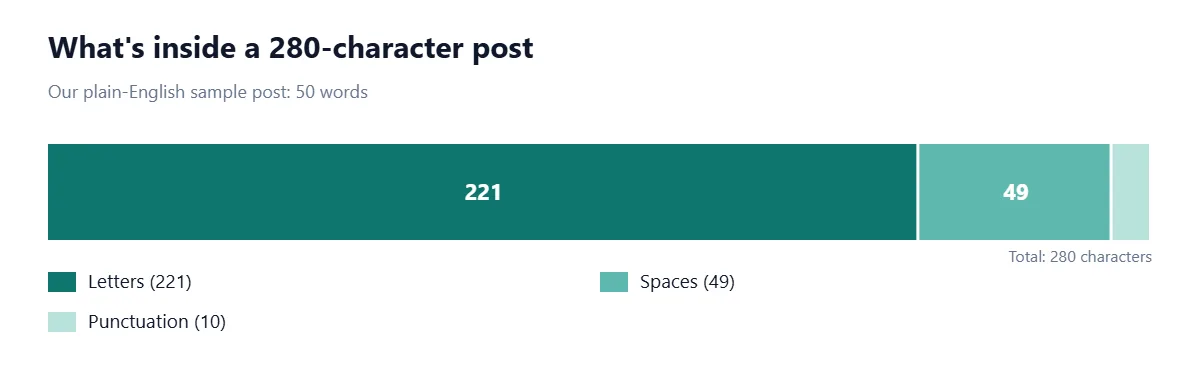
Notice how much room the spaces take: almost one character in five. That's why a limit that counts characters with spaces holds noticeably fewer words than one that counts characters without them.
How many characters are in an average word?
Peter Norvig analyzed the Google Books data, a corpus of over 743 billion words, and found the average English word is 4.79 letters long, with 80% of words between 2 and 7 letters (Norvig, English Letter Frequency Counts). That's counting every word as it appears, so short, frequent words like "the" and "of" pull the average down.
If you instead average the dictionary of distinct words, the figure jumps to 7.60 letters, because the rare words are long ones. Real text is full of short common words, so the lower figure is the one that matters for character limits.
Add a space after each word and a bit of punctuation, and you get close to 6 characters per word. We checked that against real text of different kinds:
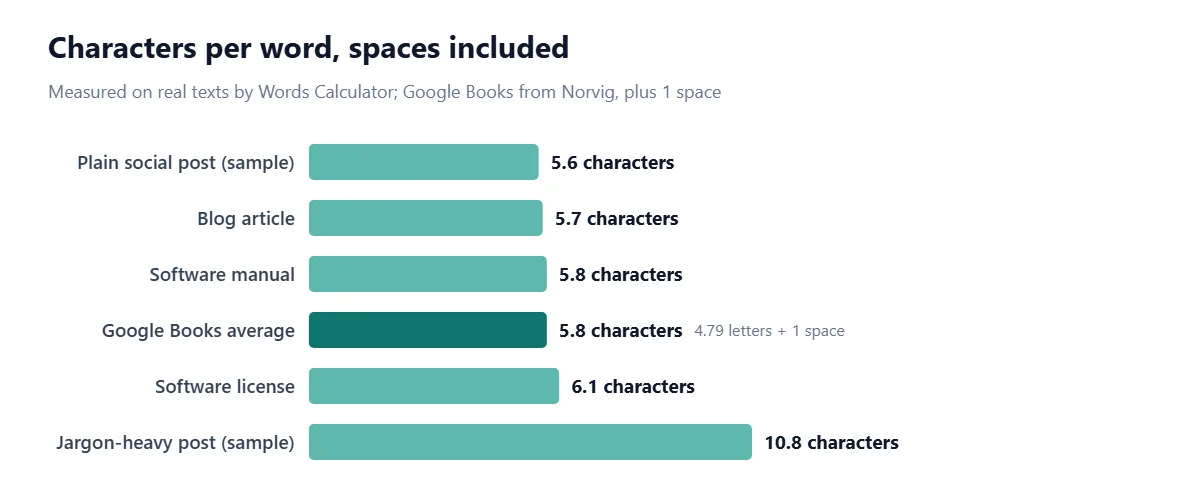
The takeaway: everyday writing sits between about 5.5 and 6.1 characters per word, so dividing by 6 gives a slightly cautious estimate. Dense, technical writing is the exception, and it can halve your word count.
Characters to words conversion chart
This chart covers the limits people run into most. The middle column is the everyday estimate. Use the left column for technical or formal writing and the right for short, casual words. All figures count spaces as characters.
Characters (with spaces) | Technical (7 per word) | Typical (6 per word) | Casual (5 per word) |
|---|---|---|---|
140 characters | 20 | 23 | 28 |
280 characters | 40 | 47 | 56 |
500 characters | 71 | 83 | 100 |
1,000 characters | 143 | 167 | 200 |
2,200 characters | 314 | 367 | 440 |
3,000 characters | 429 | 500 | 600 |
4,000 characters | 571 | 667 | 800 |
5,000 characters | 714 | 833 | 1,000 |
A few of these match real platform limits. As of September 2026, a standard post on X is up to 280 characters (X Help Center), and an Instagram caption can be up to 2,200 characters (Instagram Platform documentation). For the full rules on each platform, see our guides to the X character limit and Instagram character limits.
How many words is 500, 1,000 or 2,200 characters?
500 characters: about 83 words, or 71 to 100. That's a short paragraph or a product description.
1,000 characters: about 167 words, or 143 to 200. Roughly one long paragraph or two short ones.
2,200 characters: about 367 words, or 314 to 440. A full Instagram caption is a short blog post in length.
3,000 characters: about 500 words, or 429 to 600.
4,000 characters: about 667 words, or 571 to 800. That's a little more than one single-spaced page.
If your application or form has a character limit, see how the numbers work for the UCAS personal statement.
Work out your own characters per word
The chart uses averages. Your own writing has its own ratio, and it takes a minute to find. Paste a few things you've already written, such as old posts, a bio or an email, into the Word Counter. Divide the character count (with spaces) by the word count. If 1,150 characters come to 200 words, your ratio is 5.75, and 280 characters will hold about 280 ÷ 5.75 ≈ 49 of your words.
Do this once with casual writing and once with work writing. Most people find their work ratio is noticeably higher, because professional vocabulary runs longer. It's the same reason non-fiction takes longer to read than fiction: a large review of reading studies found the difference comes down to longer words in non-fiction (Brysbaert, 2019).
Characters to words: 1,500, 2,000, 3,500 and 5,000 characters
Longer limits turn up in application forms, product listings and job portals. At the same average of about 6 characters per word (5 letters plus a space), here's how many words fit:
Characters (with spaces) | About this many words | Typical range |
|---|---|---|
1,500 | 250 | 215–300 |
2,000 | 330 | 285–400 |
3,000 | 500 | 430–600 |
3,500 | 580 | 500–700 |
4,000 | 670 | 570–800 |
5,000 | 830 | 715–1,000 |
The range depends on your vocabulary: plain, short words sit at the top of it, technical writing at the bottom. For an exact figure, paste your text into the Character Counter, which shows characters with and without spaces alongside the word count.
Characters with spaces vs without spaces
Most online limits count spaces. X's developer documentation gives a worked example: the greeting "Hello, world" with an exclamation mark, a space and a waving-hand emoji counts as 16 characters. That total only adds up if both spaces count. Some tools, forms and translation or academic briefs count characters without spaces instead. The difference is about one character per word:
With spaces: divide by about 6. 280 characters ≈ 47 words.
Without spaces: divide by about 5. 280 characters ≈ 56 words.
In our sample texts, characters without spaces averaged between 4.7 and 5.1 per word, which is where the divide-by-5 rule comes from. If you're not sure which way a limit counts, assume spaces are included. It's the stricter reading, so you won't go over.
How many characters is a word count? Words to characters
Going the other way is useful when you've written to a word count and need to fit a character box. Multiply by 6 for characters with spaces, or by 5 without:
Words | Characters with spaces | Characters without spaces |
|---|---|---|
25 words | 150 | 125 |
50 words | 300 | 250 |
100 words | 600 | 500 |
250 words | 1,500 | 1,250 |
500 words | 3,000 | 2,500 |
1,000 words | 6,000 | 5,000 |
For anything that must fit exactly, don't estimate. Paste your text into the Character Counter to get both numbers at once.
Why the same 280 characters can hold 26 or 50 words
Word length swings the result more than people expect, and charts built on a single average hide it. We wrote three posts, each 280 characters as X would count them: one in plain English, one in corporate jargon and one that ends with a long link.
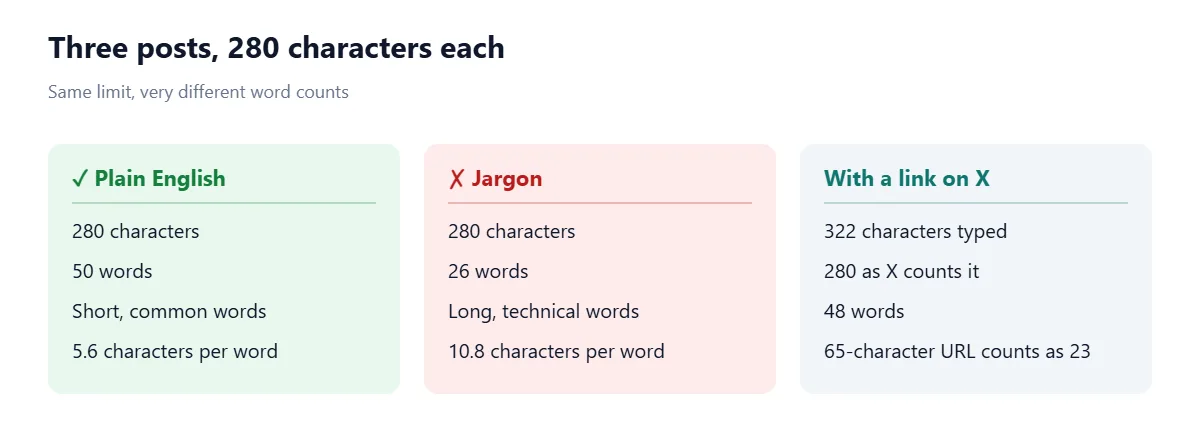
This is the part most conversion charts skip. The jargon post, full of words like "infrastructure" and "implementation," fit only 26 words. The plain one fit 50. If you're struggling to fit a limit, swapping long words for short ones often frees more space than cutting a whole sentence. "Use" instead of "utilize" saves 4 characters every time.
How X counts the 280 characters
X doesn't count every character as 1. Its developer documentation says Latin letters, punctuation and common symbols count as 1, while emojis and Chinese, Japanese and Korean characters count as 2 each (X Developer Platform, Counting characters). That means:
Links always count as 23 characters, however long or short the web address is, because X wraps every URL in its t.co shortener. In our third sample, a 65-character link counted as 23, which let the post run to 322 typed characters.
Each emoji counts as 2, even complex ones such as skin-tone or family emojis.
Text in Chinese, Japanese or Korean counts double, so a post in those languages holds about 140 characters.
X Premium subscribers can post longer text, up to 25,000 characters (X Help Center). At 6 characters per word, that's about 4,167 words. The Character Limit Checker shows your text against X and other platform limits at once.
How to fit more words into 280 characters
Cut filler first: "really," "just," "very," "in order to" (use "to"). Each cut saves 5 to 9 characters, spaces included.
Swap long words for short ones: "help" for "facilitate," "about" for "approximately."
Use numerals: "3" instead of "three" saves 4 characters.
Drop the link text if the link previews on its own. On X the link costs 23 characters regardless.
Count before you post. Rewriting a post that failed to send is slower than checking it once.
Common mistakes when converting characters to words
Using 5 characters per word for a limit that counts spaces. You'll plan about 20% too many words and go over.
Forgetting that emojis and links count differently on X. A post that looks like 270 characters in a notes app can be over, or well under, once X weighs it.
Assuming every counter agrees. Tools can differ on emojis, line breaks and accented letters. Check with the counter on the platform you're posting to.
Frequently asked questions
How many words is 280 characters?
About 47 words, assuming an average of 6 characters per word including spaces. It can range from about 40 words for technical writing to 56 for short, simple words.
How many words is 500 characters?
About 83 words with spaces counted, or roughly 71 to 100 words depending on word length.
How many words is 1,000 characters?
About 167 words with spaces counted, or roughly 143 to 200 words.
How many words is 2,200 characters?
About 367 words with spaces counted. 2,200 characters is the maximum length of an Instagram caption as of September 2026.
How many characters is an average word?
An average English word is 4.79 letters, according to Peter Norvig's analysis of Google Books. With a space and punctuation, plan on about 6 characters per word.
Do spaces count as characters?
On most platforms, yes. X counts every space as a character, so a 280-character post includes its spaces. Some forms and tools count characters without spaces, so check which one a limit uses.
How many sentences is 280 characters?
About two or three sentences. At roughly 47 words, that's three sentences of about 15 words each.
How many characters is 100 words?
About 600 characters with spaces, or about 500 without spaces.
How many words is 2,000 characters?
About 330 words, or roughly 285 to 400 depending on how long your words are, counting spaces and punctuation.
How many words is 5,000 characters?
About 830 words of everyday English, counting spaces. Plain writing with short words can reach about 1,000; technical writing may be nearer 715.
Sources
Norvig, P. English Letter Frequency Counts: Mayzner Revisited. norvig.com.
X Corp. How to post. X Help Center, 2026.
X Corp. Counting characters. X Developer Platform, 2026.
Brysbaert, M. (2019). How many words do we read per minute? A review and meta-analysis of reading rate. Journal of Memory and Language, 109.
Meta. IG User Media reference. Instagram Platform documentation, 2026.

Comments