
To write a hook, open with the single most interesting thing you have (a surprising fact, a vivid moment, a sharp question or a bold claim) in one or two sentences, then connect it to your main point right away. That's how to write a hook in a nutshell: earn attention first, then show the reader why it matters.
Most guides on how to write a hook stop at a list of hook types. This one also covers the part that trips people up: the sentence after the hook. A clever opener that doesn't connect to your point reads like a bait and switch, and teachers and editors notice.
What is a hook in writing?
A hook is the opening of a piece, usually the very first sentence, that tries to make the reader want to keep going. East Stroudsburg University's writing studio defines it as "an opening statement (which is usually the first sentence) in an essay that attempts to grab the reader's attention" (ESU Writing Studio).
Why learn how to write a hook at all? Because readers decide fast. In Jakob Nielsen's classic usability research, 79% of test users scanned any new web page, and only 16% read word by word (Nielsen Norman Group). A teacher grading 30 essays isn't scanning a web page, but the instinct is the same: a flat first line lowers expectations for everything after it.
A hook also has a job beyond grabbing attention. It sets the tone. A joke tells the reader to expect something light; a hard statistic signals a serious argument. Pick a hook that promises the kind of piece you're actually writing.
How to write a hook in 5 steps
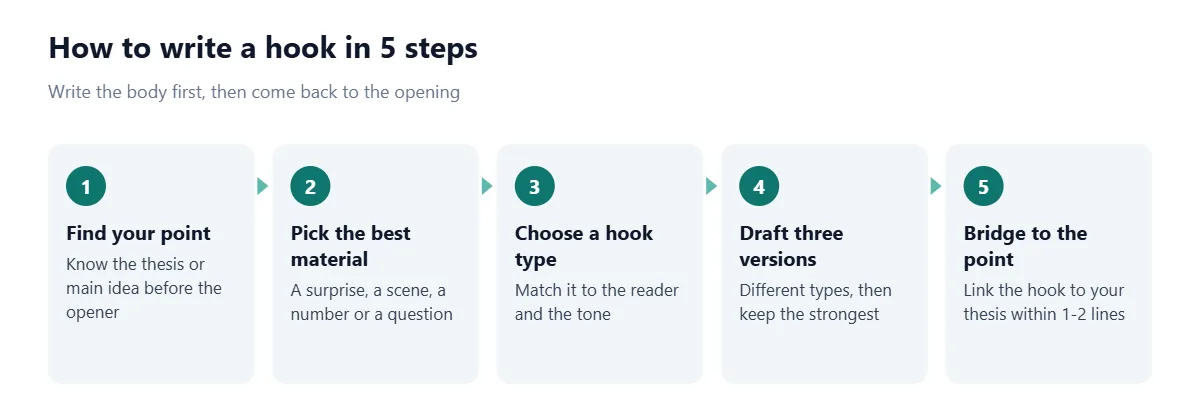
Know your point first. You can't hook a reader toward an argument you haven't settled. The UNC Writing Center suggests you "try writing your introduction last" for exactly this reason (UNC Writing Center).
List your best material. Look through your notes for anything surprising, concrete or emotional: a number that shocked you, a short story from your research, a quote from a source, a contradiction.
Choose a hook type from the eight below. Match it to the reader. A research paper calls for a fact or a puzzle; a personal essay can open with a scene.
Draft three versions using different types, then read each one aloud. Keep the one you'd want to read on.
Write the bridge. Add one or two sentences that link the hook to your thesis. If you can't write a natural bridge, the hook is probably off topic.
8 types of hooks with examples
Writing centers group hooks in slightly different ways. UNC lists an intriguing example, a provocative quotation, a puzzling scenario, a vivid anecdote and a thought-provoking question (UNC). St. Louis Community College splits them into "soft" hooks (sensory description, narrative, dialogue) and "hard" hooks (startling statistics, data, facts) (STLCC Writing Center). Here are eight practical types, each with an original example.
1. The question hook
Ask something the reader genuinely wants answered. Example: "If a city plants a tree for every resident, who decides which streets get them first?" Avoid yes/no questions with obvious answers, like "Have you ever been tired?"
2. The fact or statistic hook
Lead with a number that surprises. Example: "In one landmark study, only 16% of people read a web page word by word; the rest scanned." ESU's guide says statistic hooks work best for informational writing and must come from reliable sources (ESU). Never invent or round a figure to make it sound bigger.
3. The anecdote hook
Tell a very short story, two or three sentences, that shows your topic in action. Example: "The night before her chemistry final, my sister made 140 flashcards. She used four." Anecdotes are strong in personal essays and college application essays.
4. The scene or description hook
Drop the reader into a place with sensory detail. Example: "The library's third floor smells like dust and printer toner, and at 2 a.m. it is completely full." This is the "soft" hook STLCC describes, and it suits narratives and feature writing.
5. The quotation hook
Use a quote that speaks directly to your argument. UNC advises choosing a quotation "closely related to your argument," ideally from your own sources rather than a famous name pulled from a quote website (UNC). Always explain the quote in the next sentence.
6. The bold statement hook
Make a confident claim that some readers will push back on. Example: "Homework in elementary school does more for parents' peace of mind than for children's learning." You then spend the essay earning it.
7. The misconception hook
State what most people believe, then turn it. Example: "Most people think a long sentence is a run-on. Length has nothing to do with it." This works well for explainers and blog posts.
8. The contrast or puzzle hook
Present two facts that don't seem to fit together. Example: "Our town has more gyms than ever, and fewer people walking to school." UNC calls this a puzzling scenario, and it naturally sets up an analytical thesis.
How to write a hook for an essay
An essay hook should feel like part of the argument, not decoration. The rule from ESU is simple: "the hook has to be related to the overall topic of the paper" (ESU). Here's how the full opening fits together:
Part | Job | Typical length |
|---|---|---|
Hook | Earn attention | 1-2 sentences |
Bridge / context | Explain why the hook matters | 1-3 sentences |
Thesis | State your argument | 1-2 sentences |
For argumentative essays, a fact, contrast or bold claim usually fits best. For literary analysis, open with a revealing moment or line from the text. For personal and college essays, an anecdote or scene is hard to beat, because it shows the reader who you are before you tell them. Once your opening is drafted, our guide on how to write a thesis statement helps you land the last sentence of the introduction.
How to write a hook for a blog post or article
Online readers can leave in a second, so web hooks are usually more direct than essay hooks. The best ones name the reader's problem or answer the headline's question straight away, then promise more detail below. A blog intro that spends three sentences warming up loses people who came for the answer.
A useful test: could your first sentence be quoted on its own as the answer to the search? If yes, you've written a hook and a featured-snippet candidate at the same time. Our guide to how long a blog post should be covers what comes after the opening.
How to write a hook for a story
Fiction hooks raise a question the reader needs answered. That might be an odd detail, a strong voice, or a situation already in motion. Jane Austen opened Pride and Prejudice with a bold, ironic generalization: "It is a truth universally acknowledged, that a single man in possession of a good fortune must be in want of a wife" (Project Gutenberg).
Notice what that line does. It sounds like a statement of fact, but the irony tells you the novel will poke fun at exactly that belief. A good story hook is a promise about the voice and the conflict, not just a shock.
How to write a hook for social media and video
On social platforms the hook is often the only part people see before deciding to tap "more" or keep scrolling. Put the key idea in the first line, and cut any warm-up like "So, I've been thinking...". If you post on Instagram or LinkedIn, check how much of your caption shows before the cut with the Character Limit Checker.
Video works the same way, just measured in seconds. YouTube Studio reports the share of viewers still watching after the first 30 seconds as a key-moment metric, and suggests trying different opening styles if that number is low (YouTube Help). Show the payoff or the problem in the first few lines of your script instead of a long intro.
How long should a hook be?
Usually one or two sentences, and rarely more than about 40 words. An anecdote hook can stretch to three short sentences, but if your hook needs a paragraph, it's become the introduction. STLCC's guidance on introductions makes the related point that the whole introduction should be in proportion to the piece: a two-page essay shouldn't have a one-page introduction (STLCC).
Short sentences help. Paste your opening into the Sentence Counter to see its length; it flags any sentence over 25 words, which is usually a sign your hook is trying to do too much.
Hooks to avoid
Some openings are so common that they work against you. UNC specifically warns against these (UNC):
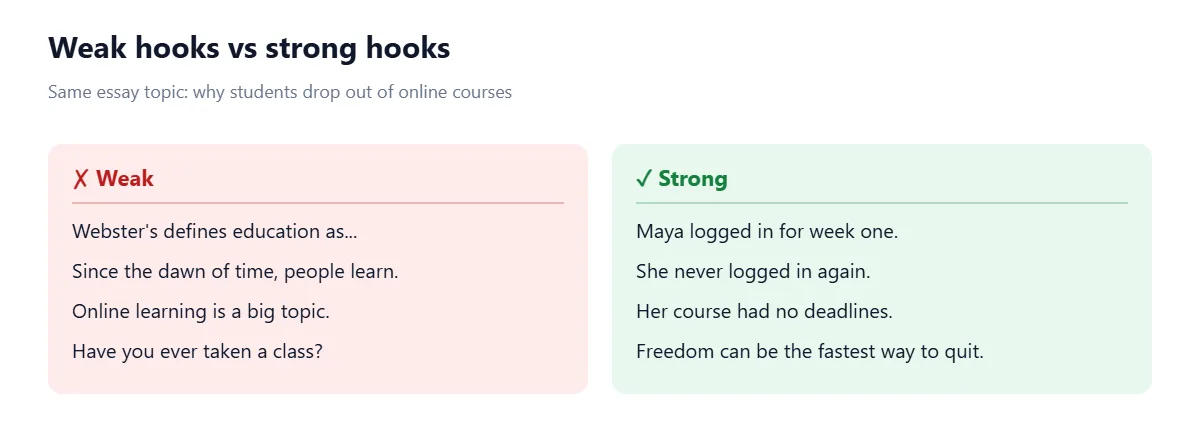
Dictionary definitions. "Anyone can look a word up in the dictionary," as UNC puts it. Defining success tells the reader nothing new.
Sweeping history. "Since the dawn of time" and "Throughout human history" are vague and almost never true.
Restating the prompt. If the assignment asks about climate policy, "Climate policy is an important topic" adds nothing.
Obvious questions. "Have you ever been stressed?" Everyone has. The reader is no more curious than before.
Two more that writing guides mention less often: fake or unverified facts, which damage your credibility in the first line, and misattributed quotes. Many famous quotes online were never said by the person they're credited to. If you can't find the original source, don't use it.
Hook checklist: test yours in one minute
Is it one or two sentences?
Is it specific to this topic, or could it open any essay?
Does the next sentence connect it to your main point?
If it uses a fact or quote, can you cite where it came from?
Does it match the tone of the piece?
Delete it and read from sentence two. If the opening is just as good, rewrite the hook.
That last test is the most honest one. A real hook earns its place; a filler opener can be cut without loss. When you've finished the essay, close the loop by echoing your hook in the ending, a trick covered in our guide on how to write a conclusion. Then paste the full draft into the Word Counter to check the length against your assignment.
Frequently asked questions
What is a hook in an essay?
A hook is the first sentence or two of an essay, written to catch the reader's attention and lead into the topic. It is followed by context and then the thesis statement.
What are the main types of hooks?
Common types are the question, fact or statistic, anecdote, scene or description, quotation, bold statement, misconception and contrast hooks. The best type depends on the topic and tone.
How long should a hook be?
A hook is usually one or two sentences. If it runs longer than about three sentences, it has turned into the introduction itself.
Can a hook be a question?
Yes, as long as the question is specific and the answer isn't obvious. Avoid yes/no questions like "Have you ever been tired?" that every reader can answer without thinking.
Should I start an essay with a definition?
Usually not. Writing centers such as UNC's advise against dictionary definitions because they are overused and tell the reader nothing new.
When should I write the hook?
Write the hook last, after you finish the body. Then you know exactly what point the hook needs to lead into.
How to write a hook for a college essay?
Open with a short anecdote or a vivid scene from your own life. It shows the reader who you are before you explain it.
What is the difference between a hook and a thesis?
The hook grabs attention, while the thesis states your argument. In a typical introduction the hook comes first and the thesis comes at the end.
Sources
The Writing Center, University of North Carolina at Chapel Hill. Introductions.
East Stroudsburg University Writing Studio. How to Write a Hook.
St. Louis Community College Writing Center. Introductions.
Nielsen, J. How Users Read on the Web. Nielsen Norman Group, 1997.
YouTube Help. Measure key moments for audience retention. Google.
Austen, J. Pride and Prejudice. Project Gutenberg.

Comments