
To learn how to write a conclusion, remember three moves: restate your thesis in fresh words, show how your main points fit together, and finish by explaining why the argument matters. For most essays that takes one paragraph of about 10% of your total word count, so roughly 100 words for a 1,000-word essay.
Conclusions get written last, at midnight, when you're tired of the topic. That's why so many of them just repeat the introduction. Below is a five-step method for how to write a conclusion that university writing centers agree on, a word-count table for common essay lengths, before-and-after examples, and the mistakes that cost marks.
What a conclusion is supposed to do
The Harvard College Writing Center breaks a conclusion into three jobs (Harvard):
What: remind the reader of your thesis. Harvard notes that “you don't need to provide an exhaustive summary.”
So what: reconnect readers to the stakes, “reminding them why your argument is important.”
Now what: leave them with something to think about. What can they “now understand, see in a new light, or grapple with?”
Newcastle University's Academic Skills Kit puts the same idea as four reader questions: Where are we? How did we get here? Where does that leave us? What next? (Newcastle). Notice that only one of those questions is about summary. The rest are about meaning.
How to write a conclusion in 5 steps
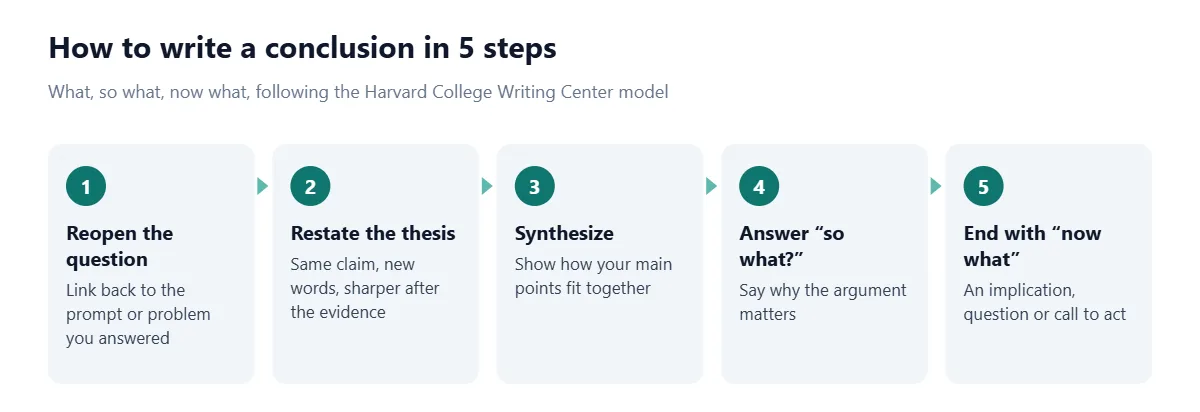
1. Reopen the question
Start with a sentence that links back to the prompt or problem. The University of Hull's library guide recommends opening with “a clear link back to the question” (Hull). If your essay answered “Should schools start later?”, your first line should land on that question, not on your last body paragraph.
2. Restate the thesis in new words
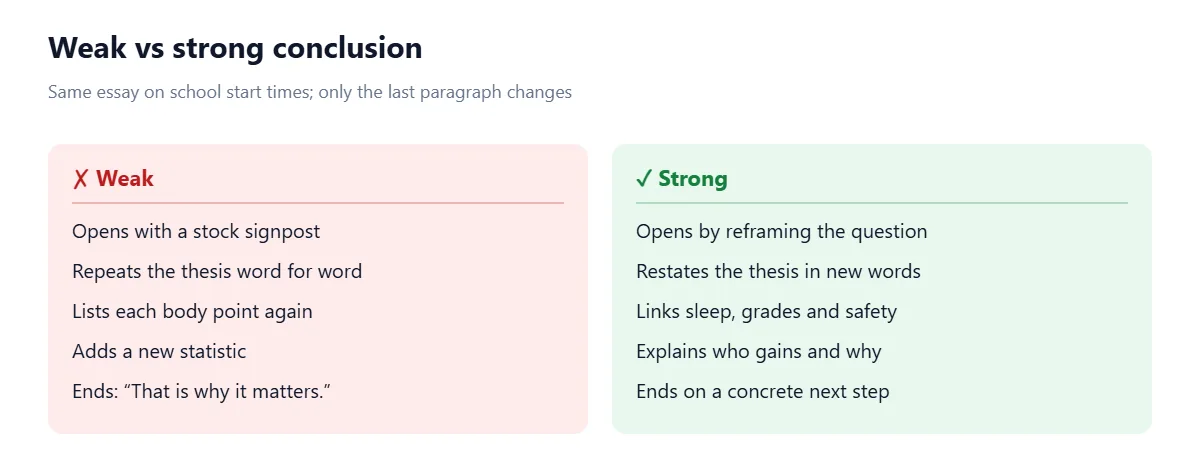
Your thesis should come back, but sharper. After 1,000 words of evidence you can say it with more confidence and precision than you could in the introduction. Never paste it in word for word; UNC's Writing Center lists “simply rephrasing the thesis” without development among the strategies to avoid (UNC). If you need help with the original claim, start with our guide on how to write a thesis statement.
3. Synthesize, don't list
UNC's advice is the single most useful line on this topic: “Synthesize, don't summarize.” Show “how the points you made and the support and examples you used fit together” (UNC). Instead of “First I discussed sleep, then grades, then safety,” write “Later start times work because the same extra hour improves sleep, which drives both the grade gains and the drop in morning accidents.”
4. Answer “so what?”
UNC suggests playing the “So what?” game: keep asking why anybody should care until you hit a real answer. That answer belongs here. Hull's guide puts it as explaining “why your ideas are important to the wider subject area” (Hull).
5. End with a “now what”
Close with an implication, a recommendation, a question for further research, or a return to an image from your opening. UNC calls that last option bringing the reader “full circle.” Keep it to one or two sentences and make it concrete.
How long should a conclusion be?
The most common guideline in UK university study guides is about 10% of the total word count. Newcastle says the conclusion “is usually about 10% of your total word count,” and Hull says the same, adding: “There is never a situation where sacrificing words in your conclusion will benefit your essay” (Hull; Newcastle).
Essay length | Conclusion (≈10%) | Typical shape |
|---|---|---|
500 words | ≈50 words | 3–4 sentences |
1,000 words | ≈100 words | 1 short paragraph |
1,500 words | ≈150 words | 1 paragraph |
2,000 words | ≈200 words | 1 long paragraph |
3,000 words | ≈300 words | 1–2 paragraphs |
5,000 words | ≈500 words | 2–3 paragraphs |
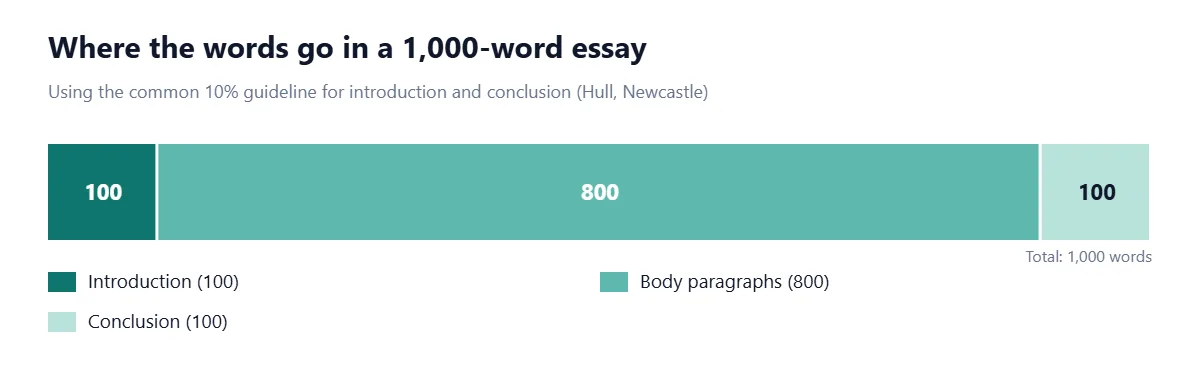
For research papers, the USC Libraries guide says the conclusion is “often the shortest section of the paper, requiring only two or three well-developed paragraphs” (USC Libraries). Treat 10% as a planning figure, not a rule your teacher will measure. For whole-essay targets, see how long is an essay, and paste your draft into the Word Counter to check the split.
Conclusion examples for different kinds of writing
Knowing how to write a conclusion for one genre gets you most of the way in another. The five steps stay the same, but the weight shifts depending on what you're writing. Here are short examples, written for this guide, showing how each one might end.
Argumentative essay
*“Starting high school at 8:30 is not a favor to teenagers who like to sleep in; as the studies above suggest, it is a fix for a schedule that works against them. In the districts examined here, the extra hour showed up in attendance, attention and safer drives to school. Districts that hesitate over bus costs should weigh them against what early bells already cost their students.”*
The thesis comes back stronger, the three body points become one cause-and-effect chain, and the last sentence gives a decision-maker something to do.
Research paper
USC's guide says to restate your objectives, then describe how your findings support or differ from prior research, and to highlight where further research is needed (USC Libraries). A typical closing line: *“Because our sample came from a single district, a multi-state study would show whether the attendance effect holds in rural schools.”* Naming a limitation this way shows command of the topic; it is not an apology.
Narrative or personal essay
Here the “so what” is what changed in you. Skip the moral (“and that taught me to never give up”) and return to a concrete detail from the opening: *“I still have the cracked stopwatch. I don't time anything with it now, but I keep it where I can see it.”*
Conclusion vs summary: what's the difference?
Part of learning how to write a conclusion is knowing what it is not. A summary tells the reader what you said. A conclusion tells them what it adds up to. Purdue OWL describes a good conclusion as one “that does not simply restate the thesis, but readdresses it in light of the evidence provided” (Purdue OWL).
Summary | Conclusion | |
|---|---|---|
Purpose | Condense content | Interpret and close |
Covers | Every main point | The thesis and its stakes |
New insight? | No | Yes, drawn from your evidence |
Where it lives | Abstracts, notes, reviews | The last part of your essay |
If you've been asked for a summary instead, that's a different skill; see how to write a summary.
What not to put in a conclusion
Most advice on how to write a conclusion comes down to what to leave out. UNC, Harvard, Hull and USC agree on most of this list:
Stock signposts. UNC lists phrases like “in summary” and “in closing” among strategies to avoid; USC calls them belaboring transitions. Your reader can see it's the last paragraph.
New evidence or subtopics. If a fact matters, it belongs in the body. USC warns: “Don't surprise the reader with new information in your conclusion.”
Stating the thesis for the first time. UNC flags this one. The reader should never meet your main claim on the last page.
Apologies. Harvard and USC both advise against apologizing for what you left out. Name limitations as directions for future work instead.
A big counterargument. Harvard notes you won't have room to refute it, so it leaves the reader doubting you.
A sudden change of tone. UNC and Hull both caution against emotional appeals that don't match an analytical paper.
Better ways to start a conclusion
If you need a first sentence, start from the idea, not a signpost. These openers work because they do the reframing for you:
“The evidence points to one answer: …”
“What these cases share is …”
“Seen together, these findings suggest …”
“The real question, then, is not X but Y.”
“If [problem] persists, …”
Pair a strong opener with a sharp closing line. Our guide on how to write a hook covers opening lines, and many of the same techniques (a concrete image, a pointed question) work as closers.
Write a draft conclusion first
Here's the tip most guides on how to write a conclusion skip. Hull's library guide recommends writing a draft conclusion *before* the main body, to clarify where the essay is going (Hull). A three-sentence placeholder keeps every paragraph pointed at the same destination. When you've finished the body, rewrite it with the evidence you actually used.
Then do a mirror check. Put your introduction and conclusion side by side. If the conclusion could replace the introduction without anyone noticing, it isn't concluding anything yet. It should sound like the same writer, one essay later.
Checklist: how to write a conclusion that earns marks
Does the first sentence link back to the question?
Is the thesis there, in new and sharper words?
Do the main points appear as one connected idea, not a list?
Is there a clear answer to “so what?”
Does the last sentence leave a next step, implication or image?
Is it about 10% of the word count?
Have you removed new evidence, apologies and signpost phrases?
Once it passes, check the length and sentence count before you submit.
Frequently asked questions
How to write a conclusion for an essay?
Link back to the question, restate your thesis in new words, show how your main points connect, explain why it matters, and end with an implication or next step. Keep it to about 10% of the word count.
What are the 3 parts of a conclusion?
A conclusion restates the thesis (what), explains why it matters (so what), and points to an implication or next step (now what). This is the model the Harvard College Writing Center teaches.
How many sentences should a conclusion be?
A conclusion is usually one paragraph of about 10% of the essay's word count. For a 500-word essay that is roughly 50 words, or 3 to 4 sentences; a 2,000-word essay needs about 200 words.
Can you add new information in a conclusion?
No new evidence or subtopics. You can add a new insight drawn from your existing evidence, such as an implication or a question for further research.
Should I start my conclusion with a signpost phrase?
It's better not to. Writing centers such as UNC and USC advise against stock transitions like in summary or in closing; start by restating the thesis or reframing the question instead.
How do you end the last sentence of a conclusion?
End with something concrete: an implication, a recommendation, a question for further research, or a return to an image from the introduction.
How long is a research paper conclusion?
Usually two or three well-developed paragraphs, according to USC Libraries. It is often the shortest section of the paper.
Should I write the conclusion first or last?
Draft a short version first to clarify where the essay is going, then rewrite it last with the evidence you actually used. The University of Hull library guide recommends this approach.
Sources
Harvard College Writing Center. Ending the Essay: Conclusions. Harvard University.
The Writing Center, UNC Chapel Hill. Conclusions. University of North Carolina at Chapel Hill.
Purdue OWL. Argumentative Essays. Purdue University.
University of Hull Library. Essay writing: Conclusions. University of Hull.
Newcastle University Academic Skills Kit. Writing introductions and conclusions. Newcastle University.
USC Libraries. Organizing Your Social Sciences Research Paper: The Conclusion. University of Southern California.

Comments