
Here is how to write a summary: read the source carefully, state its main idea in one sentence of your own, add only the key supporting points, and leave out examples, details and your opinions. A good summary is usually 5 to 25 percent of the original's length, with shorter percentages for longer sources.
That is the whole method in two sentences. The rest of this guide shows each step in practice, explains why writing guides give different length rules and how to choose between them, walks through a real before-and-after example, and gives you templates for articles, books, meetings and lectures.
What is a summary?
A summary is a short, neutral restatement of a text's main ideas in your own words. Texas A&M's writing center defines summarizing as giving the gist of a chosen passage or work in your own words. Purdue OWL adds that a summary is significantly shorter than the original and takes a broad overview of the source, and that, like a quotation or paraphrase, it must be attributed to the original source.
Before getting into how to write a summary, it helps to know what sets one apart. Three things matter. It covers the whole source, not one part. It keeps only the main points. And it reports what the author said without judging it. A review or a response paper adds your opinion; a summary does not.
How to write a summary in 6 steps
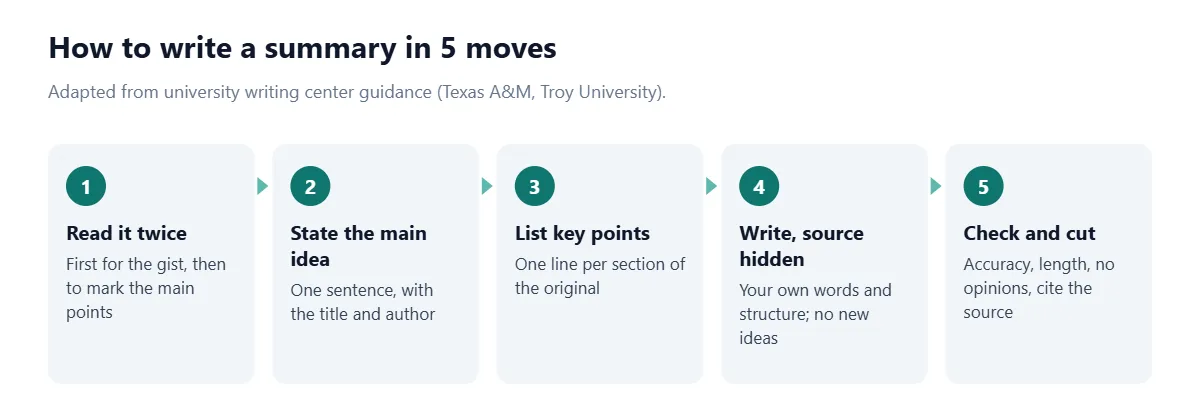
Writing centers differ on the number of steps, but they share the same core. This is a condensed version of how to write a summary that works for almost any text, from a news article to a textbook chapter.
Read the whole source twice. The first time, read for the gist without taking notes. The second time, mark the thesis and the main point of each section. Texas A&M recommends reading at least twice before you write anything.
Write the main idea in one sentence. Troy University's writing center suggests a one-sentence restatement of the main idea in your own words, including the title and author. It works much like a thesis statement, but for someone else's text, and it usually becomes the opening of your summary.
Divide the source into sections. Use the headings, or group paragraphs that make the same point. Note the single most important point of each section in a short phrase.
Write a draft with the source out of sight. Hiding the original forces you to use your own words and sentence structure, which is the easiest way to avoid accidental plagiarism.
Cut what doesn't carry the main idea. Examples, statistics, anecdotes, repetition and descriptive detail usually go. Keep a number only if the whole argument depends on it.
Check it against the source. Is every point accurate? Did you add anything the author did not say? Is the source named and cited? Then check the length.
How long should a summary be?
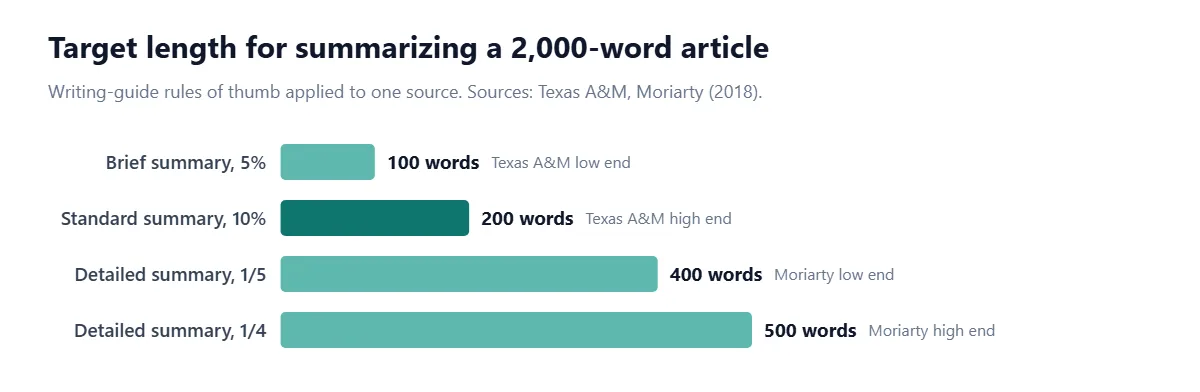
Knowing how to write a summary includes knowing when to stop. Follow your assignment's word limit first. Without one, writing guides give two rules of thumb that sound contradictory. Texas A&M says a summary should generally be five to ten percent of the original. An open textbook for college reading and writing suggests about one-fifth to one-quarter of the original when the instructor doesn't specify.
Both are sensible, because they suit different sources. Shorter texts are already dense, so a summary of a single page needs a larger share to say anything meaningful. Long texts contain far more detail and repetition, so you can drop a bigger proportion. As a practical guide:
Original length | Suggested summary | Share |
|---|---|---|
One paragraph (150 words) | 1 to 2 sentences (30 to 40 words) | about 20 to 25% |
One page (500 words) | 75 to 125 words | about 15 to 25% |
Article (2,000 words) | 150 to 300 words | about 8 to 15% |
Chapter (6,000 words) | 300 to 500 words | about 5 to 8% |
Book (80,000 words) | 500 to 1,000 words | about 1% |
The book row falls well below both rules, and that is normal. Nobody expects a 20,000-word summary of a novel. For whole books, a one-page summary of the main argument or plot, plus a short paragraph per part, is typical.
Paste your draft into the Word Counter to see where you stand, and compare it with the original's word count to get your percentage.
A summary example: original passage and summary
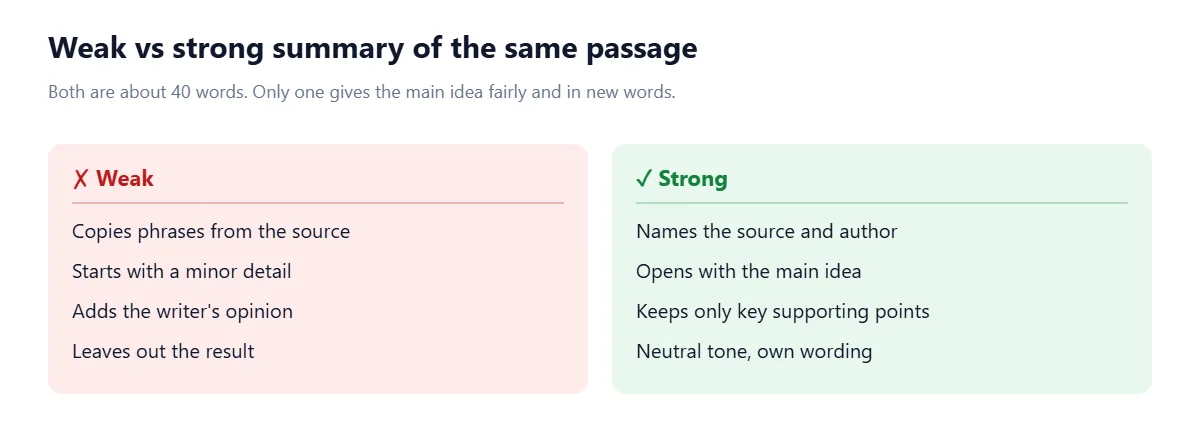
The clearest way to see how to write a summary is an example. Here is a sample passage written for this guide, followed by a summary of it. Notice what stays and what goes.
The summary is about 29 percent of the original, which is right for a single paragraph. It keeps the main finding (output held steady), the reasons, and the trade-off. It drops the six-month timeframe, the detail about parents, the complaints about Friday closures and the owners' plans. Those are true, but none of them changes the main idea.
Summary vs paraphrase vs abstract
These three are easy to mix up, and assignments often ask for one specifically.
Type | What it covers | Typical length |
|---|---|---|
Summary | Main ideas of a whole source | Much shorter than the original |
Paraphrase | One passage, all its points | Close to the original |
Quotation | Exact words, short extract | Word for word |
Descriptive abstract | What a paper is about | 100 words or less |
Informative abstract | Purpose, methods, results | Up to 10% of the paper |
Purdue OWL describes a paraphrase as usually shorter than the original, condensing it slightly, while a summary is significantly shorter. An abstract is a special kind of summary that sits at the top of a research paper. The UNC Writing Center notes that descriptive abstracts are usually 100 words or less, and informative abstracts are rarely more than 10 percent of the work.
How to start a summary
The first sentence does most of the work. It should name the source and the author and state the main idea, in the present tense. A few patterns that work:
In "[Title]," [Author] argues that [main idea].
[Author]'s [article/report/chapter] "[Title]" examines [topic] and concludes that [main idea].
According to [Author] in [Title], [main idea].
[Title] tells the story of [character], who [central conflict or arc].
After the opening sentence, use signal phrases such as "the author explains" or "the study found" to remind the reader that these are someone else's ideas. Texas A&M gives the example "In their research on plant diseases, Doe and Deer found that..." as the kind of phrase that keeps attribution clear.
How to write a summary of an article, book, meeting or video
The six steps stay the same, but what counts as a main point changes with the source. Use these outlines as a starting frame.
How to write a summary of an article or research paper
Opening: title, author, publication and main claim.
Body: the purpose, the method or evidence in one or two sentences, and the main findings.
Close: the author's conclusion or recommendation, without your verdict.
Book or chapter
Opening: title, author and the central argument (non-fiction) or the premise and main character (fiction).
Body: one or two sentences for each part or major turning point.
Close: how it ends or what the author concludes.
Meeting
Opening: date, purpose and who attended.
Body: decisions made, with one line each.
Close: action items with owners and deadlines. Readers of meeting notes want decisions, not a transcript.
Video, podcast or lecture
Opening: speaker, title and topic.
Body: the three to five main points in the order they were made.
Close: the takeaway or call to action the speaker ended on.
What not to include in a summary
Your opinion. Texas A&M advises you to avoid giving your own opinions and keep a neutral tone. Save evaluation for a separate response or review.
Minor details and examples. Troy University's guide says to leave out less important information and minor details.
Long quotations. A summary is your wording. A short quoted phrase is fine if a key term can't be rephrased.
New information. Don't add background facts the source doesn't contain, even if they are true.
Repetition. If the author makes the same point three times, it appears once in your summary.
Common summary mistakes and how to fix them
Even people who know how to write a summary slip into these habits:
Following the source paragraph by paragraph. You end up with a shrunken copy. Organize around the main idea instead.
Changing a few words per sentence. That is patch-writing, and it can count as plagiarism. Write with the source hidden.
Summarizing only the first half. Many drafts run out of space before the conclusion. Plan your word budget across all sections.
Getting the emphasis wrong. If the author spends one line on a point, it shouldn't take half of your summary.
Forgetting to cite. A summary is still someone else's ideas and needs a citation in whatever style you are using.
One useful check: paste your summary and the original into Compare Text. If long runs of identical wording show up, rewrite those sentences. If you are summarizing at the end of your own essay instead of someone else's text, that is a different job; our guide on how to write a conclusion covers it.
Summary checklist before you submit
The first sentence names the title, author and main idea.
Every main point of the source is covered, including the ending.
No examples, minor details or opinions slipped in.
The wording and sentence structure are your own.
The length meets the assignment, or sits within the ranges above.
The source is cited.
Learning how to write a summary well pays off far beyond class assignments. The same skill produces clearer meeting notes, better research notes and emails people actually read to the end.
How to write a summary step by step?
Read the source twice, write one sentence with the title, author and main idea, add the key supporting points in your own words, and cut examples, details and opinions. Then check it against the original for accuracy.
How long should a summary be?
Usually about 5 to 25 percent of the original, unless your assignment sets a word limit. Use the higher share for short passages and the lower share for long articles and chapters.
How do you start a summary?
Start with one sentence that names the title and author and states the main idea, for example: In "Title," Author argues that the main idea.
Should a summary include your opinion?
No. A summary reports the author's ideas in a neutral tone; your opinion belongs in a separate response, review or analysis.
What is the difference between a summary and a paraphrase?
A summary condenses the main ideas of a whole source into far fewer words. A paraphrase restates one passage in your own words at roughly the same level of detail.
Do you need to cite a summary?
Yes. A summary uses someone else's ideas, so it needs attribution in the text and a citation in the style your course or publication uses.
How many paragraphs is a summary?
One paragraph is enough for most articles and short readings. Summaries of long reports, chapters or books may run to several paragraphs, usually one per major section.
Can a summary include quotes?
Only sparingly. A summary should be in your own words, though a short quoted phrase is acceptable when a key term can't be rephrased.
Sources
Texas A&M University Writing Center. Summarizing. Texas A&M University.
Purdue OWL. Quoting, Paraphrasing, and Summarizing. Purdue University.
Troy University Writing Center. Writing a Summary. Troy University.
Moriarty, P. H. Writing Summaries. Integrated Reading and Writing Level 2, 2018.
The Writing Center, UNC Chapel Hill. Abstracts. University of North Carolina at Chapel Hill.

Comments