
Here's how to write a thesis statement: answer the main question of your essay in one or two sentences that make a specific claim a reasonable reader could disagree with, and hint at why you believe it. Put it at the end of your introduction, and revise it once your draft is finished.
That's the core of it. This guide walks through a five-step method, a fill-in formula, examples for argumentative, analytical and expository essays, a weak-vs-strong comparison table, and a checklist you can run in two minutes before you hand anything in.
What is a thesis statement?
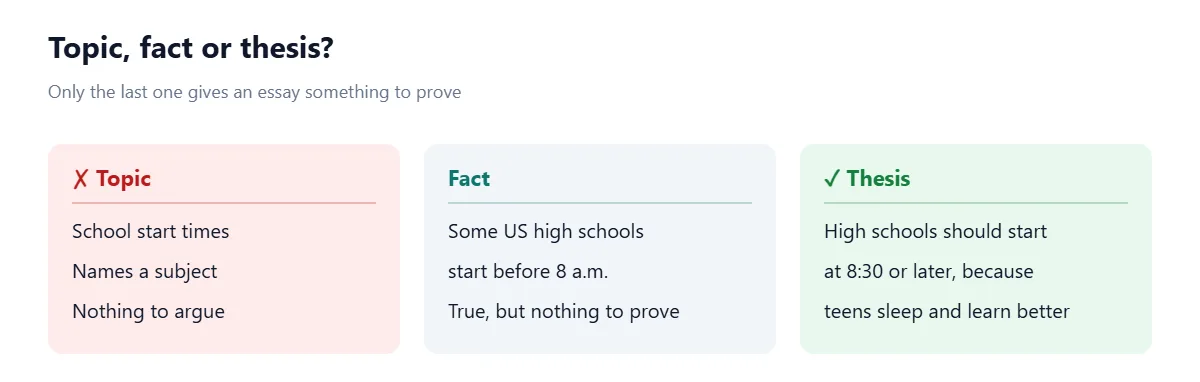
A thesis statement is the main claim of your essay, boiled down. Indiana University's writing center describes it as "a one- or two-sentence condensation of the argument or analysis that is to follow" (Indiana University). Harvard's writing center calls it your central claim, and adds the key test: it should be arguable, meaning "a thoughtful reader could disagree with it" (Harvard College Writing Center).
The thesis does two jobs at once. For you, it's a decision: you've worked out what you actually think. For your reader, it's a roadmap. UNC's writing center notes that it tells the reader how you'll interpret the subject and what to expect from the rest of the paper (UNC Writing Center).
How to write a thesis statement in 5 steps
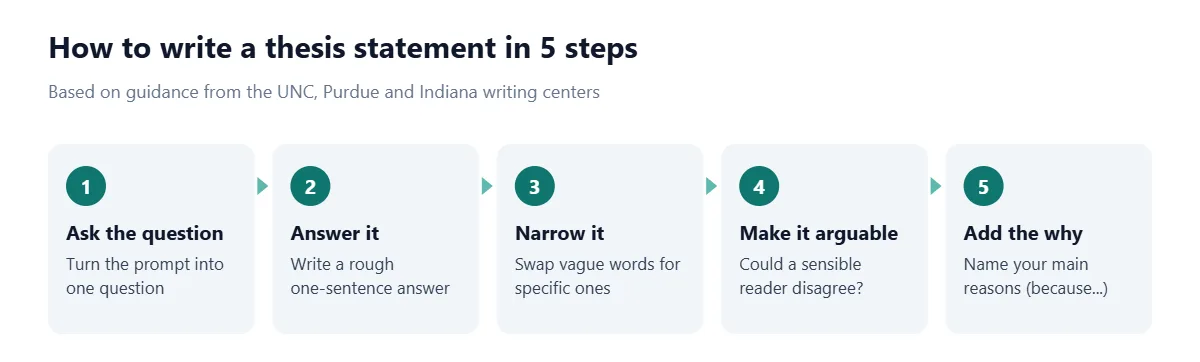
Turn the assignment into a question. "Discuss school start times" becomes "Should high schools start later?" Indiana's guide recommends exactly this: if the prompt isn't already a question, make it one, then answer it (Indiana University).
Write a rough answer. Don't polish yet. "Yes, schools should start later" is a fine working thesis. You need something to test against your evidence.
Narrow it. Replace vague words with specific ones. "Later" becomes "at 8:30 a.m. or later." "Schools" becomes "public high schools." UNC flags words like "good" and "successful" as signs a thesis is too vague (UNC).
Make it arguable. Ask whether a sensible person could take the other side. If nobody would disagree, you've written a fact or a truism, not a thesis.
Add the why. Name your main reasons, often with "because," "since" or "although." Indiana suggests these connecting words to show how your ideas relate (Indiana University).
Then come back to it at the end. Purdue OWL advises revising your thesis so it reflects exactly what you discussed, since your focus often shifts while you draft (Purdue OWL). Most strong theses are written last, not first.
A thesis statement formula you can fill in
Formulas are training wheels. They help when you're stuck, and you should feel free to drop them once your sentence sounds natural. These four patterns cover most essays:
Pattern | Example |
|---|---|
[Claim] because [reason 1] and [reason 2]. | Homework in primary school should be optional, because it adds stress and shows little benefit at that age. |
Although [counterpoint], [claim] because [reason]. | Although e-books are cheaper, print textbooks are the better choice for first-year students because they support deeper reading. |
By [doing X], [author/work] [achieves Y]. | By telling the story out of order, the novel makes the reader feel the narrator's confusion. |
[Topic] [does Y] through [A], [B] and [C]. | Coral reefs protect coastlines through wave breaking, sediment trapping and habitat support. |
Thesis statement examples for each type of essay
Purdue OWL groups academic papers into three main kinds: analytical, expository and argumentative (Purdue OWL). The thesis works a little differently in each. All examples below are original.
Argumentative thesis statement
An argumentative thesis takes a side and commits to it.
"Public libraries should drop late fines, because fines keep the people who most need libraries from returning and bring in little money."
"Remote work should be the default for office jobs that don't require physical presence, since it widens the hiring pool and cuts commuting costs without hurting output."
Analytical thesis statement
An analytical thesis breaks a text, event or idea into parts and makes a claim about how they work.
"In The Great Gatsby, the green light changes meaning as the novel goes on, from a symbol of Gatsby's hope to a sign of how impossible his dream has become."
"In Pixar's Up, the wordless opening montage does the work of a whole first act, so the audience grieves with Carl before he says a line."
Expository (explanatory) thesis statement
An expository thesis explains rather than argues, but it still needs a clear focus and a structure.
"Most first-year students struggle with time management for three reasons: unstructured schedules, part-time jobs and the shift from daily homework to a few large assignments."
"Vaccines train the immune system by showing it a harmless version of a germ, so the body can respond faster when the real one appears."
Compare-and-contrast and personal essays
For comparisons, say what the comparison reveals, not just that two things differ: "Both towns in the case study cut downtown parking, but only the one that improved its buses first kept its shops busy, which shows that order matters more than the policy itself." Personal and narrative essays usually carry a quieter thesis: the insight the story leads to. The University of the Incarnate Word's guide includes narrative essays among the types that need a thesis (UIW Writing and Learning Center).
Weak vs strong thesis statements
Most weak theses fail in one of a handful of ways. Here's what each looks like and how to fix it.
Problem | Weak | Stronger |
|---|---|---|
Just a topic | This essay is about social media and teens. | Schools should teach social media literacy, because teens can't judge sources they've never been taught to question. |
A fact | Plastic takes centuries to break down. | Single-use plastic bags should be taxed, since bans push shoppers to thicker bags that are worse for the environment. |
Too broad | Technology has changed education. | Laptops in lecture halls lower note quality, because students type without processing what they hear. |
Announcement | In this essay, I will discuss school uniforms. | School uniforms do little to reduce bullying, which follows students online and outside school anyway. |
Too vague | Shakespeare's Macbeth is a good play. | Macbeth shows ambition destroying itself: each crime makes the next one feel more necessary. |
A question | Should college be free? | Community college should be free, because it is the cheapest point at which to widen access. |
Notice what the stronger versions have in common. Each could start an argument at a dinner table, each uses concrete nouns, and each tells you what the body paragraphs will cover.
Where does the thesis statement go?
In most academic essays, it goes at the end of the first paragraph. Both UNC and Purdue give that as the standard position, because readers expect the main claim early and use it to read everything after (UNC; Purdue OWL).
In longer papers, the introduction may run two or three paragraphs, and the thesis comes at the end of that opening section. What matters is that it appears early and isn't buried in the middle of a paragraph where the reader skims past it.
How long should a thesis statement be?
One sentence is standard, and two is fine when the argument needs it. Indiana's guide describes a thesis as one or two sentences, and UNC notes it's usually presented as a single sentence (Indiana University; UNC).
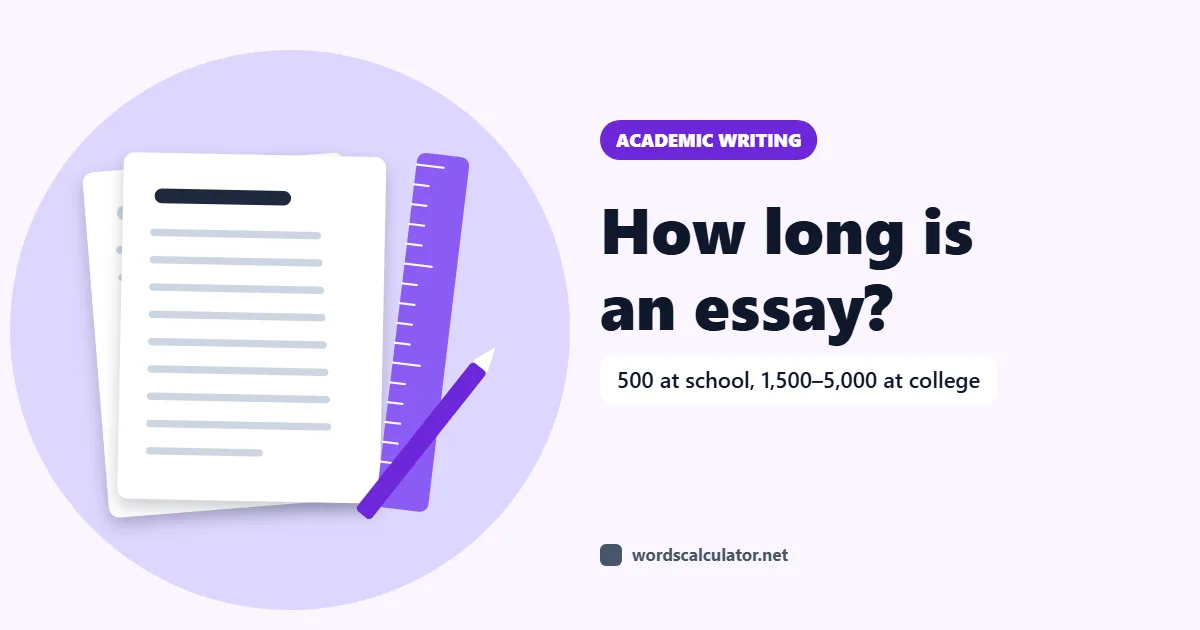
Here's a rule of thumb that most guides skip: match the thesis to the length of the essay. A 500-word essay can only prove one focused point. A 3,000-word paper can carry a claim with two or three moving parts. If your thesis promises more than the word count can deliver, narrow it. Our guide to how long an essay should be shows typical lengths, and the Word Counter will tell you exactly where your draft stands.
If your thesis runs past about 40 words, read it again. Long theses usually hide two claims, and splitting them into two sentences, or cutting the weaker one, makes the argument clearer. The Sentence Counter flags any sentence over 25 words, which is a quick way to spot a thesis that has grown too long.
Thesis statement checklist
Knowing how to write a thesis statement is half the job; testing it is the other half. Run your draft through these questions. Most come from UNC's list of ways to test a thesis (UNC).
Does it answer the question you were asked? Reread the prompt, then your thesis.
Could a reasonable reader disagree? If not, it's a fact or an opinion nobody holds against you.
Is it specific? Circle words like "good," "important," "many" and "society." Replace each one.
Does it pass the "So what?" test? The reader should see why the claim matters.
Does it pass the "how and why?" test? It should hint at your reasons, not just the conclusion.
Does every body paragraph support it? If a paragraph doesn't, change the paragraph or change the thesis.
Is it in the right place? End of the introduction, easy to find.
Common mistakes when writing a thesis statement
Announcing instead of arguing. "This paper will explore" tells the reader what you'll do, not what you think.
Listing three points with no link between them. The classic three-part thesis works for a five-paragraph essay, but the reasons should connect to one claim. If they don't, you have three essays.
Hedging everything. "Some people believe that perhaps" signals you haven't decided. Pick a side; you can acknowledge limits in the body.
Writing it first and never touching it again. Your thinking changes as you draft. Update the thesis to match what you actually proved.
Stating a personal preference. "I like summer more than winter" can't be argued with evidence. Ask what claim you could support with sources.
Once your thesis is set, the rest of the essay follows from it: each body paragraph proves one part, and the conclusion shows what the whole argument adds up to. If you're working to a limit, check your draft as you go, and see our guide to college essay length for application essays specifically.
Frequently asked questions
What are the 3 parts of a thesis statement?
A strong thesis usually has a topic, a position on that topic, and the main reason or reasons for that position. For example: "Cities (topic) should ban gas leaf blowers (position) because they're loud and polluting (reasons)."
How long should a thesis statement be?
Usually one sentence, sometimes two. If it runs past about 40 words, it often contains two separate claims that need trimming or splitting.
Where does the thesis statement go in an essay?
At the end of the introduction, which in most short essays is the last sentence of the first paragraph. Longer papers may place it at the end of a two- or three-paragraph introduction.
Can a thesis statement be a question?
No. A question can lead into your thesis, but the thesis itself has to answer it with a clear claim.
Can a thesis statement be two sentences?
Yes. Writing center guides describe a thesis as one or two sentences, and two works well when the claim and the reasons are both substantial.
What is the difference between a thesis statement and a topic sentence?
A thesis states the main claim of the whole essay. A topic sentence states the main point of one paragraph, and each topic sentence should support the thesis.
Should I write the thesis statement first or last?
Write a working thesis first so you have a direction, then revise it after drafting. Your final thesis should match what the essay actually argues.
What is the easiest way to learn how to write a thesis statement?
Turn your prompt into a question and answer it in one sentence that names your position and your main reason. A strong result is specific, arguable and focused on one main idea.
Sources
The Writing Center, University of North Carolina at Chapel Hill. Thesis Statements. UNC.
Purdue Online Writing Lab. Tips and Examples for Writing Thesis Statements. Purdue University.
Writing Tutorial Services, Indiana University Bloomington. How to Write a Thesis Statement. Indiana University.
Harvard College Writing Center. Thesis. Harvard University.
Writing and Learning Center, University of the Incarnate Word. Writing a Thesis Statement. UIW.

Comments