
How many words is a 5-minute speech? It's about 650 words if you speak at a relaxed, clear pace of 130 words per minute. Most people land somewhere between 600 and 750 words for five minutes, depending on how fast they talk and how often they pause.
That one number gets you started, but it's rarely the whole story. A wedding toast with a room full of laughing guests runs longer than the same words read to a webcam. Below you'll find a word count chart for every common speech length, the real speaking rates researchers have measured, a one-minute test to find your own pace, and the mistakes that make speeches run over.
How many words is a 5-minute speech?
At 130 words per minute, five minutes of talking comes to 650 words. That's the figure we use in the Word Counter when it estimates speaking time, and it's a good planning number for anything you'll deliver to a live audience.
Why 130 and not the 150 you'll see quoted elsewhere? Because a speech is not a conversation. On stage you slow down so people can follow, you stop for a breath between ideas, and you wait while a joke lands. A script written at 150 words per minute usually forces you to rush the last minute. Writing at 130 gives you room to sound natural and still finish on time.
Slow and deliberate (120 wpm): 600 words. Good for emotional speeches, eulogies, or a room where many listeners are not native speakers.
Relaxed and clear (130 wpm): 650 words. The safe default for most talks.
Brisk and confident (150 wpm): 750 words. Fine for experienced speakers and fast-moving pitches, but it leaves no slack.
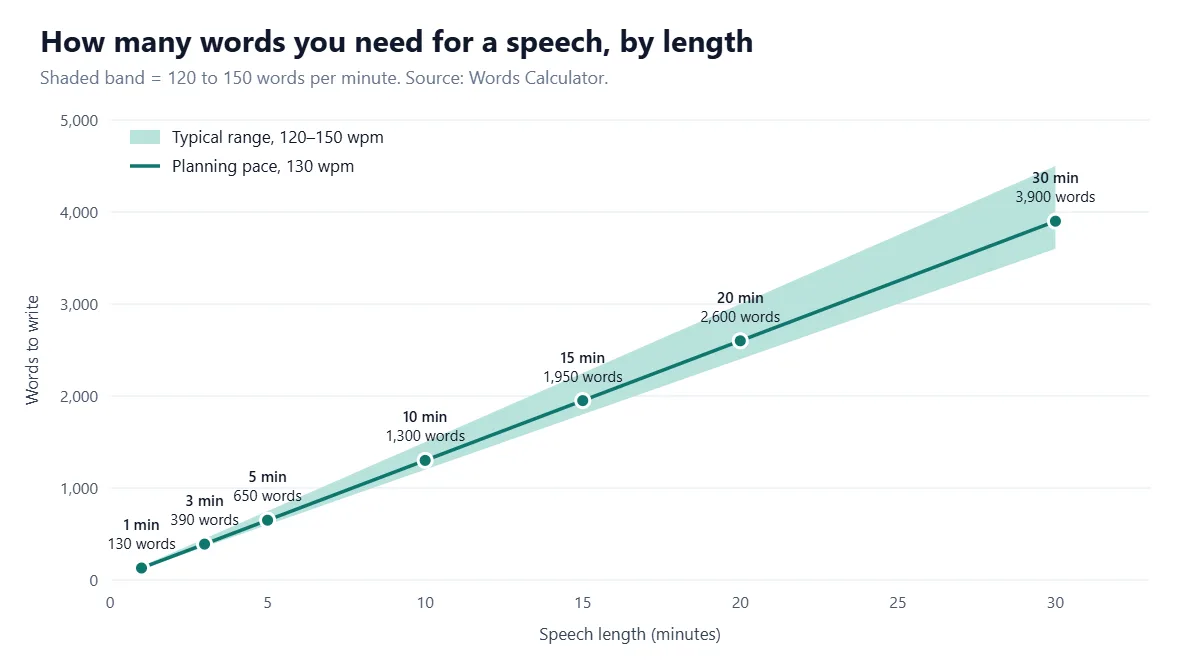
Speech word count chart: 1 to 60 minutes
Use this table to size a script before you write it. The middle column is the one to aim for; the outer columns show what happens if you speak slower or faster than average. The last column converts the planning figure into double-spaced pages (about 250 words per page), which is handy when a teacher or event organiser asks for pages rather than minutes.
Speech length | Slow (120 wpm) | Planning (130 wpm) | Fast (150 wpm) | Double-spaced pages |
|---|---|---|---|---|
1 minute | 120 | 130 | 150 | 0.5 |
2 minutes | 240 | 260 | 300 | 1 |
3 minutes | 360 | 390 | 450 | 1.6 |
4 minutes | 480 | 520 | 600 | 2.1 |
5 minutes | 600 | 650 | 750 | 2.6 |
7 minutes | 840 | 910 | 1,050 | 3.6 |
10 minutes | 1,200 | 1,300 | 1,500 | 5.2 |
15 minutes | 1,800 | 1,950 | 2,250 | 7.8 |
20 minutes | 2,400 | 2,600 | 3,000 | 10.4 |
30 minutes | 3,600 | 3,900 | 4,500 | 15.6 |
45 minutes | 5,400 | 5,850 | 6,750 | 23.4 |
60 minutes | 7,200 | 7,800 | 9,000 | 31.2 |
Need a length that isn't listed? Multiply the minutes by 130. For a 12-minute slot that's 12 × 130 = 1,560 words. To go the other way and turn a finished script into time, divide the word count by 130: a 1,000-word speech takes about 7 minutes 42 seconds.
How fast do people actually speak?
There's no single "normal" speaking rate. It changes with the situation, and the differences are bigger than most people expect. These are averages from published sources:
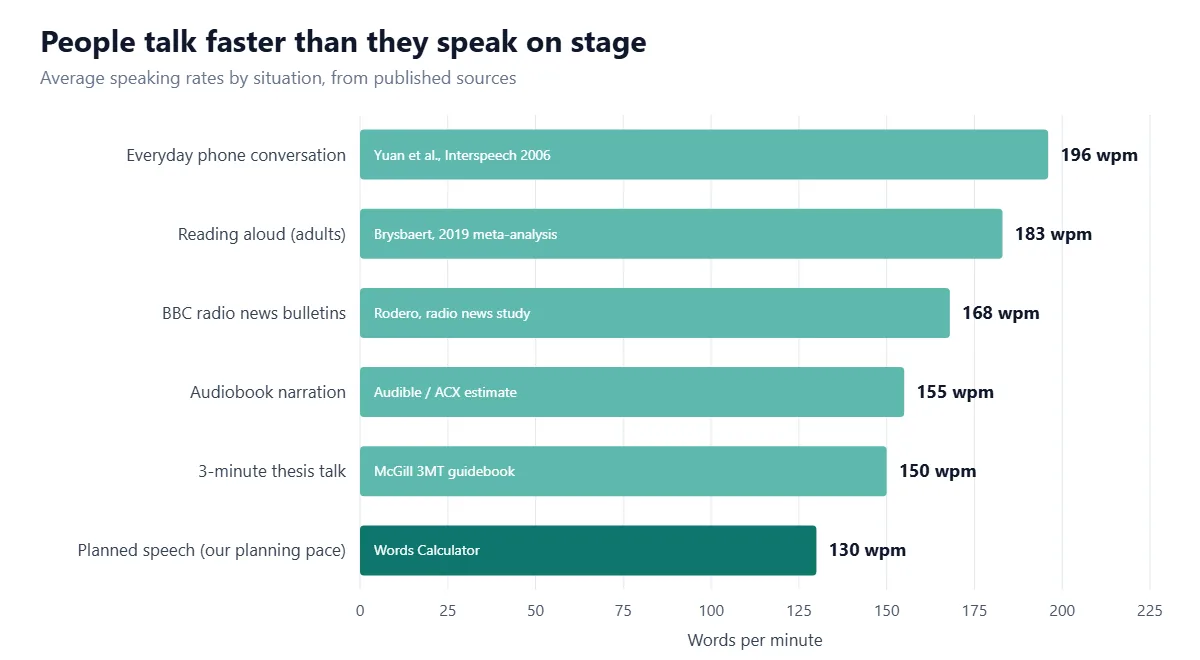
Everyday conversation: about 196 wpm. A study of thousands of recorded English phone calls found an overall rate of 196 words per minute, including the short gaps between phrases (Yuan, Liberman and Cieri, 2006).
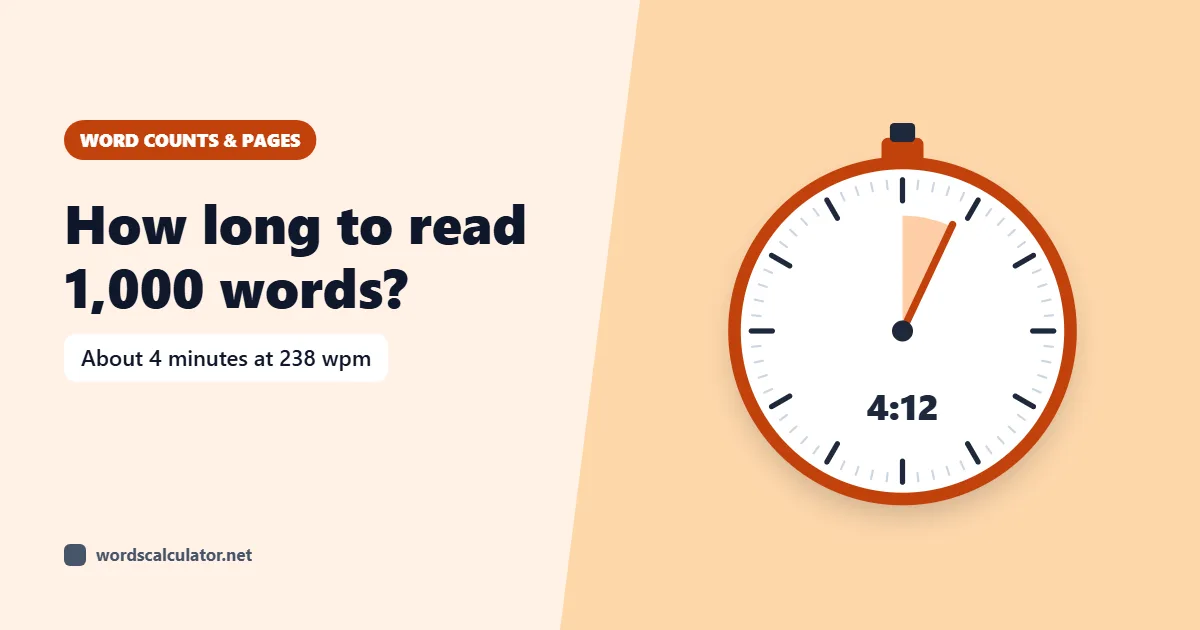
Reading aloud: about 183 wpm. A review of 77 studies with nearly 6,000 adult readers put the average oral reading rate at 183 words per minute (Brysbaert, 2019). That's why timing yourself by reading silently is misleading: silent reading is faster still, around 238 wpm for non-fiction in the same review.
Radio news: about 168 wpm. English news bulletins on BBC radio averaged 168 words per minute in a comparison of radio speaking rates (Speech tempo).
Audiobooks: about 155 wpm. Audible's production estimate is 155 words per minute, or 9,300 words per finished hour (Karen Commins on ACX rates). An 80,000-word novel therefore comes out at roughly 8.6 hours.
Research pitches: about 150 wpm. The McGill Three Minute Thesis guide advises speaking at roughly 150 words per minute, which puts a 3-minute talk at around 450 words (McGill 3MT guidebook).
Notice the gap between conversation and a prepared talk. When you chat, you don't plan sentences, you overlap with the other person, and nobody expects every word to be understood. When you stand up to speak, the audience has to follow a single thread for several minutes, so clarity beats speed.
Why a 5-minute slot doesn't mean 5 minutes of words
The most common reason speeches run long isn't talking too slowly. It's forgetting that time passes when you aren't talking. You pause between points. People laugh or clap. You click to the next slide, take a sip of water, or wait for a late guest to sit down.
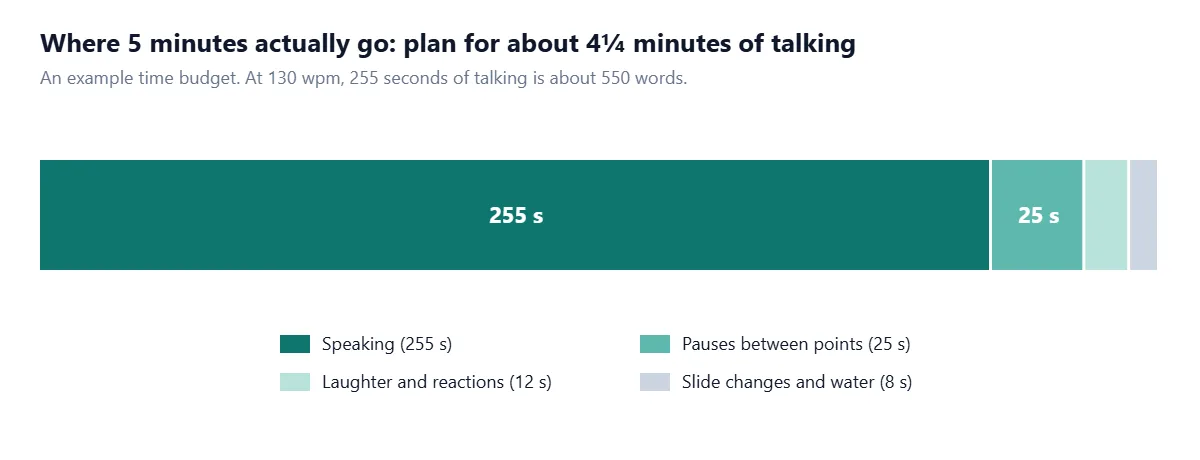
In the example above, only 255 of the 300 seconds are spent talking. At 130 words per minute that's about 550 words, not 650. As a rule of thumb, trim 10 to 15 percent from the chart figure when your limit is strict, when you expect laughter, or when you're using slides. For a toast or a eulogy, where the silences matter as much as the words, err toward the bigger cut.
Find your own speaking pace in 60 seconds
Charts give you an average. Your own pace is more useful, and it takes about a minute to measure:
Paste a few paragraphs you've written (around 300 words is plenty) into the Word Counter and note the word count.
Start a timer and read the text out loud exactly as you would on the day: standing up, at presentation volume, with natural pauses.
Stop the timer at the end and divide the words by the minutes. 300 words in 2 minutes 15 seconds (2.25 minutes) is 133 words per minute.
Do it twice more and take the average. Your first try is usually the fastest, because you're reading rather than speaking.
Use that number instead of 130 for everything else in this guide.
How long should common speeches be?
Many events come with a time limit, stated or unwritten. Here's how the most common ones translate into words at 130 wpm:
Type of speech | Usual length | Words to write (130 wpm) | Where the length comes from |
|---|---|---|---|
Elevator pitch | 30–60 seconds | 65–130 | Common practice |
Three Minute Thesis (3MT) | 3 minutes, strict | About 390 (up to 450 if you speak briskly) | 3MT competition rules |
Best man speech | 3–5 minutes | 390–650 | |
Class presentation | 5–10 minutes | 650–1,300 | Set by your teacher; always check |
TEDx talk | 3–18 minutes (3–9 is ideal) | 390–2,340 | |
Conference talk | 20–30 minutes | 2,600–3,900 | Set by the organiser |
Audiobook | Per finished hour | About 9,300 | Audible/ACX estimate (155 wpm) |
Two of these deserve a note. TEDx guidelines say talks are "typically under 18 minutes" and that 3 to 9 minutes is ideal for a focused idea, so shorter is usually better. And the 3MT limit is enforced: go over three minutes and you're out, which is why it's worth writing to 130 even though the guide suggests 150.
How many pages is a 5-minute speech?
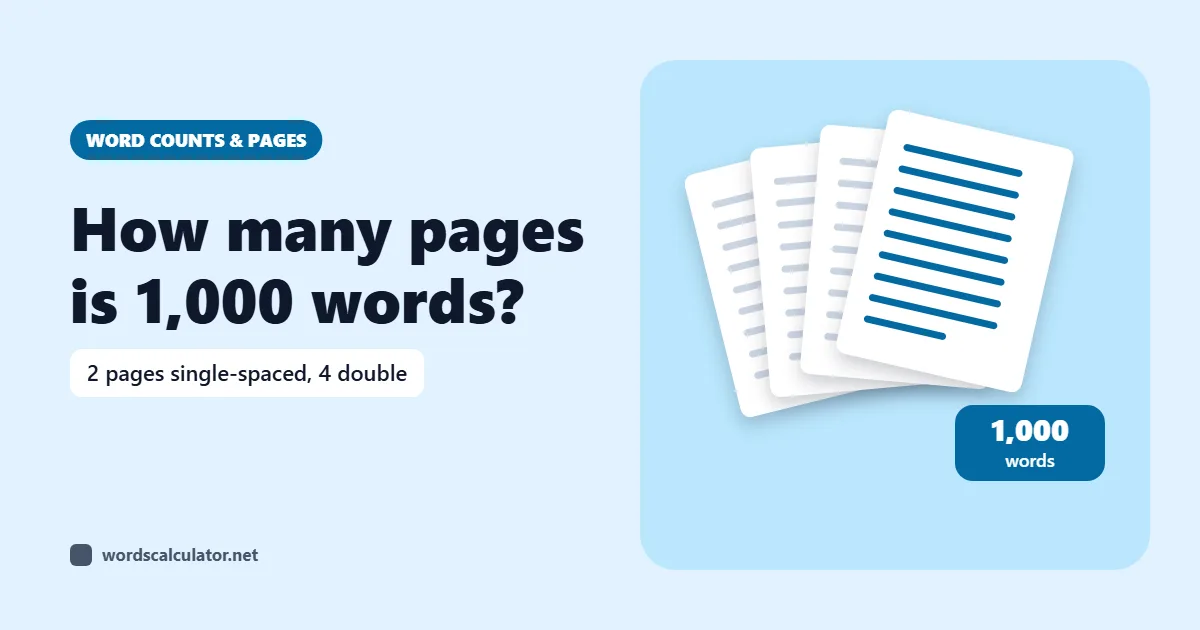
About 2½ double-spaced pages, or 1¼ single-spaced pages, in a 12-point font with one-inch margins. That assumes roughly 250 words on a double-spaced page and 500 on a single-spaced one.
If you're printing the speech to read from, don't cram it. Many speakers print in 14 to 16 point with generous line spacing so it's easy to find their place at a lectern. That can double the page count without changing the length of the talk. To see exactly how many pages your words fill in a specific font, size and spacing, try the Words Per Page calculator.
How to write a speech that fits the time
Start from the word budget, not the draft. Decide your target (for example 550 words for a strict 5-minute slot) before you write, and check it as you go.
Write for the ear. Short sentences, one idea each. Spoken language needs more repetition and signposting ("First…", "The second reason…") than writing does.
Mark your pauses. A slash or a line break in your notes where you want to breathe keeps you from speeding up.
Keep a cut section. Pick one paragraph you can drop on the day if things run late. It takes the pressure off.
Rehearse against a timer, out loud, at least three times. Silent reading runs at about 238 words per minute, so a silent read-through makes a speech look far shorter than it is.
Common mistakes that make speeches run long
Planning at 150 wpm and then speaking at 120. Pauses for emphasis, laughter and breathing slow everyone down on the day. Plan for the slower case.
Forgetting the extras. Thank-yous, introductions, and "Can everyone hear me?" all eat into your time.
Adding slides without adding time. Every slide change costs a few seconds, and a busy slide makes the audience read instead of listen.
Counting only the script. If you plan to take questions, the questions are part of your slot unless the organiser says otherwise.
The easiest way to check any draft is to paste it into the Word Counter. It shows the word count, reading time and speaking time as you type, and nothing you paste leaves your browser.
Frequently asked questions
How many words is a 3-minute speech?
About 390 words at a relaxed 130 words per minute, or 360 to 450 words depending on your pace.
How many words is a 2-minute speech?
About 260 words at 130 words per minute, and 240 to 300 words for most speakers.
How many words is a 10-minute speech?
About 1,300 words at 130 words per minute, with a normal range of 1,200 to 1,500 words.
How long does a 1,000-word speech take?
About 7 minutes 42 seconds at 130 words per minute. A fast speaker at 150 wpm finishes in about 6 minutes 40 seconds, and a slow one at 120 wpm takes about 8 minutes 20 seconds.
How long does it take to say 500 words?
About 3 minutes 51 seconds at 130 words per minute, or between 3 minutes 20 seconds and 4 minutes 10 seconds depending on your pace.
What is a good speaking pace for a presentation?
Somewhere between 120 and 150 words per minute works for most audiences. Slower is better for complex material, emotional moments and listeners who aren't native speakers.
Is 150 words per minute too fast for a speech?
Not for a confident speaker delivering familiar material, but it leaves no room for pauses. If you're nervous or the time limit is strict, plan at 130 wpm.
How do I calculate how long my speech will be?
Divide your word count by your speaking rate. A 780-word speech at 130 wpm takes 780 ÷ 130 = 6 minutes. Paste the text into a word counter to get the word count instantly.
How many words is 5 minutes of talking?
About 650 words at a relaxed 130 words per minute. Most people say between 600 and 750 words in five minutes, depending on how fast they talk and how often they pause.
How many words per minute do people speak?
Most people speak at about 120 to 150 words per minute in a speech or presentation. Around 130 words per minute is a clear, comfortable pace for an audience.
Sources
Yuan, J., Liberman, M. and Cieri, C. (2006). Towards an integrated understanding of speaking rate in conversation. Interspeech 2006.
Brysbaert, M. (2019). How many words do we read per minute? A review and meta-analysis of reading rate. Journal of Memory and Language, 109.
Speech tempo, Wikipedia (radio speaking rates, Rodero).
Commins, K. Simple math about audiobook rates (Audible/ACX 9,300 words per finished hour).
McGill University. Three Minute Thesis presenter guidebook.
TED. TEDx rules.
The Knot. How to write a best man speech.

Comments