
Do you capitalize after a colon? Yes, if what follows is a complete sentence, in AP, APA and Chicago style (Chicago switched to this rule in its 18th edition in 2024). MLA usually keeps a single sentence lowercase. In every style, a list or a fragment after a colon stays lowercase, and proper nouns and subtitles are always capitalized.
This is a style question, not a grammar rule, which is why you'll find confident sources that disagree. Many of the pages that rank for this question still describe Chicago's old rule. Below is the current rule for each major style guide, with examples, a comparison table and a decision test you can run in seconds.
The short rule for capitalizing after a colon
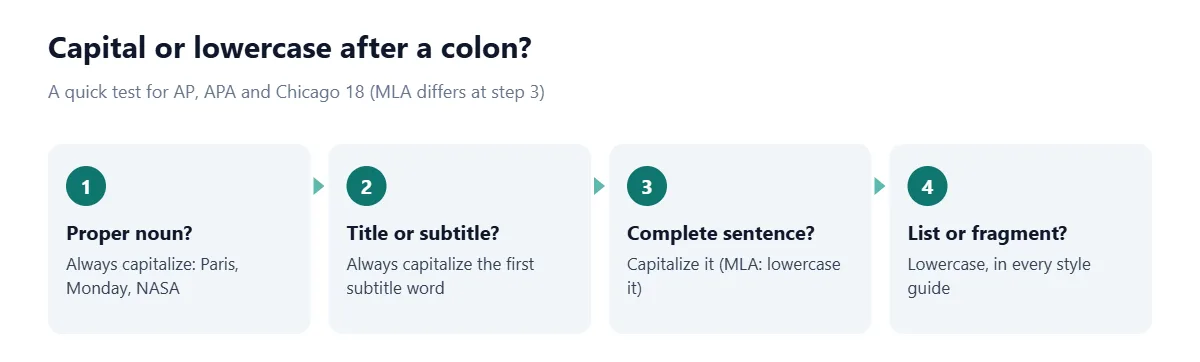
Most American style guides now agree on one test: is the text after the colon a complete sentence? If it has its own subject and verb and could stand alone with a period, capitalize the first word. If it's a list, a single word or a phrase, use lowercase.
Complete sentence: The rule is simple: Every draft needs a second reader.
List: Pack three things: a map, water and a charger.
Phrase: She had one goal: a seat on the board.
Proper noun: Only one city made the shortlist: Denver.
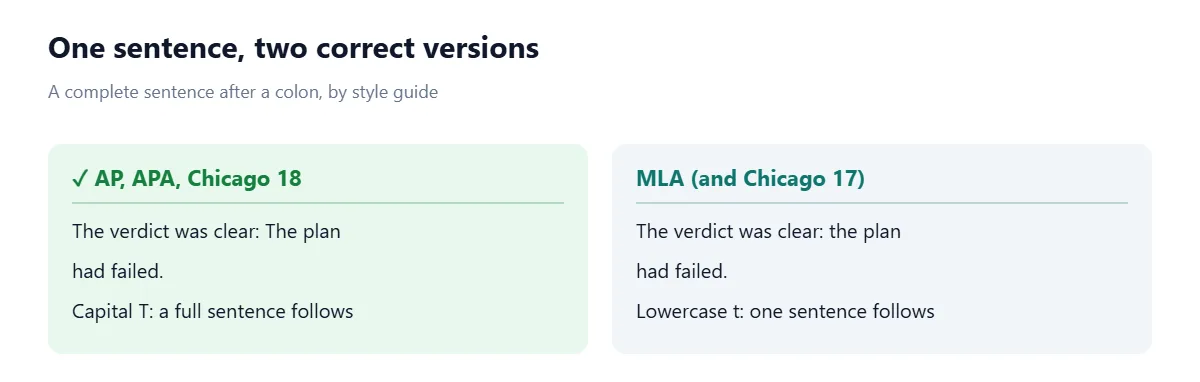
The exception is MLA, which keeps that first example lowercase. Everything else on the list above is the same in every style guide.
How to tell if it's a complete sentence
Cover everything up to and including the colon, then read what's left on its own. Does it have a subject and a verb, and does it make sense as a statement? Could you end it with a period and hand it to someone as a full sentence? If so, it's a complete sentence. "Every draft needs a second reader" passes. "A seat on the board" doesn't, because there's no verb.
Watch for short sentences that look like fragments. "It worked" and "Nobody came" are complete sentences, so they take a capital in AP, APA and Chicago 18. And watch for long phrases that look like sentences. "The best decision of her entire career so far" has eleven words but no main verb, so it stays lowercase everywhere.
Do you capitalize after a colon in AP style?
Yes, when a complete sentence follows. The Associated Press Stylebook says to "capitalize the first word after a colon only if it is a proper noun or the start of a complete sentence," as quoted by the Columbia Journalism Review (CJR).
AP: He promised one thing: The budget would balance by June.
AP: He promised one thing: a balanced budget.
Journalists also use colons in headlines and in Q&A formats, but the same test applies to body text: sentence gets a capital, fragment doesn't.
Do you capitalize after a colon in APA style?
Yes, when a complete sentence follows. The APA Publication Manual (7th edition) says to "capitalize the first word of the clause after the colon if it is a complete sentence," as quoted in Royal Roads University's guide (APA, 2020, p. 156) (Royal Roads University Library).
APA: Flooding closed two roads: Highway 1A and Cowichan Bay Road were both washed out.
APA: I have three tasks left: check my references, proofread and read the paper aloud.
APA applies the same logic to lists after a colon. If each item is an independent clause, capitalize it; if each item is a phrase, don't (APA, 2020, p. 190, via Royal Roads).
Chicago style: the rule changed in 2024
This is the change most articles haven't caught up with. Under the 17th edition of The Chicago Manual of Style, you lowercased a single sentence after a colon and capitalized only when two or more complete sentences followed. The 18th edition, published in September 2024, reversed that: "The first word of a grammatically complete sentence following a colon will now get an initial capital" (CMOS Shop Talk).
The Chicago Manual's own Q&A confirms the switch and points to section 6.67 of the 18th edition (Chicago Manual of Style Online). So if your publisher, school or company follows Chicago, check which edition they use. Many house style sheets were written under the 17th.
Text after the colon | Chicago 17th ed. | Chicago 18th ed. |
|---|---|---|
One complete sentence | lowercase | Capital |
Two or more sentences | Capital | Capital |
List or phrase | lowercase | lowercase |
Proper noun | Capital | Capital |
Do you capitalize after a colon in MLA style?
Usually not. The MLA Style Center says to "use a lowercase letter when the word that follows the colon is normally lowercased," with the example: "Bonnie had to admit what was already obvious to her roommates: she was allergic to the cat" (MLA Style Center).
MLA lists three cases where you do use a capital after the colon:
A rule or principle: The first law of editing is simple: Cut what the reader doesn't need.
Several related sentences: The results surprised us: Sales fell in May. They recovered in June.
A word that's always capitalized, such as a proper noun.
MLA is also relaxed about it. A separate Style Center answer notes that sentences after a colon "usually start with a lowercase letter, but it is acceptable to start such sentences with a capital letter" (MLA Style Center). If your teacher hasn't specified, consistency matters more than which choice you make.
Capitalization after a colon: comparison table
Here's every common case side by side. "Cap" means capitalize the first word after the colon. If you write for more than one outlet, say a newspaper and a journal, keep this table handy: the only row where the guides really split is the single complete sentence.
What follows the colon | AP | APA 7 | Chicago 18 | MLA 9 |
|---|---|---|---|---|
One complete sentence | Cap | Cap | Cap | lowercase (cap OK) |
Two or more sentences | Cap | Cap | Cap | Cap |
A rule or principle | Cap | Cap | Cap | Cap |
List of words or phrases | lowercase | lowercase | lowercase | lowercase |
Phrase or single word | lowercase | lowercase | lowercase | lowercase |
Proper noun | Cap | Cap | Cap | Cap |
Subtitle in a title | Cap | Cap | Cap | Cap |
Do you capitalize after a colon in a title?
Yes. In titles and headings, the word after a colon starts a subtitle, and all the major guides capitalize the first word of a subtitle, even a small word like a or the (Title case, Wikipedia). APA spells this out for references too: "Capitalize the first word of a subtitle in a reference" (APA, 2020, p. 167, via Royal Roads).
Title case: Salt: A World History
Sentence case (APA reference style): Sleep and memory: A review of recent findings
If you're not sure which words to capitalize in the rest of a title, see our guide to title case vs sentence case, or paste the title into the Case Converter to switch styles in one click.
Quotes, lists and other special cases
A quotation after a colon
When a colon introduces a quotation that runs into your sentence, MLA says it may start with a lowercase or capital letter, and you should simply follow whatever the source has (MLA Style Center).
A vertical or bulleted list
For a list set on separate lines, the APA guidance above is a good general rule: capitalize items that are full sentences and lowercase items that are fragments, unless your house style says otherwise. Whichever you choose, treat every item in the list the same way.
Labels like Note: and Warning:
Labels work like headings, so what follows is usually written as an ordinary sentence with a capital: Note: The office is closed on Monday. This is a design convention rather than a style-guide rule, so match whatever your document already does.
Times, ratios and references
Colons in 10:30, a 3:1 ratio or a Bible reference like John 3:16 aren't introducing anything, so capitalization doesn't come up.
Practice: capital or lowercase?
Try these before you look at the answers. The middle column is for AP, APA and Chicago 18; the last is for MLA.
Sentence | AP / APA / Chicago 18 | MLA |
|---|---|---|
The forecast was grim: [r]ain all weekend. | rain (phrase) | rain |
The forecast was grim: [i]t would rain all weekend. | It (sentence) | it |
We have one rule: [n]obody eats at their desk. | Nobody | Nobody (a rule) |
She speaks three languages: [f]rench, Urdu and Thai. | French (proper noun) | French |
The answer surprised me: [t]he data was wrong. [w]e reran it. | The ... We | The ... We (two sentences) |
Bring the essentials: [a] laptop and a charger. | a (list) | a |
Notice that the two styles only split on the second example: a single complete sentence that isn't a rule. That's the one case where you need to know which guide you're following. Everything else in the table has the same answer in every style.
Common mistakes with colons and capitals
Capitalizing a list. "We need: Eggs, flour and milk" is wrong twice. Drop the colon after "need," or rewrite it as "We need three things: eggs, flour and milk."
Following an old Chicago rule. If you learned "lowercase unless two sentences follow," that was Chicago 17. Chicago 18 capitalizes any complete sentence.
Mixing styles in one document. Capitalizing after some colons and not others looks careless. Pick a rule and apply it everywhere.
Using a colon after an incomplete lead-in. "The colors are: red, blue and green" doesn't need the colon at all. A colon reads best after a complete clause, such as "There are three colors: red, blue and green."
If you also mix up colons and semicolons, our guide to colon vs semicolon covers when to use each. And when you need to fix capitals across a whole document, the Case Converter can switch text to sentence case in one step, so you only have to adjust the words after colons by hand.
Frequently asked questions
Do you capitalize after a colon?
Capitalize after a colon if a complete sentence follows in AP, APA and Chicago (18th edition) style. Use lowercase for lists and fragments. MLA usually keeps even a full sentence lowercase.
Do you capitalize after a colon in APA?
Yes, if the words after the colon form a complete sentence. If they form a list or a phrase, APA uses lowercase.
Does Chicago style capitalize after a colon?
Yes, since the 18th edition (2024), Chicago capitalizes any complete sentence after a colon. The 17th edition only capitalized when two or more sentences followed.
Do you capitalize after a colon in MLA?
Usually not. MLA uses lowercase unless the colon introduces a rule or principle, more than one sentence, or a proper noun, though a capital is acceptable.
Do you capitalize the first word after a colon in a title?
Yes. The first word of a subtitle after a colon is capitalized in AP, APA, Chicago and MLA, even if it's a short word like a or the.
Do you capitalize a list after a colon?
No. A list of words or phrases after a colon starts with a lowercase letter unless the first item is a proper noun.
Is capitalizing after a colon a grammar rule?
No, it's a style choice. Different style guides set different rules, so follow the guide your teacher, publisher or employer uses and stay consistent.
Do you capitalize a name after a colon?
Yes. Proper nouns such as names, places and brands keep their capital letter after a colon in every style guide.
Sources
The Chicago Manual of Style Online. Chicago Style Q&A: Capitalization after a colon. University of Chicago Press.
CMOS Shop Talk. Announcing The Chicago Manual of Style, 18th Edition. University of Chicago Press, 2024.
Columbia Journalism Review. How to use the colon (quoting the AP Stylebook).
Royal Roads University Library. Capitalization after semicolons or colons (quoting the APA Publication Manual, 7th ed., 2020).
MLA Style Center. Colons: How to Use Them. Modern Language Association, 2017, updated 2020.
MLA Style Center. When should I capitalize the first letter of the first word of a quotation?. Modern Language Association.
Title case. Wikipedia.


Comments