
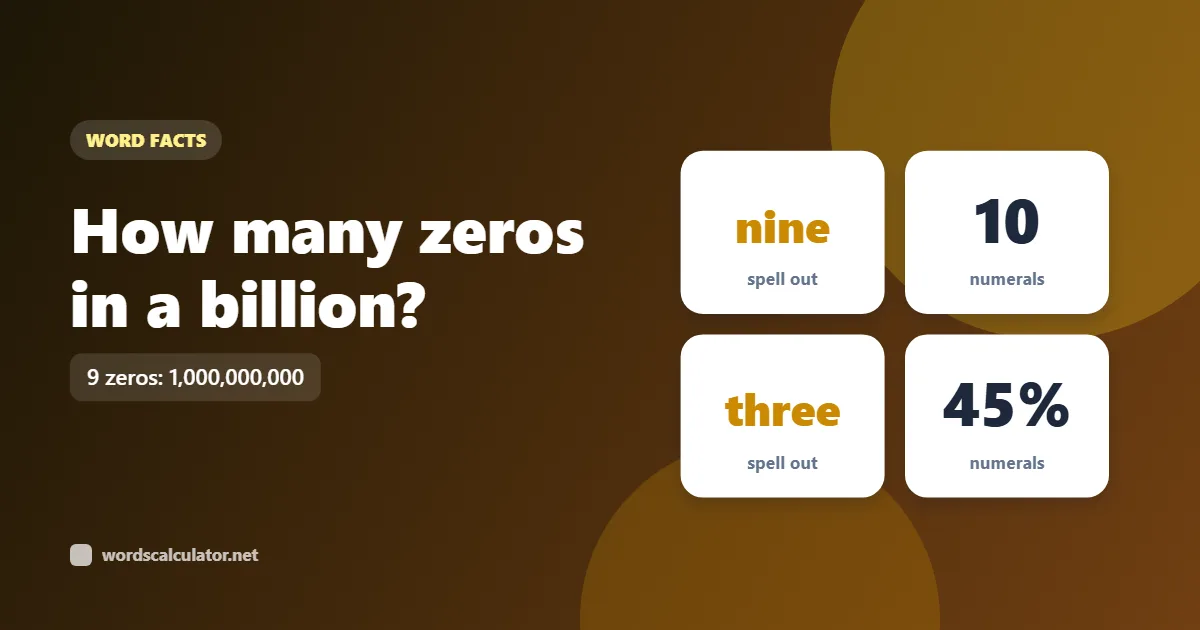
How many zeros in a billion? A billion has 9 zeros and is written 1,000,000,000. That is the short-scale billion used in the US, in modern British English and in most English writing. A million has 6 zeros and a trillion has 12.
There is one catch that most charts skip: in much of continental Europe, and in older British books, "billion" means a million million, with 12 zeros. Below you'll find the full chart from a thousand to a googol, a simple trick for working out the zeros in any -illion, the long and short scales explained, and the Indian lakh and crore system.
How many zeros in a billion, and why nine?
A billion is a thousand millions. A million is 1,000,000 (six zeros), and multiplying by a thousand adds three more zeros, so a billion is 1,000,000,000. Merriam-Webster's American definition is simply "a number equal to 1,000 million".
The commas make it easy to count. Each comma marks a group of three zeros, and a billion has three groups: 1,000,000,000. In scientific notation it is 10^9, where the small number tells you how many zeros follow the 1. The American Museum of Natural History uses the same notation and explains that astronomers write a trillion as 10^12.
How many zeros in a million, billion and trillion?
These three come up most often, in news stories, budgets and population figures:
Million: 6 zeros, 1,000,000 (10^6). Two groups of three.
Billion: 9 zeros, 1,000,000,000 (10^9). A thousand millions.
Trillion: 12 zeros, 1,000,000,000,000 (10^12). A thousand billions, or a million millions.
A useful way to feel the gaps: a million seconds is about 11.6 days, a billion seconds is about 31.7 years, and a trillion seconds is about 31,700 years. The jump from million to billion is not a small step; it is a thousandfold leap.
Large numbers are hard to picture, which is why the zeros matter. The American Museum of Natural History offers a neat way to see the scale: a million oranges would fill a swimming pool, while a billion oranges would fill a stadium to the brim. The same page notes that astronomers estimate there are more than 100 billion stars in the Milky Way.
Chart of large numbers: zeros from thousand to googol
Here is how many zeros each common number name has on the short scale, which is the standard in American and modern British English. The names from million to decillion are listed in all major English dictionaries, according to the names of large numbers reference. If you only came for how many zeros in a billion, it is the third row: nine.
Name | Zeros | Power of ten |
|---|---|---|
Thousand | 3 | 10^3 |
Million | 6 | 10^6 |
Billion | 9 | 10^9 |
Trillion | 12 | 10^12 |
Quadrillion | 15 | 10^15 |
Quintillion | 18 | 10^18 |
Sextillion | 21 | 10^21 |
Septillion | 24 | 10^24 |
Octillion | 27 | 10^27 |
Nonillion | 30 | 10^30 |
Decillion | 33 | 10^33 |
Googol | 100 | 10^100 |
Past decillion the names get rare. The largest -illion that standard dictionaries agree on is the centillion, which has 303 zeros on the short scale. Merriam-Webster confirms the pattern at the top end too: it defines a decillion as 1 followed by 33 zeros in the US and 60 zeros in British use.
A quick trick to count the zeros in any -illion
You don't need to memorize the chart. The Latin prefix tells you everything. Bi means 2, tri means 3, quadr means 4, quint 5, sext 6, sept 7, oct 8, non 9 and dec 10. On the short scale, add 1 to the prefix number and multiply by 3. It is also the quickest way to answer how many zeros in a billion, or in any other -illion, without looking it up.
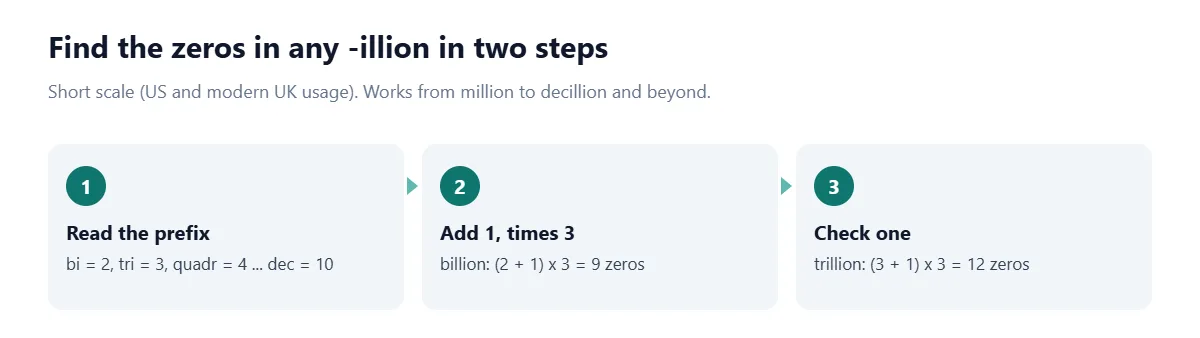
Billion: (2 + 1) x 3 = 9 zeros.
Quintillion: (5 + 1) x 3 = 18 zeros.
Decillion: (10 + 1) x 3 = 33 zeros.
Centillion: (100 + 1) x 3 = 303 zeros.
The long scale has an even simpler rule: multiply the prefix number by 6. That gives 12 zeros for a long-scale billion, 18 for a trillion and 60 for a decillion, which matches the British figure in Merriam-Webster above.
Does a billion have 9 or 12 zeros? Short scale vs long scale
So how many zeros in a billion: 9 or 12? Both answers have been correct, depending on where and when you are reading. The word was originally borrowed from French for a million squared (12 zeros). Merriam-Webster notes that American English adopted the thousand-million meaning in the 1800s, while British usage has increasingly followed it since the 1950s.
The British government made it official in 1974. Answering a question in Parliament, Prime Minister Harold Wilson said that "the word 'billion' is now used internationally to mean 1,000 million" and that it would be confusing for ministers to use it any other way. Today a billion in a UK newspaper means nine zeros.
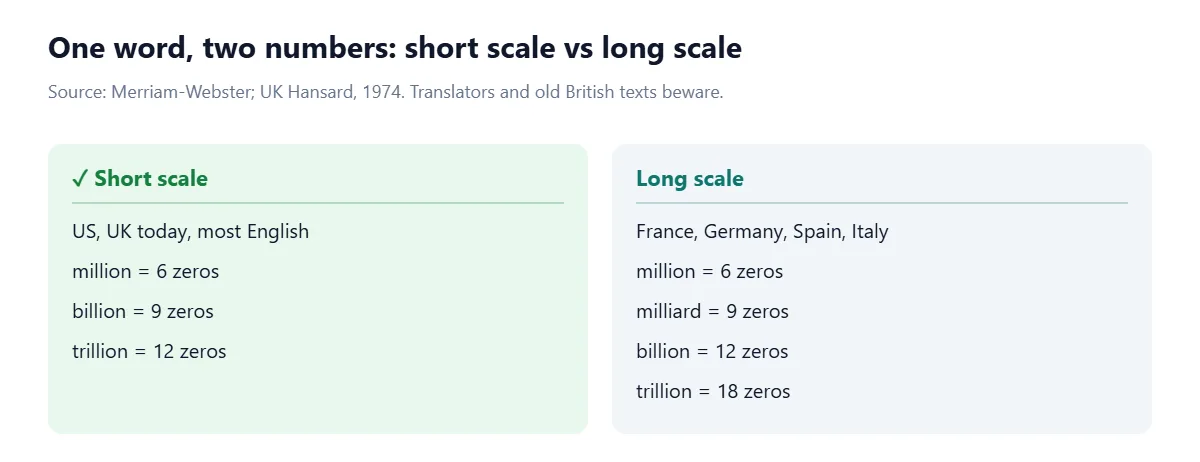
Much of continental Europe still uses the long scale, including France, Germany, Spain and Italy, with a separate word, such as milliard, for a thousand million, according to this overview of long and short scales. That creates a classic translation trap: German "Billion" and French "billion" mean a trillion in English, while German "Milliarde" and French "milliard" mean a billion.
How many zeros in a lakh and a crore? The Indian system
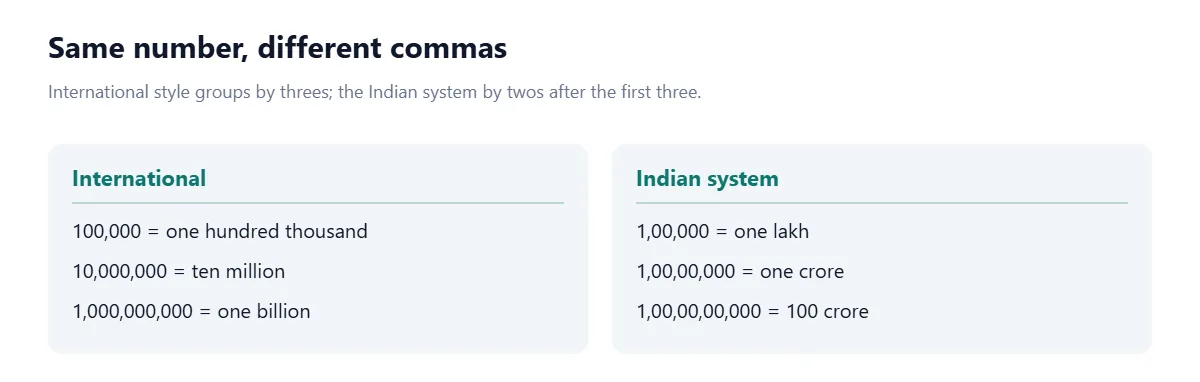
Across South Asia, large amounts are commonly counted in lakhs and crores. Merriam-Webster defines a lakh as one hundred thousand and a crore as ten million, or 100 lakhs.
Lakh: 5 zeros, written 1,00,000 (one hundred thousand).
Crore: 7 zeros, written 1,00,00,000 (ten million).
One billion: 100 crore, written 1,00,00,00,000.
The commas look different because the Indian numbering system groups the first three digits and then pairs of two. So 123,456,789 in international style becomes 12,34,56,789. The word arab is sometimes used for 100 crore (10^9), but in everyday speech and news, "100 crore" is far more common.
How many zeros in 2 billion, 10 billion and half a billion?
Multiples of a billion are where people slip, so here are the common ones worked out:
Amount | Written in full | Zeros |
|---|---|---|
Half a billion | 500,000,000 | 8 |
1 billion | 1,000,000,000 | 9 |
1.5 billion | 1,500,000,000 | 8 (after the 15) |
2 billion | 2,000,000,000 | 9 |
10 billion | 10,000,000,000 | 10 |
100 billion | 100,000,000,000 | 11 |
1,000 billion | 1,000,000,000,000 | 12 (a trillion) |
The pattern: multiplying by 10 adds one zero, and multiplying by 1,000 moves you to the next -illion. Half a billion has one fewer zero than a billion because 500,000,000 is a nine-digit number, while 1,000,000,000 has ten digits.
How many zeros in a billion dollars?
The same nine. A billion dollars is $1,000,000,000, so the currency doesn't change the zeros you write. It only changes what happens after the decimal point. Written in cents, a billion dollars is 100,000,000,000 cents, which has 11 zeros, because every dollar is 100 cents and that adds two more.
Currency is also where the scale problem bites hardest. A European news report about a budget of "2 Billionen Euro" in German means two trillion euros in English, not two billion. Financial writers often sidestep the issue with "bn" and "tn" abbreviations or with the full figure in a table.
How to write a billion in words and numbers
In ordinary writing, "1 billion" or "one billion" is clearer than a string of zeros, and numerals plus the word work well for large round numbers, such as "$3 billion" or "7.9 billion people". Our guide on when to spell out numbers covers the main style rules.
On a check or a legal document, you write the full amount in words: "One billion and 00/100 dollars". The Number to Words Converter turns any figure into words, including lakh and crore wording, and our step-by-step guide shows how to write a check amount in words.
Googol and googolplex: how many zeros?
A googol is 1 followed by 100 zeros. Britannica records that the name was coined in 1937 by Milton Sirotta, the nephew of mathematician Edward Kasner, and that the search engine's name is a misspelling of it.
A googolplex is 10 to the power of a googol: a 1 followed by a googol zeros. It is a finite number, but writing out a googol zeros is not something anyone could actually do, which makes it the rare number that is easier to define than to show.
Common mistakes when counting zeros
Counting commas instead of zeros. A billion has three commas but nine zeros. Each comma stands for three zeros.
Mixing scales. Treating a European "billion" as nine zeros turns a trillion into a billion.
Losing a zero in decimals. 2.5 billion is 2,500,000,000, which has 8 zeros after the 25, not 9.
Confusing crore and million. One crore is ten million, not one million.
Misreading 1e9. Calculators and spreadsheets often show a billion as 1E+09. The number after the E is the count of zeros.
If you are still unsure which billion your source means, look for context such as a currency, a date or a country. When in doubt, write the number in full or in scientific notation so nobody has to guess.
How many zeros in a billion?
A billion has 9 zeros: 1,000,000,000. That is the short-scale billion used in the US and in modern British English.
How many zeros in a million?
A million has 6 zeros: 1,000,000. A thousand millions make a billion.
How many zeros in a trillion?
A trillion has 12 zeros: 1,000,000,000,000. It is a thousand billions, or a million millions.
Does a British billion have 12 zeros?
It used to. The UK government formally adopted the 1,000 million meaning in 1974, so a billion in British English today has 9 zeros, but older British texts may use 12.
How many zeros are in a crore?
A crore has 7 zeros: 1,00,00,000 in the Indian system, or 10,000,000 (ten million) in international style. One billion equals 100 crore.
How many zeros in 10 billion?
Ten billion has 10 zeros: 10,000,000,000. Each multiplication by ten adds one zero.
How many zeros in a googol?
A googol has 100 zeros, written 10^100. A googolplex is 1 followed by a googol zeros.
What comes after a trillion?
A quadrillion, with 15 zeros, followed by a quintillion (18), sextillion (21), septillion (24), octillion (27), nonillion (30) and decillion (33).
Sources
Merriam-Webster. Billion. Merriam-Webster Dictionary.
Merriam-Webster. Decillion. Merriam-Webster Dictionary.
Merriam-Webster. Googolplex. Merriam-Webster Dictionary.
Merriam-Webster. Lakh and Crore. Merriam-Webster Dictionary.
UK Parliament. "Billion" (Definition), written answer. Hansard, 1974.
American Museum of Natural History. How Much Is a Billion?. AMNH OLogy.
Encyclopaedia Britannica. Googol. Britannica.
Long and short scales. Wikipedia.
Names of large numbers. Wikipedia.
Indian numbering system. Wikipedia.


Comments