
How many letters are in the alphabet? The English alphabet has 26 letters, from A to Z. Five of them are vowels (A, E, I, O, U) and the other 21 are usually counted as consonants, with Y (and occasionally W) able to play either role.
That's the short version. Below you'll find the full list, the vowel and consonant split (and why sources disagree on it), the letters English dropped, the strange story of the ampersand, the most and least used letters, and how English compares with other languages.
How many letters are in the alphabet? The full A to Z list
There are 26, and every modern English dictionary, keyboard and school chart agrees on the number (Wikipedia, English alphabet). Here they are in order:
A B C D E F G H I J K L M N O P Q R S T U V W X Y Z
The alphabet is a version of the Latin alphabet. Each letter has a capital form and a small form, and each has a name ("bee" for B, "double-u" for W). The position numbers are handy for puzzles and codes: A is 1, M is 13, N is 14 and Z is 26, so the alphabet splits into two equal halves at M and N.
How many vowels and consonants are in the alphabet?
The usual school answer is 5 vowels and 21 consonants. Strictly, the picture is a little messier, and this is where most quick answers stop short.
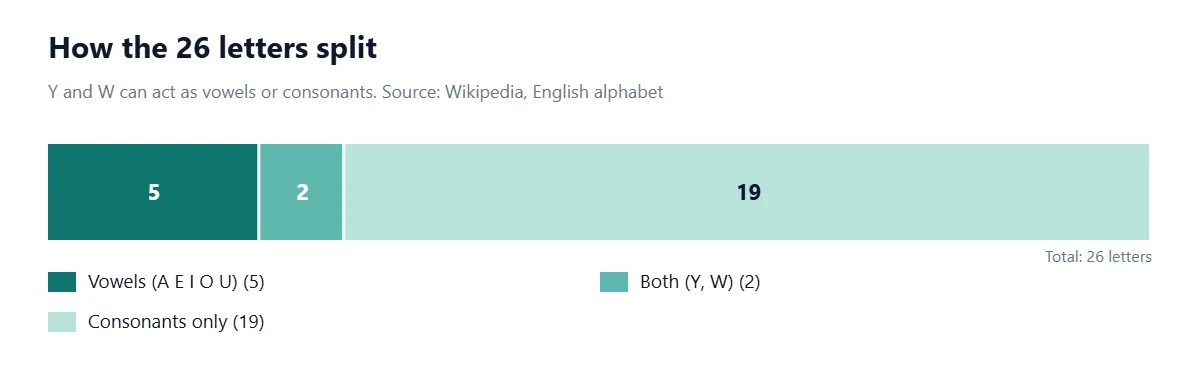
Always vowels: A, E, I, O, U.
Sometimes vowels: Y is a consonant in "young" and "yes" but a vowel in "myth" and "gym." W is nearly always a consonant, but it helps spell vowel sounds in words like "cow" and "saw" (Wikipedia).
Always consonants: the remaining 19 letters, B C D F G H J K L M N P Q R S T V X Z.
So both "21 consonants" and "19 consonants plus two semi-vowels" are fair answers. If a teacher or quiz asks how many consonants are in the alphabet, 21 is the expected number. If you're writing about pronunciation, the 19 + 2 split is more accurate.
Uppercase and lowercase: 26 letters, 52 forms
Each of the 26 letters has two forms, so there are 52 letter shapes in everyday English writing. Some pairs look alike (C and c, O and o, S and s), and some look nothing alike (A and a, G and g, R and r).
This matters when you count characters. A character counter treats "A" and "a" as one character each, so a 10-letter word is 10 characters whatever its case. If you need to check capitals specifically, the Character Counter counts every character you paste, and the Case Converter switches text between upper, lower, sentence and title case in one click.
Letters that used to be in the English alphabet
The 26-letter set is newer than most people think. Old and Middle English used several extra letters, some of them borrowed from runes, plus the ligature ethel (œ). They faded out between about 1300 and the age of printing (Wikipedia).
Letter | Name | Sound | Replaced by |
|---|---|---|---|
þ | Thorn | th (as in thin, this) | th |
ð | Eth | th | th |
ƿ | Wynn | w | w (around 1300) |
ȝ | Yogh | gh, y and similar | gh, y (by the 1400s) |
æ | Ash | a as in cat | a |
Thorn and eth both stood for the th sound. Printing finished thorn off: the imported typefaces had no þ, so printers swapped in Y, which is why old shop signs say "Ye Olde." It was always read as "the," never "yee" (Wikipedia, Thorn)). Icelandic still uses both þ and ð, and Faroese keeps ð (Wikipedia, Eth).
Wynn represented the w sound and fell out of use in the Middle English period, around 1300 (Wikipedia, Wynn).
Yogh covered several sounds and was replaced by gh and y. That's why "night" has a silent gh: Middle English spelled it niȝt (Wikipedia, Yogh).
Ash was named after the rune for an ash tree and marked the vowel in "cat." It's still a full letter in Danish, Norwegian, Icelandic and Faroese (Wikipedia, Æ).
When did J, U and W become separate letters?
Three of today's 26 letters are late additions. For centuries, I and J were treated as one letter, and so were U and V. The letters u and j were introduced as distinct from v and i in the 16th century, and w took on the status of an independent letter around the same time (Wikipedia).
W's name is a fossil of that history. It's called "double-u" because it started out as two u's (or v's) written side by side.
Was the ampersand the 27th letter of the alphabet?
Sort of. In 19th-century American schoolbooks, children recited the alphabet with & at the end, and some texts taught it as the 27th letter (Wikipedia, Ampersand). When a letter could also stand alone as a word, it was recited with the Latin "per se" (by itself), so the end of the alphabet went "X, Y, Z, and per se and." Said quickly, that became "ampersand," a word in common use by 1837.
Whether & was ever an official letter is a different question. It was never part of the alphabet in the way J or W are. It was a symbol that pupils learned along with the letters, which is why the English alphabet is 26 letters today, not 27.
What are the most and least common letters?
E is the most common letter in English text, making up about 12.7% of all letters. Z is the rarest at about 0.07% (Wikipedia, Letter frequency, citing Robert Lewand's Cryptological Mathematics).
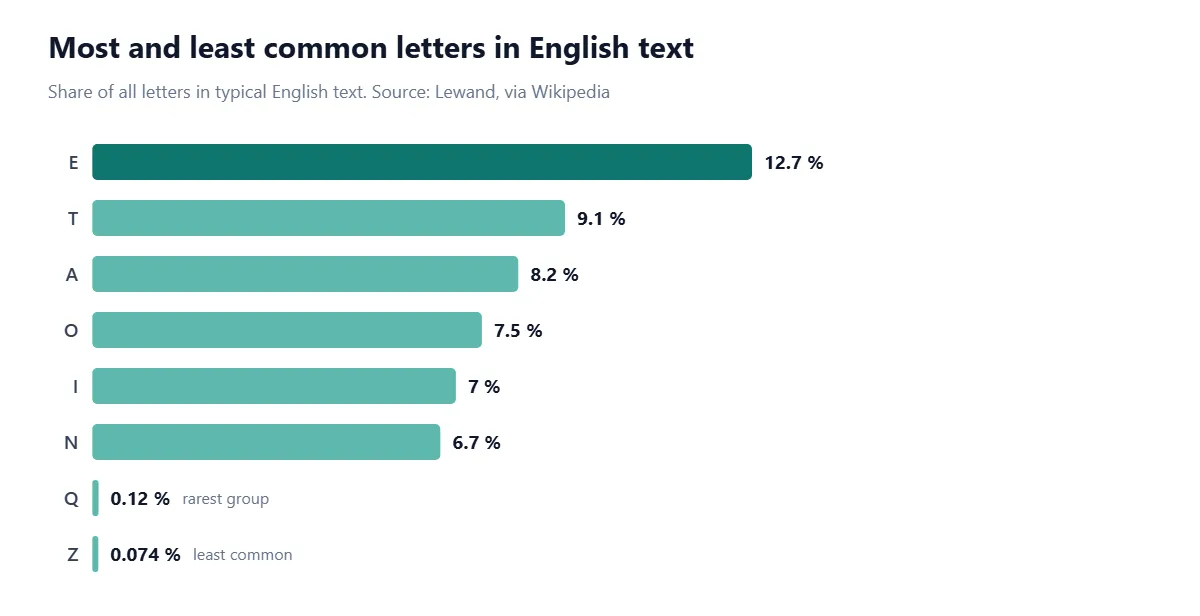
The full order from most to least common, in Lewand's data, is E T A O I N S H R D L C U M W F G Y P B V K J X Q Z. The first letter of a word follows a different pattern. T starts about 16% of English words in running text, mostly because of "the," "to," "that" and "this" (Wikipedia).
Curious which words drive those numbers? Our guide to the most common words in English shows how a few short words dominate everyday text.
How many letters are in other alphabets?
Ask how many letters are in the alphabet in another language and the answer changes a lot. The count depends on what a language treats as a letter rather than a letter with an accent or a two-letter combination.
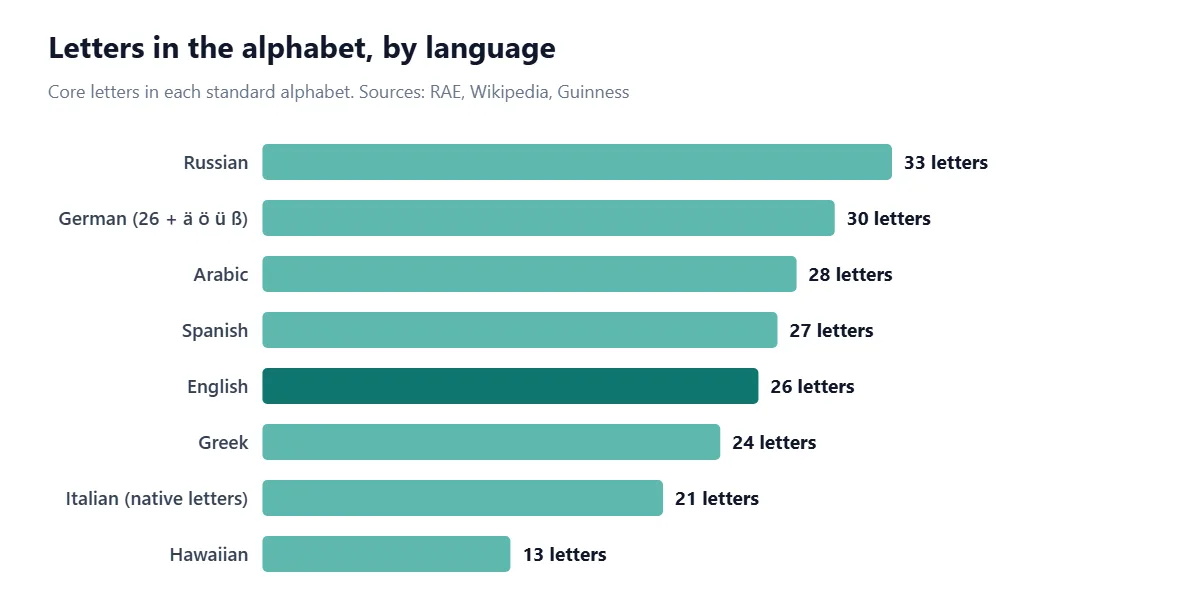
Spanish: 27. The Real Academia Española lists the 26 Latin letters plus ñ. Ch and ll used to be listed, but the RAE now treats them as digraphs (two-letter combinations), not letters (RAE).
German: 30. The 26 basic letters plus ä, ö, ü and ß. A capital ẞ became an official letter in 2017 (Wikipedia, German orthography).
Italian: 21 native letters. J, K, W, X and Y appear only in loanwords, names and a few special cases (Wikipedia, Italian alphabet).
Russian: 33 letters in the Cyrillic alphabet (Wikipedia, Russian alphabet).
Greek: 24, alpha to omega (Wikipedia, Greek alphabet).
Arabic: 28 basic letters, written right to left, with no capital letters (Wikipedia, Arabic alphabet).
Hawaiian: 13. Five vowels and eight consonants, including the ʻokina, a glottal stop (Wikipedia, Hawaiian alphabet).
What is the shortest alphabet in the world?
The Rotokas language of Bougainville, Papua New Guinea, has the smallest alphabet in use. Guinness World Records lists it at 11 letters (Guinness World Records), while the alphabet as currently described has 12: A, E, G, I, K, O, P, R, S, T, U and V (Wikipedia, Rotokas alphabet). Either way, it's less than half the size of the English set.
Is the last letter "zee" or "zed"?
Both are correct. American English says "zee." British, Irish, Canadian, Australian and most other varieties say "zed" (Wikipedia). The letter is the same; only its name changes.
Sentences that use all 26 letters
A sentence that contains every letter of the alphabet at least once is called a pangram. The best known is "The quick brown fox jumps over the lazy dog," which uses all 26 letters in 35. A tighter one is "Pack my box with five dozen liquor jugs," at 32 letters.
You can check any pangram yourself: paste it into the Character Counter to see the character count with and without spaces. And if you need to put a list of words in A to Z order, the Alphabetize List tool does it instantly.
Frequently asked questions
How many letters are in the alphabet?
The English alphabet has 26 letters, from A to Z. Counting capital and small forms separately, there are 52 letter shapes.
How many vowels are in the alphabet?
There are 5 vowel letters in English: A, E, I, O and U. Y often works as a vowel too, as in "myth" and "happy."
How many consonants are in the alphabet?
There are 21 consonants if you count Y and W as consonants, which is the standard school answer. Without them, 19 letters are always consonants.
What is the 27th letter of the alphabet?
There isn't one today. In the 19th century the ampersand (&) was often recited after Z and taught as a 27th letter, which is how it got the name "ampersand."
What is the 13th letter of the alphabet?
M is the 13th letter of the English alphabet. N is the 14th, so M and N mark the halfway point.
What is the least used letter in English?
Z is the least used letter, at about 0.07% of letters in English text, followed by Q, X and J.
Which language has the most letters in its alphabet?
Among the alphabets compared here, Russian has the most, with 33. Some writing systems such as Chinese and Japanese kanji use thousands of characters, but they aren't alphabets.
Did the English alphabet always have 26 letters?
No. Old English used extra letters such as thorn (þ), eth (ð), wynn (ƿ) and ash (æ), and J, U and W only became separate letters in the 16th century.
Sources
English alphabet. Wikipedia.
Letter frequency. Wikipedia (citing Lewand, Cryptological Mathematics).
Ampersand. Wikipedia.
Thorn (letter)), Eth, Wynn, Yogh and Æ. Wikipedia.
Real Academia Española. Abecedario. Diccionario panhispánico de dudas.
German orthography, Italian alphabet, Russian alphabet, Greek alphabet, Arabic alphabet and Hawaiian alphabet. Wikipedia.
Guinness World Records. Shortest alphabet. Guinness World Records.
Rotokas alphabet. Wikipedia.

Comments