
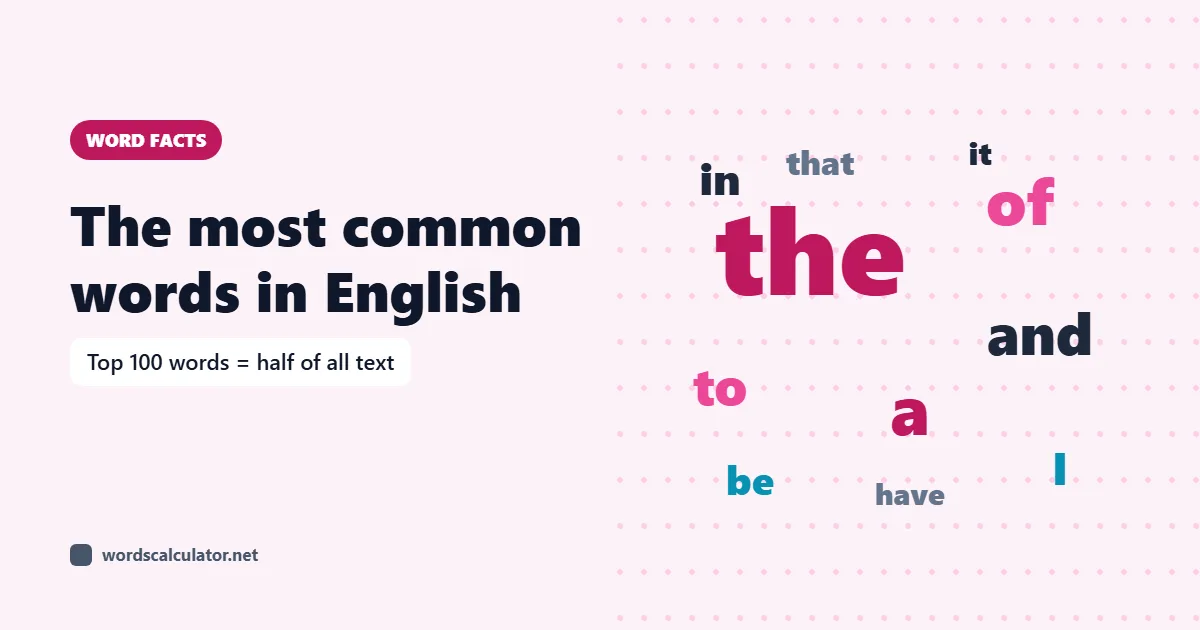
The most common words in English start with "the", followed by be, to, of, and, a, in, that, have and I. The top 100 words are so heavily used that they make up about half of all written English, according to Oxford's 2-billion-word corpus.
Those rankings come from counting real text on a massive scale, not from anyone's opinion. Below you'll find the top 25 in a table, the rest of the top 100, the most common nouns, verbs and adjectives, and a simple way to find the words you lean on too much in your own writing.
What is the most common word in English?
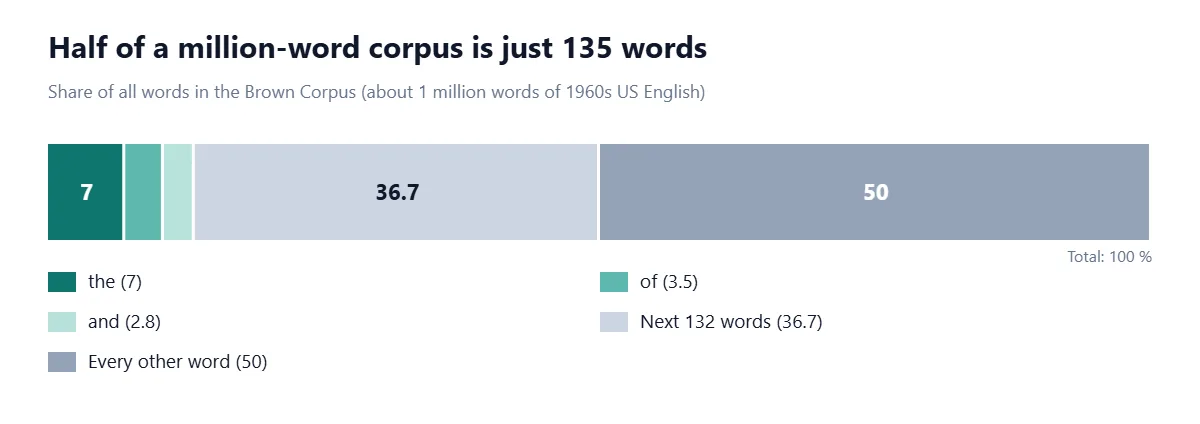
"The." It sits at number one in the Oxford English Corpus, in the American COCA corpus and in the classic Brown Corpus. In the Brown Corpus, a classic collection of about a million words of American text from the 1960s, "the" accounts for nearly 7% of all words: 69,971 occurrences. The runner-up, "of", is only half as frequent at slightly over 3.5% (Wikipedia: Zipf's law).
That steep drop from first to second place isn't a coincidence. Word frequencies follow a pattern called Zipf's law: the second most common word appears roughly half as often as the first, the third roughly a third as often, and so on down a very long tail. In the Brown Corpus, just 135 different words make up half of all the words in the collection.
The 25 most common words in English
The best-known ranking comes from the Oxford English Corpus, a collection of more than 2 billion words of 21st-century English from novels, newspapers, blogs, specialist journals and more, gathered by Oxford University Press (Wikipedia: Most common words in English; Wikipedia: Oxford English Corpus). Here's the top 25:
Rank | Word | Word type | Rank | Word |
|---|---|---|---|---|
1 | the | article | 14 | on |
2 | be | verb | 15 | with |
3 | to | preposition | 16 | he |
4 | of | preposition | 17 | as |
5 | and | conjunction | 18 | you |
6 | a | article | 19 | do |
7 | in | preposition | 20 | at |
8 | that | conjunction, determiner | 21 | this |
9 | have | verb | 22 | but |
10 | I | pronoun | 23 | his |
11 | it | pronoun | 24 | by |
12 | for | preposition | 25 | from |
Rank 13 is "not", which didn't fit the table neatly. One detail matters when you read any list like this: Oxford counts lemmas, not exact spellings. "Be" at number 2 includes am, is, are, was, were and every other form of the verb, and "have" includes has and had. A plain word-by-word count of the same text would split those up, so "be" as a single spelling would sit much lower.
The 100 most common English words: ranks 26 to 100
Continuing the Oxford English Corpus list, in order:
26–50: they, we, say, her, she, or, an, will, my, one, all, would, there, their, what, so, up, out, if, about, who, get, which, go, me
51–75: when, make, can, like, time, no, just, him, know, take, people, into, year, your, good, some, could, them, see, other, than, then, now, look, only
76–100: come, its, over, think, also, back, after, use, two, how, our, work, first, well, way, even, new, want, because, any, these, give, day, most, us
Scan that list and you'll notice how few of these words mean anything on their own. "Time" at 55 is the first noun. Most of the rest are pronouns, prepositions, conjunctions and a handful of all-purpose verbs such as get, make, go and take.
How many words make up most of written English?
Far fewer than you'd guess. Oxford reports that its top 100 lemmas account for 50% of all the words in the Oxford English Corpus. Push further down the list and coverage keeps climbing, though more slowly each time.
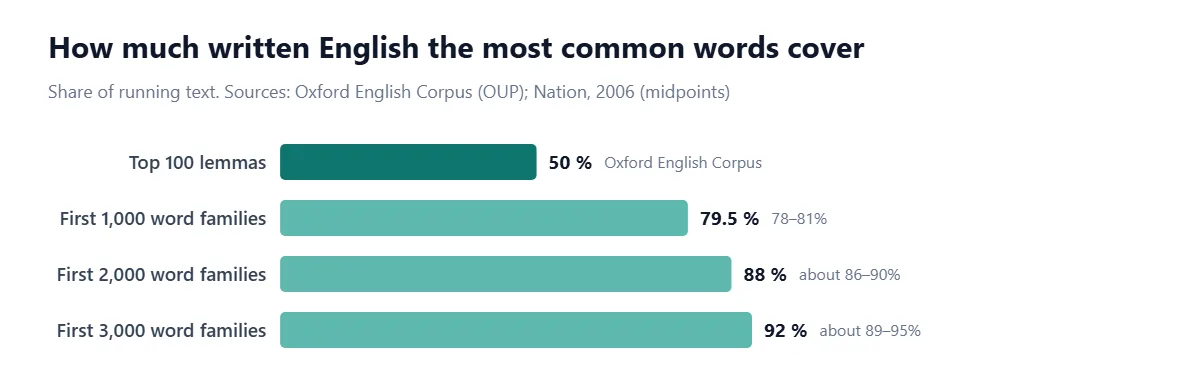
The word family figures come from applied linguist Paul Nation, who measured how much text each band of 1,000 word families covers. A word family groups a word with its forms and derivatives, so nation, national and nationally count once. The first 1,000 families cover about 78% to 81% of written text, the second 1,000 add roughly 8% to 9%, and the third 1,000 add 3% to 5% (Nation, 2006).
Here's the nuance most frequency articles miss: high coverage isn't the same as understanding. If you know 80% of the words on a page, one word in five is still a mystery, and those are usually the content words that carry the meaning. Nation's work suggests readers need about 98% coverage, or 8,000 to 9,000 word families, to read comfortably without help (Nation, 2006). We cover vocabulary size in more depth in how many words are in the English language.
Function words vs content words
Frequency lists are dominated by function words: articles, prepositions, pronouns, conjunctions and helper verbs. They hold a sentence together but carry little meaning of their own. Content words (nouns, main verbs, adjectives and most adverbs) carry the meaning, and there are vastly more of them, each used far less often.
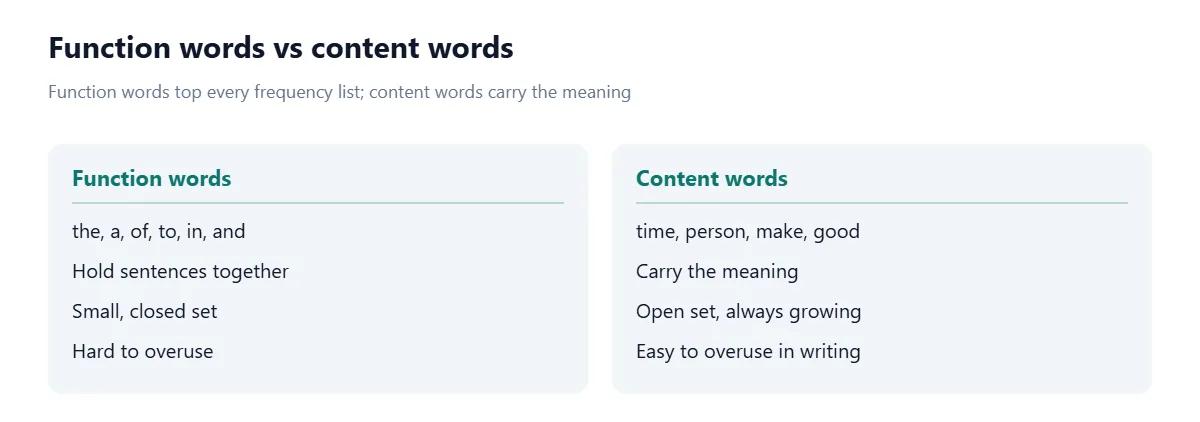
This split explains a practical point for writers. You can't use "the" too often; it's needed wherever it's needed. But if a content word such as "important", "really" or a key noun shows up again and again, readers notice. When you edit for repetition, ignore the function words and look at the content words.
Most common nouns, verbs and adjectives in English
Oxford also ranked the top words by part of speech. These are the top 10 in each group, in order:
Nouns: time, person, year, way, day, thing, man, world, life, hand
Verbs: be, have, do, say, get, make, go, know, take, see
Adjectives: good, new, first, last, long, great, little, own, other, old
Prepositions: to, of, in, for, on, with, at, by, from, up
The nouns tell a story of their own: time, people, years, days and life are what most English text is about. The verbs are almost all short, old, irregular words.
Why different lists give different rankings
If you compare the Oxford list with lists built from American English, TV subtitles or spoken conversation, the top 10 barely changes but the order below it shifts. Analyses of the older Brown Corpus give results "similar, but not identical" to Oxford's. Three things drive the differences:
What's being counted. Lemmas (be = am, is, was) produce different rankings from raw word forms.
The mix of text. Conversation, fiction, news and academic writing each favor different words, which is why serious frequency lists report results by genre.
When the text was written. A 1960s corpus and a 21st-century corpus can rank everyday nouns and verbs differently, even when the grammar words at the top stay put.
The Corpus of Contemporary American English (COCA), a billion-word corpus split across eight genres from blogs to academic journals, is the usual source for American frequency lists (WordFrequency.info). "The" is number one there too, but check genre-specific lists if you're teaching or studying a particular kind of English.
How to find the most common words in your own writing
Your own writing has a frequency list too, and it's more useful to you than Oxford's. Here's a quick way to check it:
Paste your draft into the Word Counter. Nothing you paste is uploaded.
Look at the list of words and phrases you repeat most.
Skip past the function words (the, and, to, of). They're supposed to be frequent.
Note any content word or phrase that appears far more than the others, especially within a few sentences of itself.
Swap some instances for a synonym, a pronoun, or cut them when the sentence works without them.
If you need a list of words in alphabetical order for study or a vocabulary sheet, the Alphabetize List tool will sort it and remove duplicates. And for practice with less common words, try the Random Word Generator.
Frequently asked questions
What is the most common word in English?
"The" is the most common word in English. In the Brown Corpus it makes up nearly 7% of all words, about twice as often as the second-place word, "of".
What are the 10 most common words in English?
According to the Oxford English Corpus, they are the, be, to, of, and, a, in, that, have and I. Nearly all are grammar words rather than words with a meaning of their own.
What is the most common noun in English?
"Time" is the most common noun in the Oxford English Corpus, followed by person, year, way and day.
What is the most common verb in English?
"Be" is the most common verb, counting all its forms such as is, are and was. It's followed by have, do, say and get.
How many words make up half of written English?
About 100. The 100 most common lemmas account for 50% of the words in the Oxford English Corpus, and in the Brown Corpus 135 words make up half of the text.
What is the most common adjective in English?
"Good" is the most common adjective in the Oxford English Corpus, followed by new, first, last and long.
How many common words do you need to know to understand English?
The first 1,000 word families cover about 78% to 81% of written text, but comfortable reading needs about 98% coverage, which takes 8,000 to 9,000 word families.
What is the difference between function words and content words?
Function words, such as the, of and and, hold sentences together and dominate frequency lists. Content words, such as nouns, verbs and adjectives, carry the meaning and are far more numerous.
Sources
Wikipedia. Most common words in English (Oxford English Corpus rankings, from Oxford University Press).
Wikipedia. Oxford English Corpus.
Wikipedia. Zipf's law (Brown Corpus frequencies).
Nation, I.S.P. How Large a Vocabulary Is Needed for Reading and Listening?. Canadian Modern Language Review, 63(1), 2006.
ERIC. How Large a Vocabulary Is Needed for Reading and Listening? (abstract). 2006.
Davies, M. WordFrequency.info (COCA frequency data).

Comments