
How many words are in the English language? Nobody knows the exact number, but the Oxford English Dictionary documents about 500,000 words, and a study of millions of digitized books estimated that English had just over 1 million words in use by 2000. A typical 20-year-old native speaker knows around 42,000 of them.
Those numbers are all correct, and they still disagree by a factor of two. That is not sloppy research. It comes down to one question the counters answer differently: what exactly is a word? Below you'll find what each major source counts, why the totals differ, how fast English grows, and how many words you need to read and speak comfortably.
How many words are in the English language?
The honest answer is a range. Merriam-Webster puts it plainly: English "includes roughly 1 million words," though "most linguists would take that estimate with a chunk of salt" (Merriam-Webster). The figures you can trust come from two kinds of sources: dictionaries, which list words editors have researched, and corpus studies, which count every distinct word that shows up in a huge body of text.
Dictionary counts: roughly 470,000 to 520,000. These are the words that made it through an editor's checks for real, widespread use.
Corpus counts: about 1 million. These include rare technical terms, brand-new coinages and words that no dictionary has recorded yet.
Personal vocabulary: roughly 27,000 to 52,000. That's the range of dictionary words most native-speaking 20-year-olds recognize.
If you need one number for a quiz or a school report, "about half a million words in the largest dictionaries" is the safest statement. "English has a million words" is defensible too, as long as you say it's an estimate of everything in use rather than a dictionary count.
How many words are in the dictionary? Counts by source
Here are the main reference counts, with what each one actually measures. Note the units: some count entries (headwords), some count meanings, and some count word forms, which is why you can't line them up as if they measured the same thing.
Source | Count | What it measures |
|---|---|---|
Google Books lexicon (2000) | About 1,022,000 | Distinct words in English books |
Oxford English Dictionary online | 520,779 entries | Entries as of January 2026 |
Oxford English Dictionary (publisher) | About 500,000 | Words documented |
Webster's Third New International | About 470,000 | Entries, incl. 1993 addenda |
Webster's Third, single words only | About 348,000 | One-word forms |
OED 2nd edition (1989, print) | 290,500 | Entries in 20 volumes |
American Heritage Dictionary, 4th ed. | 116,161 | Entries |
Sources: Oxford University Press describes the OED as "documenting 500,000 words" (OUP). The exact January 2026 entry count, plus 888,251 meanings, is reported in the Oxford English Dictionary article on Wikipedia, which also gives the 1989 print figure. Merriam-Webster gives the Webster's Third figure. The single-word and American Heritage figures come from the Google Books study described below (Michel et al., 2011).
One detail most roundups miss: the OED is still growing mid-revision. Its third edition began in 2000, is expected to finish in 2037, and is "expected roughly to double the dictionary in size". The online entry count has already risen by about 79% since the 1989 print edition. So any OED figure you quote needs a date next to it.
Why there's no exact count of English words
Counting words sounds like a job for a computer. The trouble is deciding what to count. Merriam-Webster lists the main snags in its FAQ, and every one of them changes the total.
Inflected forms
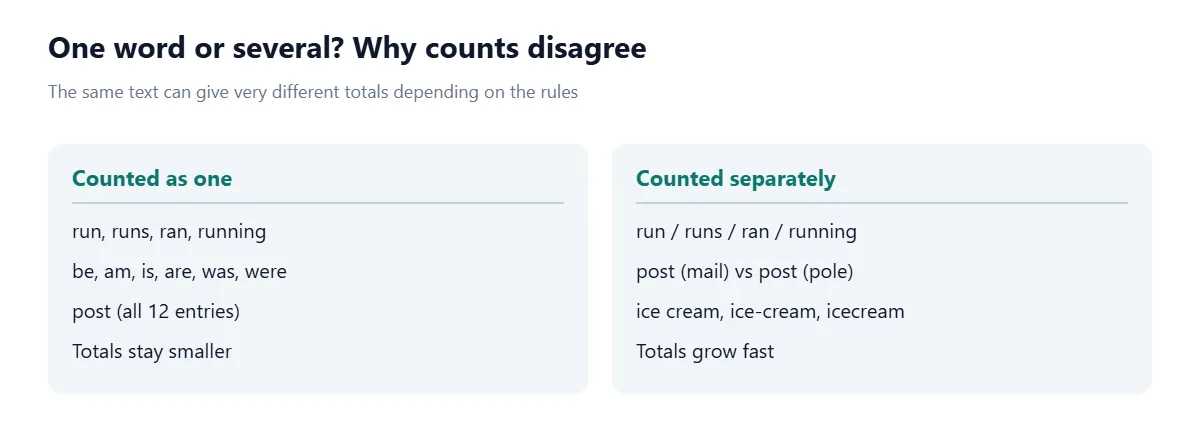
Are drive, drives and drove one word or three? Dictionaries usually treat them as one entry. Language researchers call that bundle a lemma. Counting every form separately would multiply the total several times over, especially for verbs like be, which has eight forms.
Words with more than one meaning
Merriam-Webster notes it has twelve different entries for post: the post that delivers mail, the post you hammer into the ground, a job post and so on. Is that one word or twelve? Different counts give different answers.
Compounds, names and jargon
Is ice cream one word? What about a chemical name, a brand name, a place name or a slang term used by one online community? Specialist fields such as medicine and chemistry have huge vocabularies of their own, and most of those terms never reach a general dictionary.
The language never stops moving
New words arrive every month and old ones fall out of use. A historical dictionary like the OED keeps words that fell out of use centuries ago, while a learner's dictionary sticks to current English. A count is only ever a snapshot.
Does English have a million words?
Possibly, depending on the rules. The strongest evidence comes from a 2011 study in Science that analyzed millions of digitized books through Google Books. The researchers counted distinct words that appeared at least once per billion words and estimated "the number of words in the English lexicon as 544,000 in 1900, 597,000 in 1950, and 1,022,000 in 2000" (Michel et al., 2011).
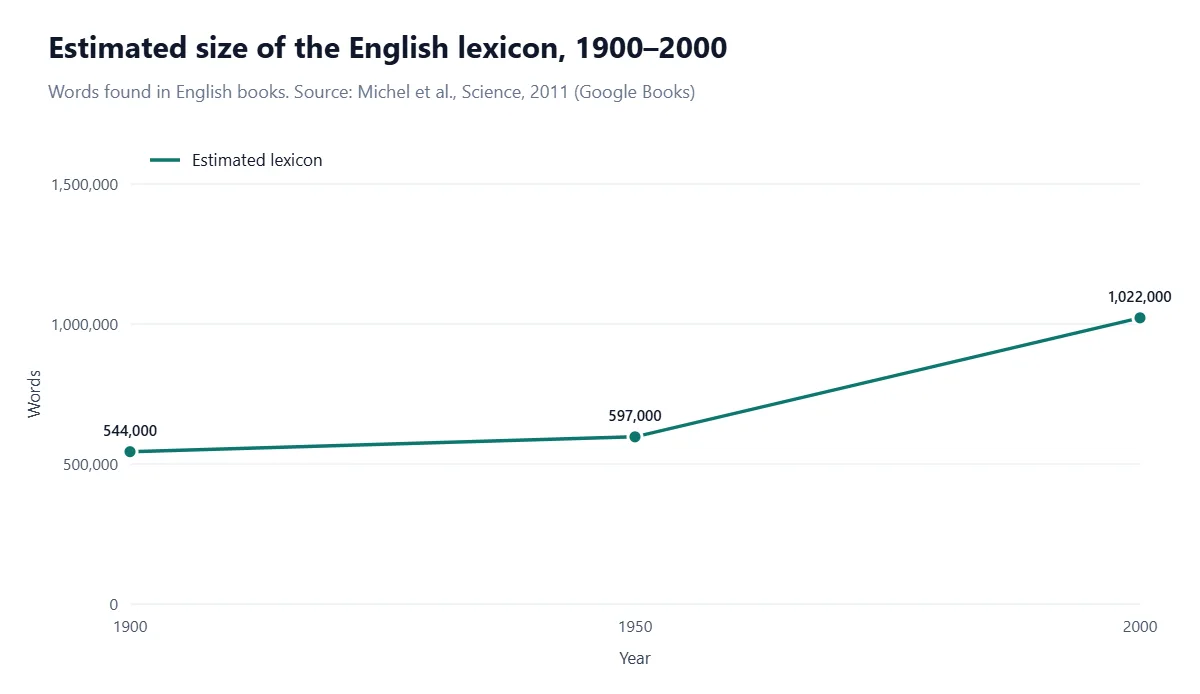
They also found that 52% of those words, about 531,000, were "lexical dark matter" missing from standard dictionaries. Whatever you think of the exact figure, it shows how much English exists outside the reference books.
Why you should be careful with the million-word claim
You may also see the Global Language Monitor, a media analytics company, credited with counting English's millionth word. In June 2009 it announced that the millionth word was "Web 2.0" and claimed a new word appeared roughly every 98 minutes (Christian Science Monitor). Linguists were not impressed. The method was secret, and the winning "word" was arguably a phrase. Geoffrey Pullum picked the announcement apart on Language Log, and linguist Dennis Baron had already questioned the company's secret formula (Baron, 2008). Treat any single exact figure for "all of English" as a publicity number, not a measurement.
How many new words are added to English each year?
The Google Books study estimated that English gained roughly 8,500 words a year in the second half of the 20th century, growing the lexicon by more than 70% in 50 years. That works out to about 23 new words a day across all of published English.
Dictionaries move more slowly because they wait for evidence that a word has stuck. The OED adds words in regular updates; its latest one, as of September 2026, added more than 500 new words, phrases and senses (OED). Not every coinage survives. Many new words fade within a few years, which is exactly why editors wait.
How many words does the average person know?
Far fewer than the dictionary holds. In one of the largest vocabulary studies ever run, Marc Brysbaert and colleagues tested 221,268 people online against a list of 61,800 English lemmas. The median 20-year-old native speaker of American English knew about 42,000 lemmas, with most people falling between 27,000 and 52,000. By age 60 the median rose to about 48,200, which is roughly one new word every two days of adult life (Brysbaert et al., 2016).
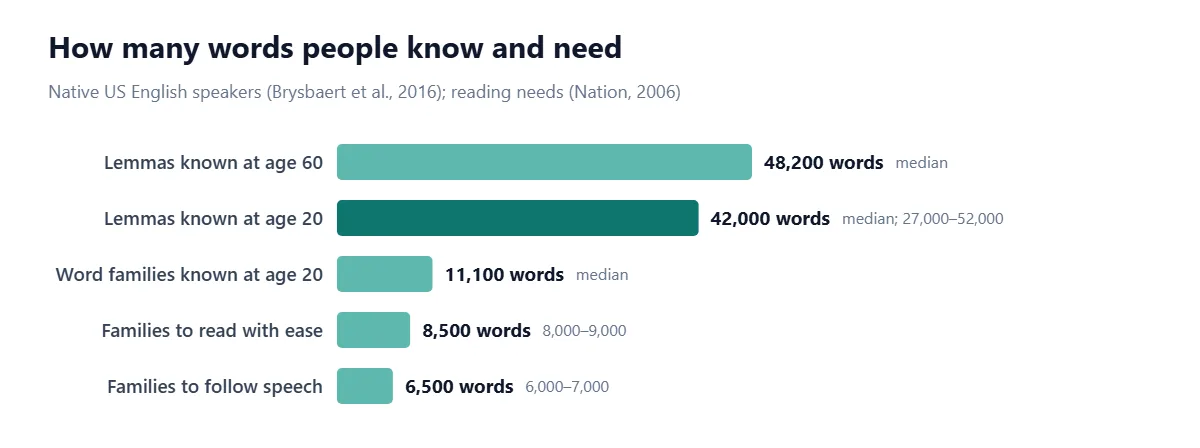
Two caveats make these numbers easier to read. First, "knowing" here means recognizing the word as real, which can be shallow. The number of words you actually use when you write or speak is smaller. Second, when related forms are grouped into word families (nation, national, nationally, nationalize), the same 42,000 lemmas shrink to about 11,100 families.
Put those together and a typical adult recognizes around 8% of the OED's entries. That's not a failing. Most of the dictionary is rare, technical or historical vocabulary that almost nobody needs.
How many English words do you need to be fluent?
For English learners this is the number that matters. Applied linguist Paul Nation estimated that if you need to know 98% of the words in a text to understand it without help, you need "a 8,000 to 9,000 word-family vocabulary" for written text and 6,000 to 7,000 word families for spoken English (Nation, 2006).
That target is lower than it looks because the most frequent words do most of the work. In Nation's figures, the first 1,000 word families alone cover roughly 78% to 81% of written text. We look at that effect in detail in our guide to the most common words in English.
Everyday conversation: start with the most frequent 2,000 to 3,000 word families.
Following films, podcasts and talk: aim for 6,000 to 7,000 families.
Reading novels and newspapers comfortably: aim for 8,000 to 9,000 families.
Common mistakes when quoting word counts
Treating entries and words as the same thing. An OED entry can hold many senses and forms. "520,779 entries" and "888,251 meanings" describe the same dictionary.
Using an old OED figure without a date. The dictionary is mid-revision and grows every few months, so a number from 1989 or even 2020 is out of date.
Citing the million-word milestone as fact. The Google Books estimate is a careful research figure; the 2009 millionth-word announcement is not.
Comparing languages by dictionary size. Dictionaries follow different rules for compounds and inflections, so a bigger dictionary doesn't prove a bigger language.
If you're counting words in your own text rather than in the whole language, the rules are simpler: most word counters split on spaces, so ice cream counts as two words and ice-cream as one. Our guide to how to check word count covers those quirks, and the Random Word Generator is a fun way to meet some of the English words you don't know yet.
Frequently asked questions
How many words are in the English language?
No one knows exactly, but the Oxford English Dictionary documents about 500,000 words and a Google Books study estimated just over 1 million words in use by 2000. The total depends on whether you count inflected forms, compounds and technical terms.
How many words are in the Oxford English Dictionary?
The OED documents about 500,000 words. Its online edition held 520,779 entries and 888,251 meanings as of January 2026, and it keeps growing with regular updates.
How many words are in the Merriam-Webster dictionary?
Merriam-Webster's largest dictionary, Webster's Third New International Dictionary, Unabridged, has about 470,000 entries including its 1993 addenda.
How many words does the average person know?
A typical 20-year-old native speaker of American English knows about 42,000 dictionary words (lemmas), with most people between 27,000 and 52,000. The figure rises to about 48,000 by age 60.
How many words do you need to be fluent in English?
About 8,000 to 9,000 word families to read unassisted and 6,000 to 7,000 to follow spoken English, according to Paul Nation's research. Everyday conversation needs far fewer.
Does English have more words than other languages?
There's no reliable way to say. Dictionaries in different languages count compounds, inflections and borrowed words differently, so their totals can't be compared fairly.
How many new words are added to English each year?
A Google Books study estimated about 8,500 new words a year in the late 20th century. Dictionaries add fewer, since they wait for evidence that a word is in lasting use.
What was the millionth word in English?
The Global Language Monitor claimed in 2009 that "Web 2.0" was English's millionth word, but linguists rejected the claim because the method was secret and the term is a phrase.
Sources
Merriam-Webster. How many words are there in English?. Merriam-Webster.
Oxford University Press. Oxford English Dictionary. Oxford Languages.
Wikipedia. Oxford English Dictionary (entry and meaning counts, January 2026; second edition figures).
Oxford English Dictionary. OED home page (latest update note). Oxford University Press, 2026.
Michel, J.-B. et al. Quantitative Analysis of Culture Using Millions of Digitized Books. Science, 331, 2011.
Brysbaert, M., Stevens, M., Mandera, P. and Keuleers, E. How Many Words Do We Know?. Frontiers in Psychology, 7, 2016.
Nation, I.S.P. How Large a Vocabulary Is Needed for Reading and Listening?. Canadian Modern Language Review, 63(1), 2006.
Christian Science Monitor. English language gets its one millionth word, website says. 2009.
Pullum, G.K. Millionth word story botched. Language Log, 2009.
Baron, D. A million English words, or only 600,000?. University of Illinois, 2008.

Comments