
The average typing speed is about 52 words per minute on a computer keyboard, based on a study of 168,000 volunteers. On a smartphone the average drops to about 36 words per minute, and most people fall somewhere between 30 and 70 wpm on a keyboard.
You may have seen 40 wpm quoted as the average. That figure is older and still shows up as a job requirement, but the best recent data puts ordinary computer users higher. Below you'll find where the numbers come from, how "words per minute" is actually calculated, what speed employers ask for, and what separates fast typists from slow ones.
What is the average typing speed?
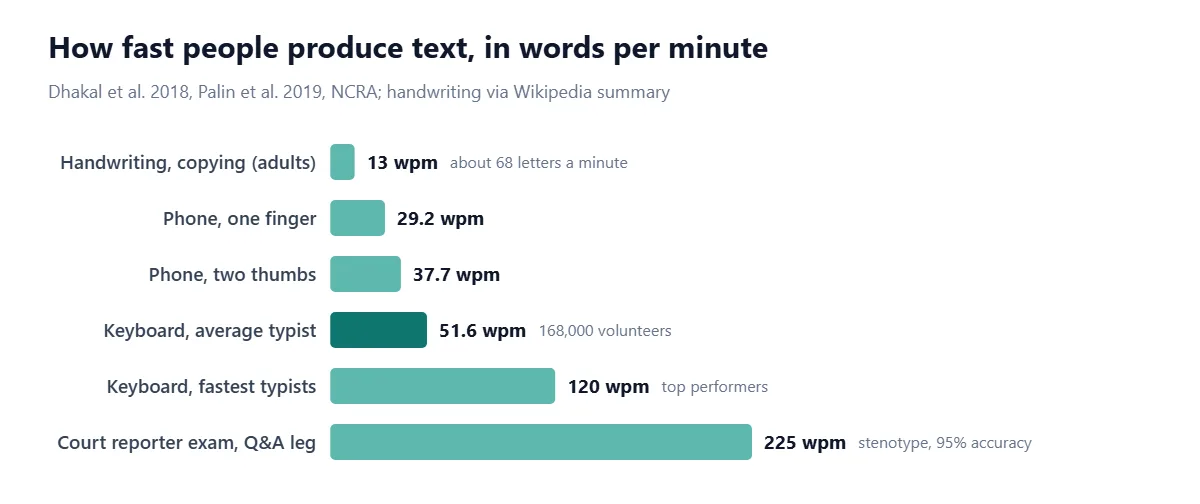
The largest study of everyday typing was run by researchers at Aalto University and the University of Cambridge. They collected 136 million keystrokes from 168,000 volunteers who took an online typing test, and found an average speed of 51.56 wpm, with a standard deviation of about 20 wpm (Dhakal et al., 2018). The fastest participants typed at 120 wpm or more, while the slowest were around 26 wpm.
That spread matters more than the average. A standard deviation of 20 wpm means it's completely normal to type in the 30s, and equally normal to type in the 70s. If you're at 45 wpm, you're not slow. You're in the middle of the pack.
One caution: the volunteers chose to take a typing test, and people who do that are probably more comfortable at a keyboard than the population as a whole. So treat 52 wpm as the average for people who type regularly, not for everyone.
Average typing speed on a phone
The same research group ran a follow-up study on mobile devices with 37,370 volunteers. The average was 36.2 wpm, with 2.3% of errors left uncorrected, and the fastest typists passed 80 wpm (Palin et al., 2019). Measured the same way, phone typing was about 15 wpm slower than typing on a physical keyboard.
Two thumbs beat one finger: 37.7 wpm against 29.2 wpm.
Autocorrect helps, word prediction doesn't: people who used autocorrect averaged 43.4 wpm, while those who leaned on suggested words were slowest, at about 32.8 wpm. Tapping a suggestion means looking up from the keys, which costs more time than it saves.
Age makes a big difference on phones: volunteers aged 10 to 19 averaged 39.6 wpm, and those aged 50 to 59 averaged 26.3 wpm.
Speaking into your phone is faster still. A Stanford study found that speech recognition let people enter English text about three times faster than a smartphone keyboard, with fewer errors (Ruan et al., 2016). If you write long messages on the go, dictating a first draft and tidying it with your thumbs is often quicker than typing the whole thing.
How is typing speed (wpm) calculated?
Typing tests don't count words the way a word counter does. By convention, one "word" is any five characters, including spaces and punctuation. The Aalto study used exactly this definition: the length of the typed text in five-character units, divided by the minutes between the first and last keypress.
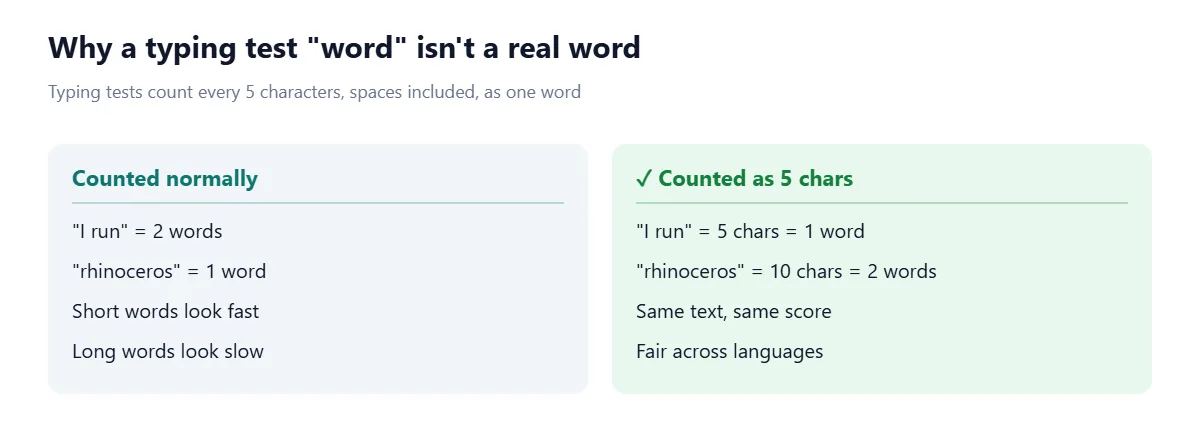
The rule exists so that scores are comparable. Typing "the cat sat" feels faster than typing "characteristically", but the number of keys pressed is what takes the time. Counting characters rather than words puts every test passage on the same scale.
Tests also differ in how they treat mistakes. Some report a raw (gross) speed and an accuracy percentage side by side. Others knock points off for every uncorrected error and report a net speed. If a job application asks for a certificate, check which kind it wants, because a fast but sloppy typist can score very differently on the two.
What is a good typing speed?
Using the study's average and spread as a guide, here's how keyboard speeds roughly compare:
Speed (keyboard) | How it compares | What it feels like |
|---|---|---|
Under 30 wpm | Well below average | Looking at the keys often |
30–45 wpm | Slightly below average | Fine for email and chat |
45–60 wpm | Average | Keeps up with most office work |
60–80 wpm | Above average | Typing rarely slows you down |
80–100 wpm | Fast | Close to the speed of thought |
100–120 wpm | Very fast | Competitive typists |
120+ wpm | Top performers | The fastest in the study |
Accuracy counts as much as speed. In the Aalto data the average participant left about 1.2% of errors uncorrected. A typist at 70 wpm who has to go back and fix every other line may finish a document later than a steady typist at 55 wpm.
Typing speed requirements by job
Most jobs don't test typing at all, but some do. When they do, the bar is usually lower than people expect:
Job or test | Typical requirement | Source |
|---|---|---|
California state jobs needing typing | 40 wpm on a 5-minute proctored test | |
Data entry (number pad) | Often 8,000–10,000 keystrokes per hour | |
Court reporter (NCRA RPR) | 180, 200 and 225 wpm legs at 95% accuracy | |
Professional typists, 1970s–80s | 60–90 wpm |
Court reporters are a special case. They don't use a normal keyboard: they write on a stenotype machine that enters whole syllables or words in a single stroke, which is how the Registered Professional Reporter exam can ask for 225 wpm of spoken testimony. Nobody reaches that on a standard QWERTY keyboard for long.
For everything else, 40 wpm is the number to beat. If you're preparing for a test, practice on the format they'll use (a five-minute test is harder to keep steady than a one-minute one) and aim for a comfortable margin above the minimum.
Typing speed vs handwriting and speaking
Typing is fast compared with a pen. Adults copying text by hand average about 68 letters a minute, or roughly 13 wpm, according to an occupational therapy study cited in Wikipedia's words per minute article. Even a slow typist beats that by a wide margin.
Speaking is faster than both. The Word Counter estimates speaking time at 130 wpm, a comfortable pace for a prepared talk, and it's easy to hit that without effort. (For how that turns into speech lengths, see how many words is a 5-minute speech.) Reading is quicker again: adults read non-fiction silently at about 238 wpm on average (Brysbaert, 2019), which is why reading 1,000 words takes only about four minutes.
Copying speed isn't writing speed
This is the part that typing tests leave out. A test measures how fast you copy text you can see. When you write your own words, you stop to think, reread and rephrase, and your real output falls sharply.
A 1999 study by Karat and colleagues, summarized in the same Wikipedia article, found that participants averaged 32.5 wpm when transcribing text but only 19.0 wpm when composing their own. That's a drop of more than 40%. So if you're estimating how long a report will take, don't divide the word count by your test score. Divide by something closer to half of it, and add time for editing.
Task | At 40 wpm (copying) | At 52 wpm (copying) | At 20 wpm (composing) |
|---|---|---|---|
280-character post (56 test words) | 1.4 minutes | 1.1 minutes | 2.8 minutes |
300-word email | 7.5 minutes | 5.8 minutes | 15 minutes |
1,000-word article | 25 minutes | 19 minutes | 50 minutes |
2,500-word report | 63 minutes | 48 minutes | 2 hours 5 minutes |
How to test your typing speed
Online typing tests work fine, but you can also measure yourself with tools you already have. Typing from a printed page is a truer test than most websites, because you aren't reading and typing in the same window.
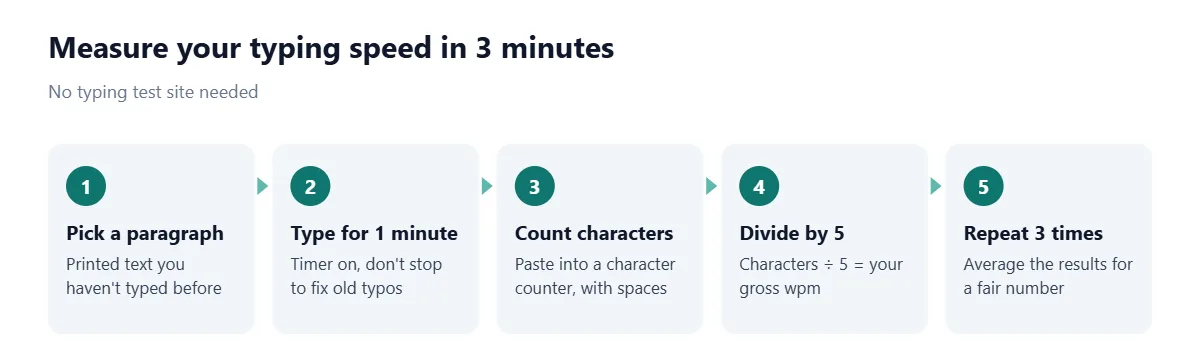
For the counting step, paste your text into the Character Counter and use the "with spaces" figure. If you typed 260 characters in one minute, that's 260 ÷ 5 = 52 wpm. Want fresh practice text that you can't memorize? The Random Word Generator will give you a new list every time.
How to type faster
The Aalto team looked at what the fastest typists actually do, and some of the answers are surprising.
Make fewer mistakes first. Fast typists made fewer errors of every kind. Backspacing is the single biggest drain on speed, so slow down until you're accurate, then build up.
Learn rollover. The strongest predictor of speed was rollover: pressing the next key before releasing the last one. The fastest typists did it on 40 to 70% of keypresses, while slow typists hardly did it at all.
Stop looking at your hands. Keeping your eyes on the screen lets you catch errors early instead of at the end of a line.
Don't obsess over ten fingers. Fast typists used more fingers on average (8.4 against 5.3), but self-taught typists using fewer fingers reached speeds comparable to trained touch typists. A consistent technique matters more than a textbook one.
Practice real text, little and often. Short daily sessions on sentences, not random letter drills, build the common letter patterns your fingers need.
On a phone, use two thumbs and autocorrect. Skip the suggestion bar unless the word is long.
Common myths about typing speed
"The average is 40 wpm." It's a reasonable job threshold, but the largest recent study measured an average of about 52 wpm among regular computer users.
"You must touch type to be fast." Plenty of fast typists use fewer than ten fingers. What they share is accuracy and rollover.
"A higher score means you'll write faster." Test scores measure copying. Composing your own text runs at roughly half that speed for most people.
"Phone typing will catch up." Not yet: in the studies above measured the same way, it was about 15 wpm slower than a physical keyboard.
If you want to see how much you've written in a session, paste the draft into the Word Counter. It shows words, characters, and reading and speaking time, and your text never leaves your browser.
Frequently asked questions
What is the average typing speed?
About 52 words per minute on a computer keyboard, based on a 2018 study of 168,000 volunteers. On a smartphone the average is about 36 words per minute.
Is 40 wpm a good typing speed?
40 wpm is slightly below the average of about 52 wpm, but it meets the minimum that many office and government jobs ask for, such as California state positions that require typing.
What is a good typing speed for a job?
Most jobs that test typing ask for 40 wpm or more, with good accuracy. Around 60 to 80 wpm is considered fast, and specialist roles like court reporting use stenotype machines at 180 to 225 wpm.
How is words per minute calculated in typing tests?
Typing tests treat every five characters, including spaces and punctuation, as one word. Divide the characters typed by five, then divide by the minutes taken.
What is the average typing speed on a phone?
About 36 wpm, according to a 2019 study of more than 37,000 volunteers. Two-thumb typists averaged 37.7 wpm and one-finger typists 29.2 wpm.
How fast do the fastest typists type?
The fastest participants in the 168,000-person study typed at 120 wpm or more. Most of them used rollover, pressing the next key before releasing the previous one.
Does touch typing make you faster?
Usually, but it isn't required. Fast typists used more fingers on average, yet self-taught typists using fewer fingers reached speeds comparable to touch typists.
How fast is typing compared with handwriting?
Typing is roughly four times faster. Adults copy by hand at about 13 wpm, compared with about 52 wpm on a keyboard.
What is the average WPM?
The average typing speed is about 52 words per minute (wpm) on a computer keyboard, based on a study of 168,000 volunteers, and about 36 wpm on a smartphone.
How many words per minute is good typing?
Anything above the 52 wpm average is good, and 60 to 80 words per minute counts as fast. Around 40 wpm is a common minimum for office jobs.
Sources
Dhakal, V., Feit, A. M., Kristensson, P. O. and Oulasvirta, A. Observations on Typing from 136 Million Keystrokes. CHI 2018.
University of Cambridge. What makes a faster typist?. 2018.
Palin, K., Feit, A. M., Kim, S., Kristensson, P. O. and Oulasvirta, A. How do People Type on Mobile Devices? Observations from a Study with 37,000 Volunteers. MobileHCI 2019.
Ruan, S., Wobbrock, J. O., Liou, K., Ng, A. and Landay, J. Speech Is 3x Faster than Typing for English and Mandarin Text Entry on Mobile Devices. arXiv, 2016.
National Court Reporters Association. Registered Professional Reporter.
CalCareers. Typing certification requirements. State of California.
Words per minute. Wikipedia (five-character word, handwriting speed, Karat et al. 1999, keystrokes per hour).
Brysbaert, M. How many words do we read per minute? A review and meta-analysis of reading rate. Journal of Memory and Language, 2019.

Comments