
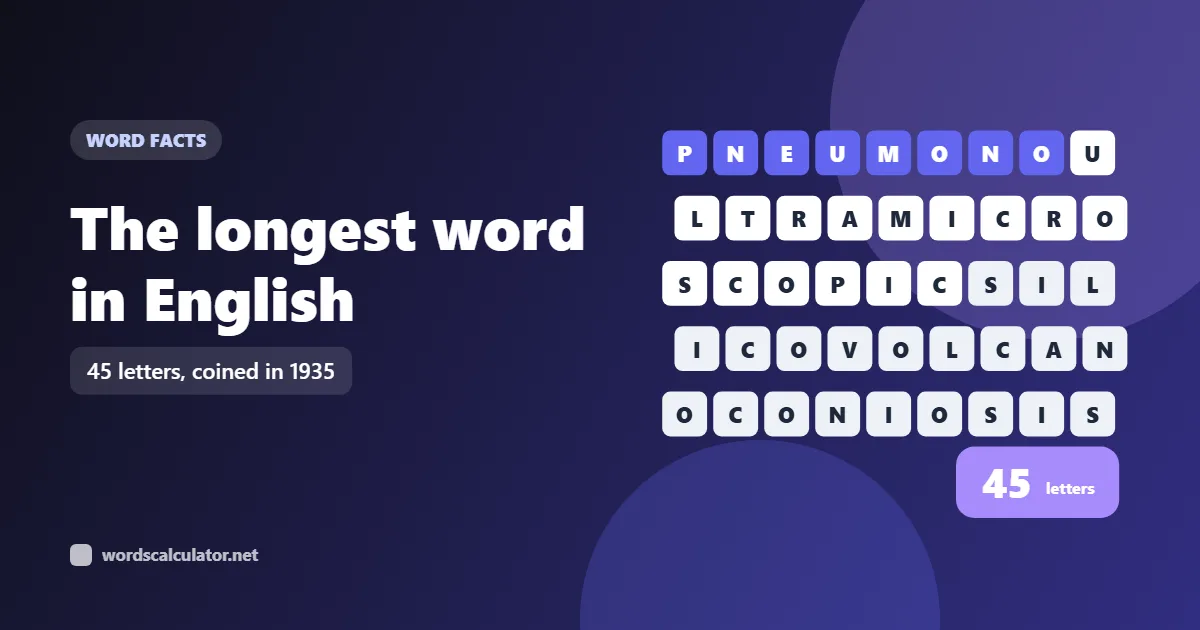
The longest word in English found in major dictionaries is pneumonoultramicroscopicsilicovolcanoconiosis, at 45 letters. It names a lung disease caused by breathing in very fine silica dust, and it was invented in 1935 precisely to be the longest word.
"Longest word" turns out to be a slippery title. It depends on whether you accept made-up words, technical terms, chemical names or place names, and different dictionaries draw those lines in different places. This guide ranks the contenders, shows exactly how many letters each one has, and explains which claims hold up.
What is the longest word in English?
Pneumonoultramicroscopicsilicovolcanoconiosis is the answer you'll find in dictionaries. Britannica calls it the longest word in major English dictionaries (Britannica Dictionary), and Merriam-Webster says it is "entered in most standard English dictionaries" (Merriam-Webster). Merriam-Webster defines it as "a pneumoconiosis caused by inhalation of very fine silicate or quartz dust" (Merriam-Webster dictionary).
Here's the twist most lists leave out: the word was a stunt. Everett M. Smith, then president of the National Puzzlers' League, coined it in 1935, and it first appeared in print in the New York Herald Tribune that February (Wikipedia). Dictionary.com describes it as a made-up word without real medical use (Dictionary.com). The ordinary medical term for lung disease caused by silica dust is silicosis. The long version survives because people kept writing about it as the longest word, which is exactly the kind of repeated use that earns a dictionary entry.
How to spell and say pneumonoultramicroscopicsilicovolcanoconiosis
The word looks impossible until you split it into its Greek and Latin parts. Each piece carries a bit of the meaning, and together they read almost like a sentence: lung, very small, silica, volcano, dust disease.
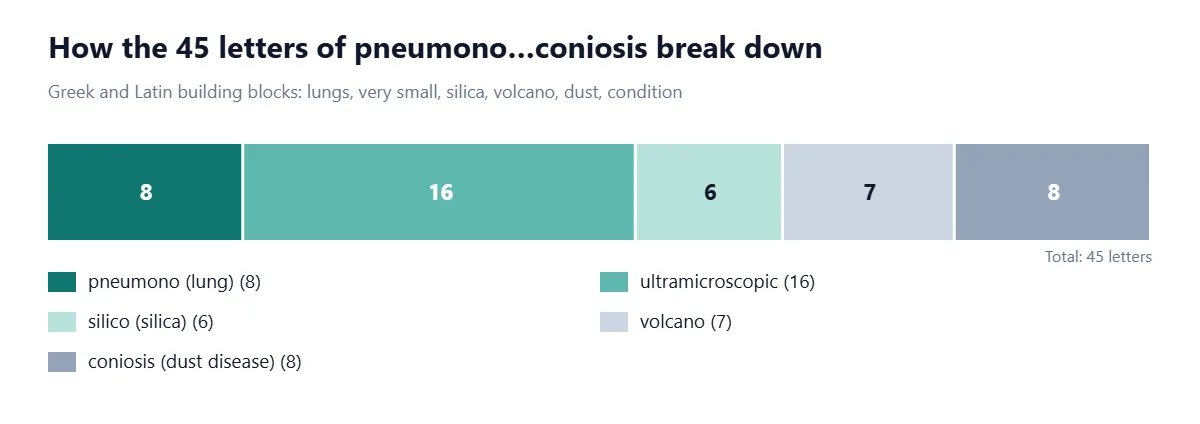
pneumono (8 letters): lung, as in pneumonia.
ultramicroscopic (16): too small to see even with an ordinary microscope.
silico (6): silica, the mineral in sand and quartz.
volcano (7): the dust in question was described as fine volcanic ash.
coniosis (8): a disease caused by dust.
Spelling tip: write it as five chunks first (pneumono · ultramicroscopic · silico · volcano · coniosis), then join them. It's easy to drop the o after pneumon or the o in silico, and a quick letter count will catch either slip: if you don't get 45, something is missing.
The longest words in English, ranked
We counted every word below with a script, letters only. That matters, because many websites quote slightly different totals, usually because someone counted by hand.
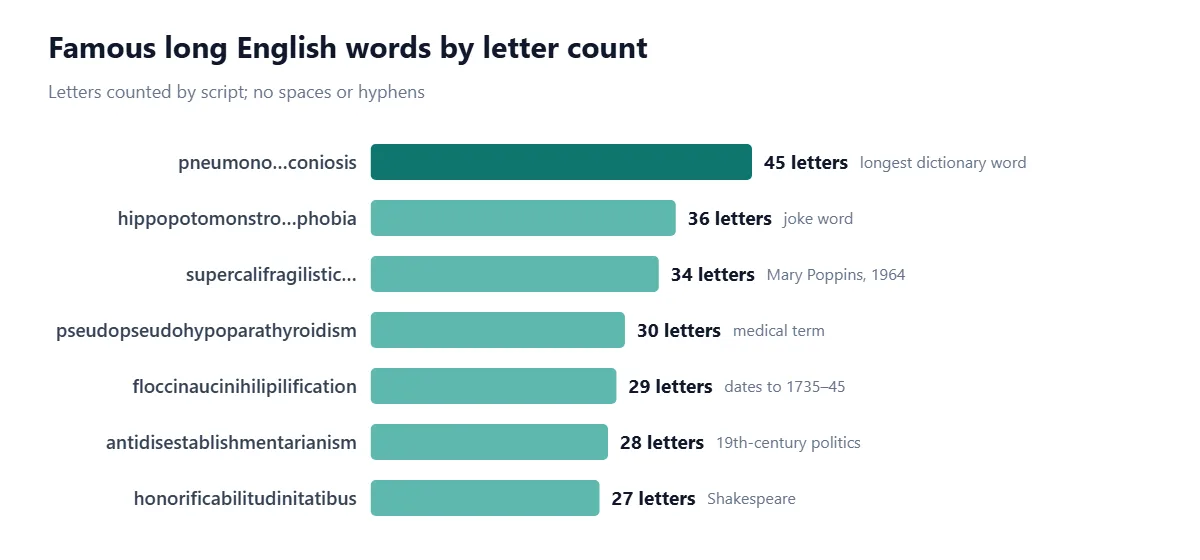
The table shows what each one means and whether two popular online dictionaries list it, as of September 2026. The difference between them is the whole story of the "longest word" debate.
Word | Meaning | Merriam-Webster.com | Dictionary.com |
|---|---|---|---|
pneumonoultramicroscopicsilicovolcanoconiosis | Lung disease from fine silica dust | Yes | Yes |
supercalifragilisticexpialidocious | Fantastic (a nonsense word) | No | Yes |
pseudopseudohypoparathyroidism | A rare inherited endocrine disorder | Yes | Not checked |
floccinaucinihilipilification | Judging something worthless | No | Yes |
antidisestablishmentarianism | Opposing disestablishment of a state church | No | Yes |
hippopotomonstrosesquippedaliophobia | Joke term for fear of long words | No | No |
Supercalifragilisticexpialidocious (34 letters)
The Sherman Brothers made it famous in the 1964 Disney film Mary Poppins. Dictionary.com lists it as a nonsense word meaning "fabulous" (Dictionary.com). Merriam-Webster leaves it out, saying some long words are "rarely or never used in a sentence, but instead are simply used as examples of long words".
Floccinaucinihilipilification (29 letters)
This one is old: Dictionary.com dates it to 1735–45 and traces it to four Latin words that all mean "of little or no value" (Dictionary.com). The same entry notes that Jacob Rees-Mogg used it in the House of Commons in 2012, making it the longest word in Hansard at the time.
Antidisestablishmentarianism (28 letters)
The classic playground answer. It means opposition to withdrawing state support from an established church, especially the Church of England in the 1800s (Dictionary.com). It's often called the longest word that wasn't invented just to be long. Merriam-Webster still doesn't list it.
Hippopotomonstrosesquippedaliophobia (36 letters)
Supposedly the fear of long words, which is the whole joke. You'll see it on a lot of "longest words" lists, but it isn't a medical term, and Dictionary.com says plainly that it "is not in our dictionary (yet)" (Dictionary.com). Merriam-Webster uses it only as a wink in its long-words article.
Pseudopseudohypoparathyroidism (30 letters)
A genuine medical condition that resembles pseudohypoparathyroidism but with normal blood calcium levels (Merriam-Webster). Merriam-Webster notes it is the only word in its dictionary with a repeating pseudo. If you want the longest word that doctors actually use, this is a strong candidate.
Why the titin chemical name isn't the longest word
You may have seen claims that the longest word in English has 189,819 letters and takes hours to say. That's the full chemical name of titin, a giant muscle protein. Written out amino acid by amino acid, starting with methionyl and ending with isoleucine, it does contain 189,819 letters (Wikipedia: Titin).
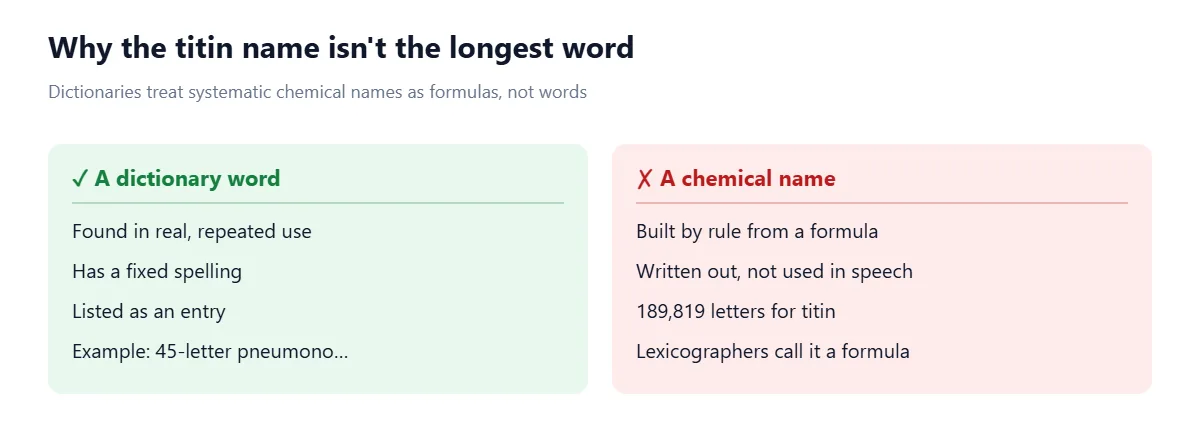
The catch is that "lexicographers regard formal names of chemical compounds as verbal formulae rather than English words." The name isn't used in speech or writing; it's generated by rule from the protein's structure, and a different protein gives a different name. The human form of titin has 34,350 amino acids, so even reading two amino acid names a second would take almost 4 hours 46 minutes. By the same logic, you could build an endless "word" by writing out any long number, which is why dictionaries don't play along.
What about the longest place names?
Place names are proper nouns, so they don't compete with dictionary words, but they are longer. Merriam-Webster points to a New Zealand hill, Taumatawhakatangihangakoauauotamateaturipukakapikimaungahoronukupokaiwhenuakitanatahu, which our script counts at 85 letters. A lake in Massachusetts, Lake Chargoggagoggmanchauggauggagoggchaubunagungamaugg, has 49 letters in the main name and 53 with Lake.
That lake is a neat example of letters versus characters. Count the space in "Lake Chargogg…" and you get 54 characters, not 53. Character limits on social media, forms and SEO titles always include spaces, so if you're checking a long name against a limit, use the Character Counter rather than counting letters by hand.
The longest word without repeating a letter
Words that use each letter only once are called isograms (or heterograms). The two best-known long examples each have 15 letters, and both are real dictionary entries:
uncopyrightable (15): not able to be protected by copyright (Merriam-Webster).
dermatoglyphics (15): skin patterns, such as those on fingertips, or the study of them (Merriam-Webster).
subdermatoglyphic (17): a longer isogram reported from a medical paper, but it rarely appears in dictionaries (Wikipedia: Isogram).
The longest one-syllable words
At the other extreme are words that pack lots of letters into a single beat. Strengths is the classic answer: nine letters, one syllable, and only one vowel. Merriam-Webster's pronunciations for strength all have a single syllable (Merriam-Webster). Stretched and scratched also have nine letters and one syllable. Some dictionaries allow squirrelled (11 letters) to be said as one syllable, which is why it sometimes tops these lists (Wikipedia).
What is the longest word in Shakespeare?
Honorificabilitudinitatibus, at 27 letters. Costard says it in Love's Labour's Lost (Act 5, Scene 1) while teasing two pompous characters. It comes from a medieval Latin word meaning roughly "the state of being able to achieve honours," and it is also the longest English word that strictly alternates consonants and vowels (Wikipedia).
Common mistakes when quoting the longest word
Calling antidisestablishmentarianism the longest word. It's famous, but at 28 letters it's well short of the 45-letter record.
Counting hyphens and spaces as letters. Letter counts and character counts differ once a name has spaces, as with Lake Chargogg… above.
Treating titin as a word. It's a chemical formula in letters, and dictionaries don't list it.
Assuming every dictionary agrees. Merriam-Webster leaves out supercalifragilisticexpialidocious and antidisestablishmentarianism; Dictionary.com includes both. Say which dictionary you mean.
Want to check a letter count yourself? Paste the word into the Character Counter: it shows characters with and without spaces, so you can see letters and total characters side by side. For words in a longer piece of writing, the Word Counter gives you words, characters and reading time in one go. If you're after unusual words for a game, try the Random Word Generator, or read about how many words are in the English language.
Frequently asked questions
What is the longest word in the English dictionary?
Pneumonoultramicroscopicsilicovolcanoconiosis, with 45 letters, is the longest word in major English dictionaries. It refers to a lung disease caused by inhaling very fine silica dust.
How many letters are in supercalifragilisticexpialidocious?
Supercalifragilisticexpialidocious has 34 letters. It was made famous by the 1964 film Mary Poppins and appears in some dictionaries but not in Merriam-Webster.
How many letters are in antidisestablishmentarianism?
Antidisestablishmentarianism has 28 letters. It means opposition to withdrawing state support from an established church, especially the Church of England.
What is the 189,819-letter word?
It's the full chemical name of the protein titin, written out amino acid by amino acid. Lexicographers treat chemical names like this as formulas, not words, so it isn't counted as the longest word.
Is pneumonoultramicroscopicsilicovolcanoconiosis a real disease?
Not as a medical diagnosis. The word was coined in 1935 by Everett M. Smith of the National Puzzlers' League to be the longest word, and doctors use the term silicosis instead.
What is the longest word with no repeated letters?
Uncopyrightable and dermatoglyphics, with 15 letters each, are the longest common dictionary words that don't repeat a letter. Subdermatoglyphic has 17 but is rarely listed.
What is the longest one-syllable word in English?
Strengths, with nine letters and one syllable, is the usual answer. Some dictionaries allow squirrelled, with 11 letters, to be pronounced as one syllable.
What is the longest word in Shakespeare?
Honorificabilitudinitatibus, with 27 letters, spoken by Costard in Love's Labour's Lost, Act 5, Scene 1.
What is the longest word in the world?
The longest word ever written out is the full chemical name of the protein titin, at 189,819 letters, but it's a formula rather than a dictionary word. The longest word in major English dictionaries is pneumonoultramicroscopicsilicovolcanoconiosis, at 45 letters.
Sources
Merriam-Webster. The Longest Long Words List. Merriam-Webster.
Merriam-Webster. Pneumonoultramicroscopicsilicovolcanoconiosis, Pseudopseudohypoparathyroidism, Uncopyrightable, Dermatoglyphics and Strength entries. Merriam-Webster.
Britannica Dictionary. The Longest Word in the Dictionary. Encyclopaedia Britannica.
Dictionary.com. Pneumonoultramicroscopicsilicovolcanoconiosis, Supercalifragilisticexpialidocious, Floccinaucinihilipilification and Antidisestablishmentarianism entries. Dictionary.com.
Wikipedia. Pneumonoultramicroscopicsilicovolcanoconiosis.
Wikipedia. Titin.
Wikipedia. Longest word in English.
Wikipedia. Isogram.
Wikipedia. Honorificabilitudinitatibus.

Comments